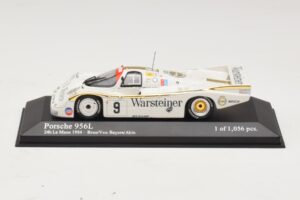
Used
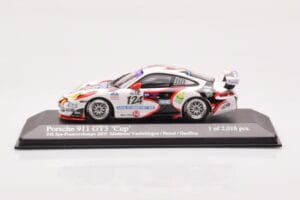
Porsche 911 997 GT3 Cup #124 Mattheus / Geoffroy / Vanbellingen / Fumal 24 Hours of Spa 2005 Minichamps 1:43
Only 3 left
Price:
33.00 €
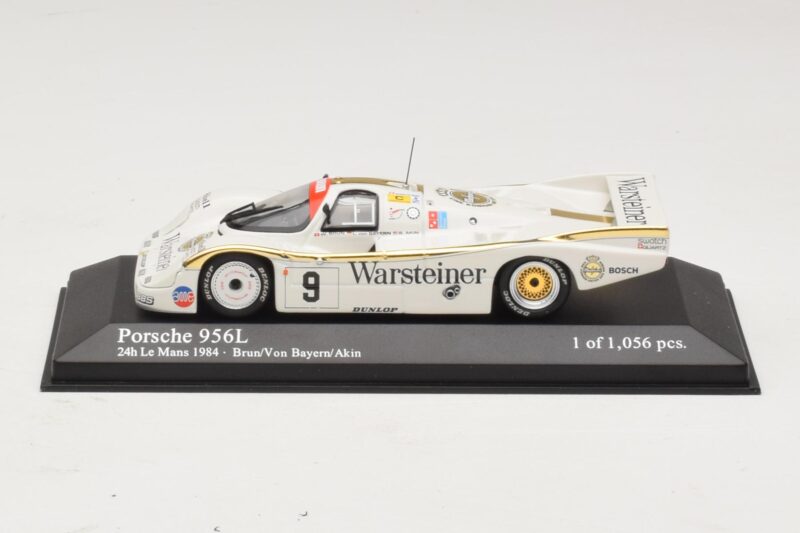
TL;DR: Minichamps' 1:43 diecast reproduces the Warsteiner-liveried Porsche 956 Langheck that ran as car #9 for Brun Motorsport at the 1984 24 Hours of Le Mans. Sealed one-piece body, tampo-printed sponsor graphics, a Group C prototype built for Le Mans' long straight.
Group C prototypes weren't built for beauty; they were built to survive 24 hours at speeds few road cars could touch. The 956 Langheck, its tail stretched for lower drag, was Porsche's answer to the long Mulsanne straight. Minichamps captures the Brun Motorsport entry in Warsteiner colors at 1:43.
Minichamps casts this 956 as a sealed one-piece diecast body, the standard construction at 1:43 for a prototype whose shape depends entirely on smooth, unbroken surfacing. Group C cars ran with long, low doors and no separate opening panels worth modeling at this size, so a fixed shell is not a compromise here, it is the correct way to represent this bodywork. What matters at this scale is livery integrity: the Warsteiner branding, the car number nine, and the Brun Motorsport sponsor graphics all need to sit flat and register cleanly across the car's compound curves. Tampo printing handles that, laying the graphics directly onto the painted shell rather than relying on decals that can silver or lift at the edges over time. The Langheck's stretched tail, the long-tail bodywork Porsche fitted specifically for Le Mans to cut drag on the Mulsanne straight, comes through in the casting's extended rear deck, a shape distinct enough from the short-tail 956 that a collector who knows the difference will spot it immediately. Wheel detail, the low nose splitter, and the rear wing profile round out a casting built around aerodynamic function rather than road-car styling, which is exactly what a Group C prototype should look like on a shelf.
Porsche's 956 arrived in 1982 and quickly became the car to beat in Group C, the World Endurance Championship's premier prototype class through the 1980s. The factory Rothmans team ran the headline effort, but Porsche also sold 956 chassis to customer teams, and those privateer entries filled out the Le Mans grid year after year, often outnumbering the works cars. Brun Motorsport, one of the established customer squads of the period, ran this Warsteiner-sponsored 956L as car number nine at the 1984 running of the 24 Hours of Le Mans. The Langheck bodywork these long-tail cars wore was purpose-built for that one circuit's demands: the Mulsanne straight rewarded a slipperier shape over outright cornering grip, and Porsche's engineers stretched the tail specifically to chase top speed there. That single-purpose engineering is part of what makes the 956 such a rewarding subject for a scale model, a car whose bodywork tells you exactly which track it was built to conquer. For a collector, that distinction between factory and customer liveries is part of the appeal, each one a different chapter of the same platform's story.
At 1:43, a 956 Langheck sits comfortably alongside other Group C prototypes from the same era, a scale that lets a collector assemble an entire Le Mans grid without needing a room to display it. This Warsteiner-liveried entry pairs naturally with other 1984-era Porsche customer cars, or stands as a single representative of the privateer side of Group C racing. The sealed body and tampo-printed livery are exactly what this subject calls for, prioritizing graphic accuracy over any opening feature a prototype racer never needed in period. For anyone building a Group C shelf, a privateer Le Mans entry like this one fills a real gap between the famous factory liveries.