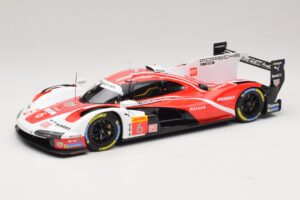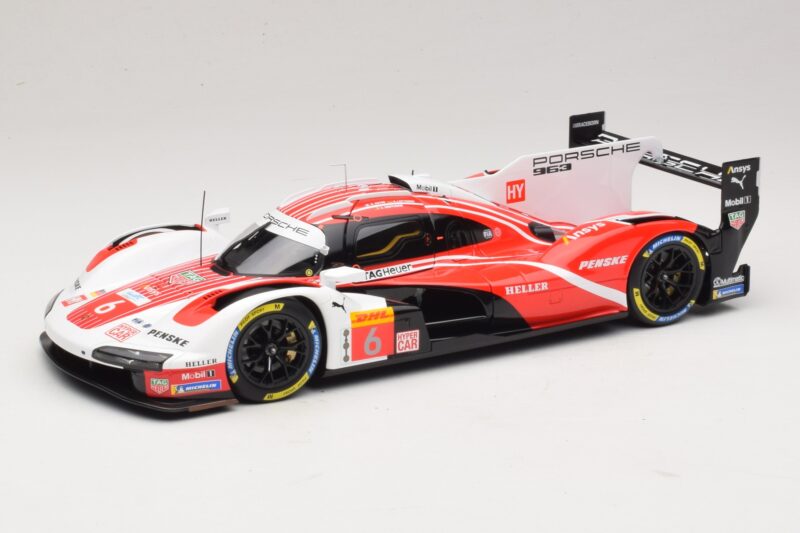
Porsche 963 LMDh #6 Team Penske K. Estre / A. Lotterer / L. Vanthoor WEC Champions 2024 Norev 1:18

Porsche 963 LMDh #6 Team Penske K. Estre / A. Lotterer / L. Vanthoor WEC Champions 2024 Norev 1:18
Current price: 100.00 €

VAT included

In stock
Ships by Nov 27, 2026
Shipping rates by country
Pay securely with
Shipping to 79 countries Worldwide delivery
Prices incl. 23% VAT No hidden costs
Shipping rates by country Tracked & insured
Pay in EUR € Local currency
Specifications
Brand
Porsche
Manufacturer
Norev
Scale
1:18
Material
Diecast
Model Condition
New Model
SKU
187162
100% authentic Direct from manufacturers
5-layer carton Foam-filled interior
Easy returns 14 days from delivery
Secure payment 256-bit SSL encryption

About the Porsche 963 LMDh #6 Team Penske K. Estre / A. Lotterer / L. Vanthoor WEC Champions 2024 Norev 1:18

TL;DR: The Norev Porsche 963 LMDh #6 1:18 is a diecast model of the Team Penske car driven by Kévin Estre, André Lotterer and Laurens Vanthoor to the 2024 WEC championship. Built with moving panels and a metal body, it suits collectors of modern Le Mans prototypes and Porsche endurance racing.

Prototype models live or die on the aero. The Norev Porsche 963 LMDh #6 1:18 carries the Team Penske entry that Estre, Lotterer and Vanthoor took to the 2024 WEC title, and it gives you a car whose whole shape was drawn by airflow: a broad rear wing, tight bodywork and sculpted fenders. A modern endurance racer, in metal.

Porsche 963 LMDh and the 2024 WEC Season

What LMDh Means for the Car

LMDh stands for Le Mans Daytona hybrid, a rules formula that lets a manufacturer build a hybrid prototype around an approved chassis and a shared hybrid system, then race it in both the World Endurance Championship and the IMSA series in North America. For Porsche that produced the 963, a twin-turbocharged V8 prototype that debuted in 2023. For US collectors the dual-series approach is the draw: the same car has a home in Le Mans-style endurance racing and on the American sports-car calendar.

The #6 Car and Its Three Drivers

Team Penske entered the 963 as Porsche Penske Motorsport, and the #6 car carried Kévin Estre, André Lotterer and Laurens Vanthoor. The trio finished 2024 as WEC champions, which is why this livery is the one collectors single out among 963 variants. Endurance racing is a team sport, and the model honors that: three names, one car number, one season. Its appeal is the cumulative result of a long championship, not a single dramatic finish.

Norev Porsche 963 in 1:18 Diecast

Sponsor Graphics, Aero and Metal Mass

A prototype livery is mostly printed detail, so the first test is registration: sponsor logos, number panels and stripe edges should sit square against the body surfaces and stay crisp where the paint curves into a fender. Metal mass gives the model the dense, cool feel of diecast and a stable, planted look on a shelf, while the aero parts, such as the splitter, the rear wing and the fender edges, are the thinnest sections of the casting and the ones to protect during handling. Production-run tooling simplifies the finest aero details compared with a hand-built resin prototype, which is the honest trade at this level.

Moving Panels on a Prototype Casting

This model is built with moving panels. On a car dominated by bodywork, that lets you see how the large panels sit against one another, and it makes the piece better to handle and photograph. Diecast hinge clearances widen the shut lines slightly compared with a sealed casting, and large, thin panels deserve slow, gentle movement. Support the body near the hinge, never the wing or splitter, and the model should keep its alignment through years of careful use.

Judging a Modern Prototype Replica

A prototype replica is judged from three angles. From the side, check the profile: the cabin should sit low and forward with a long rear deck, and the body should look wide in proportion to its height. From the front, look at the width of the splitter and how tightly the fenders wrap the wheels, since a modern prototype's stance is wide and low. From behind, study the rear wing and its supports, which dominate the silhouette and are easy to get subtly wrong. Then look at livery edges, tire lettering and any fine mesh or intake detail, which show how deep the tooling goes. Compare against official race photographs from the 2024 season instead of memory, because endurance cars run different aero configurations across a season, and wing shape changes between circuits. Be willing to accept small simplifications; at 1:18 some fine parts must be thickened to survive handling. Finally, set the model under the lamp you plan to use, with light from above and to one side, and watch how reflections travel across the large surfaces. Smooth, continuous reflections mean clean casting and paint, while wobbly ones point to surface waves.

Placing the #6 Beside Other Le Mans Prototypes

At 1:18 a modern prototype takes more shelf depth than a road car, so measure the cabinet before you order. The #6 works well beside other Le Mans and IMSA-era racers: a line from classic sports prototypes to hybrid Hypercar and GTP machines tells the story of endurance racing across decades. Porsche-focused collectors can place it with earlier Porsche competition cars to show the brand's long run of prototype work. Be honest about the tier: this is production-run diecast, so expect solid finish and good weight rather than the micro-detail of an ultra-premium prototype model. The advantages are a championship-winning subject, a livery of real historical weight and a model that can be handled without anxiety. For collectors who want a recent title-winning prototype in metal, it is a straightforward choice.

100.00 €
100.00 €
0