Last one
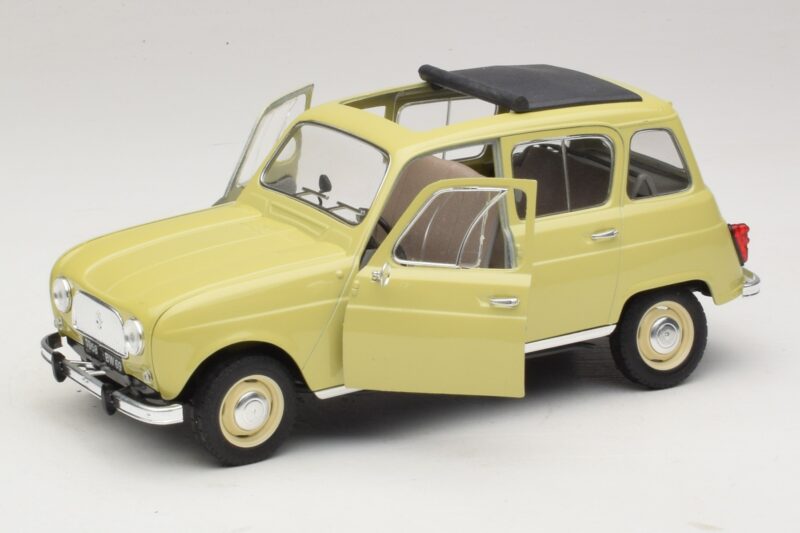
TL;DR: The Solido Renault 4L 1:18 is a Yellow diecast replica of the 1961 French hatchback, with opening parts and a body about 20 cm long. Its upright, boxy shape and bright finish make it an approachable retro city car piece with real metal weight.
Few cars looked as unfussy as the Renault 4, and the Solido Renault 4L 1:18 reproduces that plain, upright shape in Yellow. The design started from usefulness and ignored fashion, and the result is a car that has aged remarkably well. On a shelf, it offers a very different kind of appeal from sports cars: friendly, practical and quietly distinctive.
Renault launched the 4 in 1961 as a front-engined, front-wheel-drive small car with a rear hatch, a layout that made it flexible enough to carry people or cargo with equal ease. The L designation refers to the better-equipped version, and the model uses the 4L name in its title. Its upright cabin, flat panels and long-travel suspension made it comfortable on poor roads, and it stayed in production for roughly three decades. For a collector, that longevity means plenty of reference material, so comparing a model with photographs of the real car is easy and worthwhile.
The 4L's body is made of simple, flat surfaces, which means a replica has little to hide behind. Check the roofline first: it should be nearly level, with an almost vertical rear that gives the car its upright profile. Look next at the front grille and lamp area, where small details define the car's face. Wheels are small and sit close to the body corners, so any oversized wheel or incorrect stance is obvious. Because the body has so few curves, panel gaps and alignment matter more than on a complex sports car, and a good model shows even, consistent shut lines.
The zinc-alloy body gives this 1:18 4L a solid, dense feel, more substantial than its modest size suggests. The large flat panels act as a test of the paint: Yellow over metal should be even and glossy across the hood, roof and doors, with no blotchiness or visible texture. Under a directed lamp, the flat surfaces reflect cleanly when the finish is good. Diecast tolerances are broader than those of a resin casting, so gaps are a little wider, but on a workhorse design with visible panel lines that looks natural and does not detract from the car's honest character.
This model has opening parts, which fits a car designed around practicality. Test hinged sections gently and watch how they close: they should come back flush with an even gap, and nothing should rub against its neighbor. Hinges at this scale are small relative to the body weight, so lift the model from underneath instead of by a panel. A routine of mostly closed display with occasional opening for inspection protects edge paint and keeps hinges snug. Because the flat panels show every mark, handle the model with clean, dry hands to avoid smudges on the yellow.
At about 20 cm, the 4L is a compact 1:18 piece that suits almost any cabinet. Yellow is a strong, cheerful color that stands out against darker cars and neutral backing, and the boxy shape provides an interesting visual contrast to sleek coupes and sports cars placed beside it. It looks particularly good in a themed group of small European cars, where its proportions and color feel natural.
Soft, even lighting works well for flat-sided designs like this, avoiding harsh glare on the large panels. Keep the model away from direct sunlight to protect the paint over many years, and dust it with a soft brush rather than a cloth, which can catch on small trim and lamp details. A clear shelf with room on each side lets the upright silhouette read properly.
The 4L suits collectors who enjoy design that comes from purpose rather than prestige, and it pairs naturally with the Renault 4CV and Fiat 500 in a small-car story that spans the 1950s and 1960s. Solido's diecast sits at an accessible tier, with real metal weight and moving parts but without the finishing or part count of hand-assembled pieces. For the right buyer that is exactly the point, since an everyday car deserves an everyday-friendly model that can be handled and enjoyed. Anyone planning to order will find it a low-risk, characterful piece that adds personality to a retro city car display.