Used

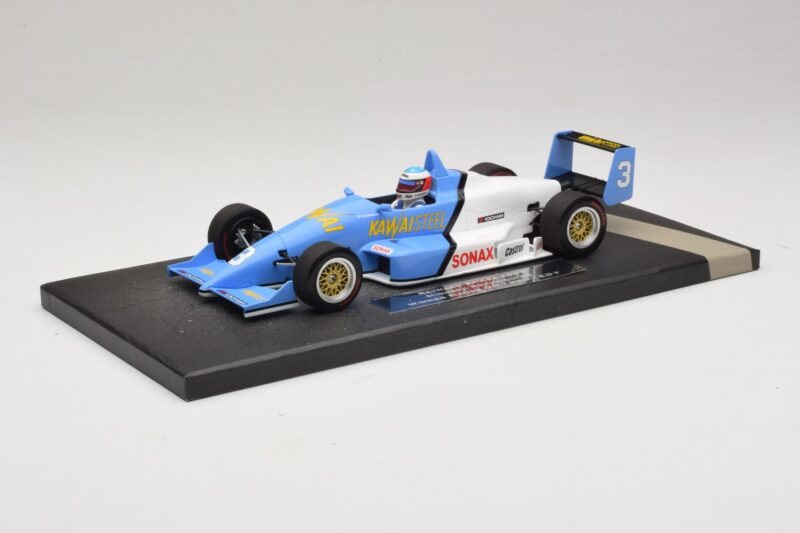
TL;DR: Minichamps' 1:18 resin Reynard F903 Spiess reproduces Michael Schumacher's winning car from the 1990 Macau Grand Prix, a Formula 3 event long treated as an unofficial world championship for the category. The sealed one-piece body preserves the open-wheel nose and wing detail of a car raced before Schumacher's F1 career began.
Before seven world titles and a legend of his own making, Michael Schumacher was a Formula 3 driver winning on a street circuit carved into the hills above Macau's harbor. Minichamps' resin casting freezes that specific, formative victory rather than any of his later, better-known machinery.
The Macau Grand Prix's Formula 3 race has long carried outsized prestige within the category, drawing the strongest national F3 champions to a demanding street circuit and functioning, in practice if not in official title, as the sport's world championship decider for junior single-seater talent. Schumacher's 1990 win there came the same year he claimed the German Formula 3 championship, and the Macau result is frequently cited as the moment his talent registered internationally before Mercedes and later Jordan gave him his route into Formula 1. The Reynard F903 chassis, powered by a Volkswagen-derived Spiess engine, was among the era's competitive F3 packages, and this specific livery documents that exact winning combination.
This model has no opening cockpit surround or engine cover; the body is a single sealed resin shell. Formula 3 chassis of this period carried simpler aerodynamics than a contemporary Formula 1 car, a single-element front wing and a modest rear wing rather than the multi-element packages that came later, and resin's tight casting tolerances hold those cleaner, less complex surfaces with sharp, undistorted edges. The narrow, high-sided cockpit and the period-correct rollover hoop are cast as fixed exterior detail, and livery registration along the narrow sidepods needs to be precise given how little surface area a period F3 car offers for graphics.
Pre-F1 career pieces occupy a genuinely different collecting niche than any of Schumacher's later Ferrari or Benetton liveries, appealing specifically to collectors tracing a driver's full trajectory rather than just the championship years. At 1:18 scale a period F3 single-seater typically measures around 25 to 26 centimeters given the era's longer wheelbase proportions relative to modern junior formula cars, and its narrower body sits distinctly among wider GT or touring subjects on a mixed motorsport shelf. This is a harder subject to source than a mainstream F1 livery, which adds to its appeal for a dedicated Schumacher or junior formula collection.
Open-wheel single-seaters expose their suspension and wing mounting detail more than a bodied car does, so check those areas closely for crisp resolution when evaluating a resin casting like this one. The narrow body benefits from a raised display stand rather than sitting flat, since the driver's helmet and cockpit surround are among the most detailed elements and deserve to be seen at eye level. Early-career motorsport liveries generally sit at a moderate price point relative to flagship F1 pieces, reflecting the smaller production runs these specialist subjects receive.
No. The body is a sealed one-piece resin casting, with all cockpit and engine detail cast into the fixed exterior shell.
It has long functioned as an unofficial Formula 3 world championship decider, drawing top national champions to a demanding street circuit, and Schumacher's 1990 win there raised his international profile before Formula 1.
A period Formula 3 chassis like the F903 is narrower than an F1 car but similar in length at 1:18 scale, roughly 25 to 26 centimeters, due to its era-typical wheelbase proportions.
Yes, it documents his pre-Formula 1 career specifically, a distinct and harder-to-source chapter compared to his widely available Ferrari and Benetton liveries.