Last one

This model is currently sold out. Enter your email and we'll let you know when it's back in stock.
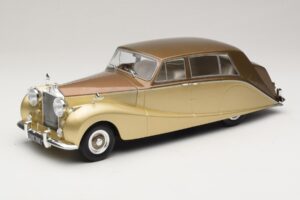
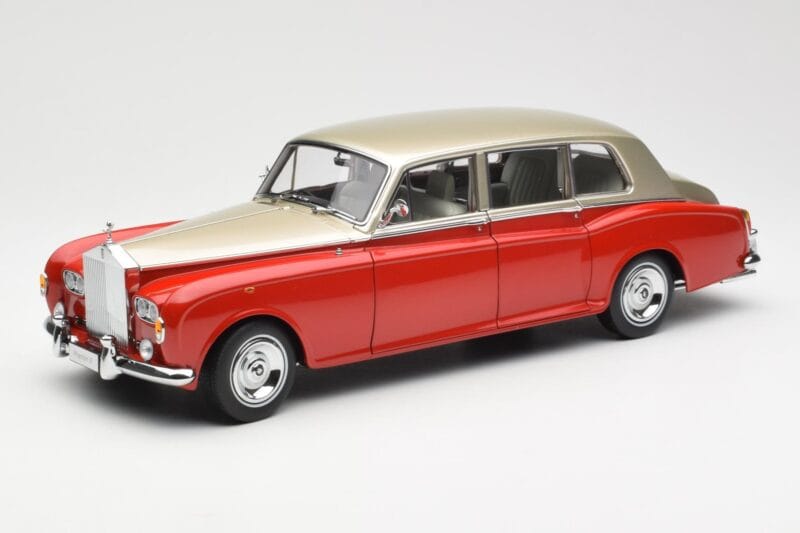
TL;DR: Kyosho's 1:18 diecast Rolls-Royce Phantom VI reproduces the coachbuilt state limousine in red over light beige, with formal upright proportions and a rear division glass typical of ceremonial coachwork. Produced from 1968 on Mulliner Park Ward bodies, it anchors an ultra-luxury sedan display at collector-grade diecast quality.
Few cars were built to be looked at from the curb rather than driven for pleasure, and the Phantom VI is one of them. Kyosho's diecast keeps that formal, upright presence intact, right down to the two-tone paint split that ceremonial coachbuilders favored.
Rolls-Royce introduced the Phantom VI in 1968 as a direct successor to the Phantom V, retaining much of that car's separate chassis and formal proportions while updating mechanicals over its long production run into the 1990s. Rather than selling through the ordinary showroom channel, most Phantom VIs went to heads of state, corporations, and specialist hire fleets who needed a car built for ceremony rather than commuting. Coachwork came from Mulliner Park Ward, which built each body to order rather than off a fixed production line, and that bespoke approach is why surviving examples show such variation in trim and paint even within one model line.
The division glass behind the front seats is the detail that defines this car's purpose: a chauffeur occupied the front, separated from the principal passengers by a partition that could be raised for privacy or lowered on request. Rear seat space was generous by design, with occasional jump seats folding away when not needed, and the greenhouse sat tall enough that a passenger could exit without ducking. Kyosho's model reproduces that upright glass area and the long rear doors that gave passengers unhurried entry and exit, the visual signature separating a state limousine from an ordinary luxury sedan even at a glance across a room.
Two-tone paint was common on coachbuilt Rolls-Royces of this era, and the red over light beige split on this piece follows that convention rather than inventing a fashion the original coachbuilders never used. Kyosho keeps the color break running along the correct waistline, with a clean, straight demarcation rather than a soft-edged transition that would look like a printing error. The chrome grille, headlamp surrounds, and bumper work are picked out separately from the body paint, holding the crisp detail a formal limousine's fittings demand.
Doors, hood, and trunk open on metal hinges, and the body's zinc alloy construction gives the model real weight in the hand, a useful cue for a car whose full-size original was famously substantial. The long doors swing through a wide arc to clear the sill properly, echoing the unhurried entry the real car offered. It is a heavier, more deliberate object than a resin casting of the same scale, which suits a subject that was never about lightness.
At full 1:18 scale, a car this long occupies more shelf depth than a sports coupe of the same scale, so it rewards a dedicated spot rather than a crowded row. It reads best beside other formal or ceremonial subjects, where its restrained two-tone paint and tall glasshouse make the case for a distinct chapter in a luxury sedan collection separate from performance cars entirely. Judge the fidelity by the straightness of that waistline paint split and the squareness of the division glass, the two details a Mulliner Park Ward body was actually built around.