Last one
Used
Back in stock
This model is currently sold out. Enter your email and we'll let you know when it's back in stock.
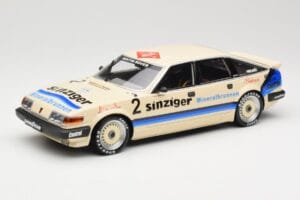
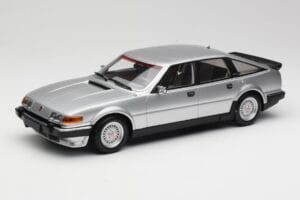
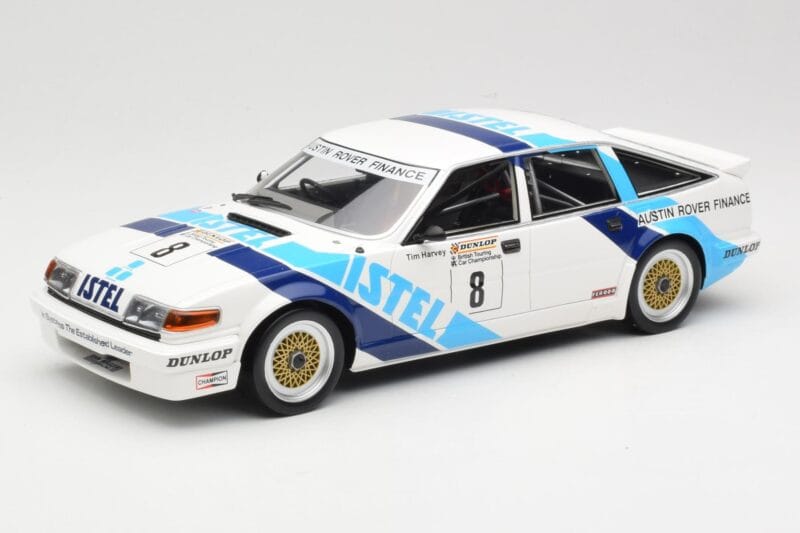
TL;DR: Minichamps' 1:18 diecast Rover SD1 Vitesse reproduces Tim Harvey's Istel-liveried entry that won Class A in the 1987 Dunlop RAC British Touring Car Championship. Sharp sponsor graphics and race numbering over the SD1's fastback body mark a genuine class-winning livery, a solid addition to a 1980s BTCC touring car display.
By 1987, the British Touring Car Championship ran under a multi-class structure that let smaller and larger-engined saloons compete for their own honors within the same events, and Tim Harvey's Istel-backed SD1 Vitesse claimed Class A honors against that format's specific demands.
Tim Harvey built his reputation across the late 1980s BTCC grids before going on to claim the outright championship in the early 1990s, and the Istel-sponsored SD1 Vitesse was part of that developing career, a car campaigned within Rover's continuing presence in British touring car racing after the SD1's TWR-backed European efforts had wound down. Rover's continued presence in British domestic racing through the mid-to-late 1980s, even as the manufacturer's factory-backed European program faded, kept the SD1 Vitesse relevant on home soil longer than its production run alone might suggest. Winning Class A in 1987 meant beating the specific field of similarly-classed cars entered that season, a genuine measure of competitiveness within the rules the BTCC applied at the time.
The BTCC's multi-class structure through the 1980s split the grid by engine displacement, letting smaller-engined saloons fight for their own class honors even when they couldn't match the outright pace of larger-engined rivals on the same track. Class A generally covered the larger-displacement end of that spectrum, the bracket where a V8-powered SD1 Vitesse could compete on genuinely level terms rather than being outgunned by cars several classes removed. That structure meant a Class A win carried real weight rather than being a footnote behind an outright victory, since it reflected performance against the most direct rivals a Vitesse actually faced.
Minichamps applies the Istel livery's sponsor lettering and accent colors with clean, consistent registration across the SD1's curved fastback panels, keeping text legible at this scale rather than blurring into an indistinct block of color. The race number and class designation are positioned accurately relative to period photographs of BTCC entries, small details that matter to collectors who know the specific livery well enough to spot a misplaced number or an off-shade accent color. As a diecast, the doors open to reveal a race-trimmed cabin distinct from the road-going Vitesse's interior, with simplified upholstery and visible roll-cage structure consistent with a genuine competition car.
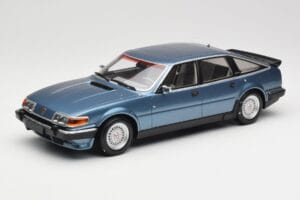
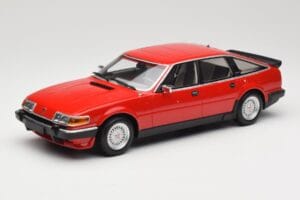
This Istel-liveried Class A winner slots naturally alongside a European touring car entry and a standard road-going Vitesse, giving a collector distinct chapters of the same platform's story: the road flagship, the European campaign, and the British domestic series that followed it. At around 22 centimeters in 1:18 scale, the fastback body's proportions stay consistent across variants, so they sit level and evenly spaced without one design looking out of place beside the others. Rotating which car sits at eye level within that grouping every so often helps distribute dust exposure evenly across the display and keeps any single livery from fading under repeated direct light.