Used
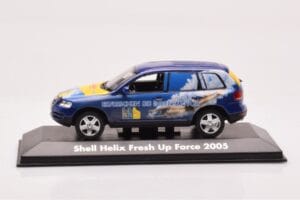
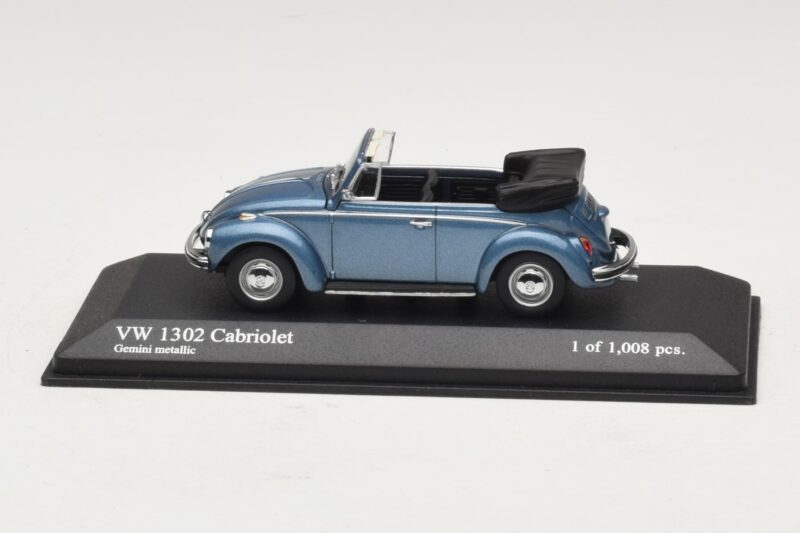
TL;DR: Minichamps' 1:43 diecast Volkswagen 1302 Cabriolet reproduces the 1970 Super Beetle convertible in blue metallic paint, the Karmann-built open-top version of VW's best-selling small car. The sealed one-piece body holds accurate folding-top proportions and tidy shut lines at a compact, affordable scale.
The Beetle convertible was never a sports car, it was a slow, cheerful reminder that open-top motoring didn't need to cost a fortune, and the 1302 Cabriolet carried that idea into the 1970s. Minichamps' 1:43 rendition keeps that unpretentious character intact rather than dressing it up.
Minichamps casts this 1302 as a sealed, one-piece diecast shell, the folded soft-top molded into the body rather than a separate piece that raises or lowers. At 1:43 that is standard practice, and it lets the tooling hold the Beetle's distinctive rounded proportions, the bulging fenders and short overhangs, without hinge tolerances interrupting the shape. Zinc alloy gives the small casting genuine weight for its size, a reassuring density in the hand that a resin equivalent at this scale would not deliver. The folded-top silhouette behind the windshield is shaped correctly rather than left as a flat, simplified hump, a small detail that separates a considered cabriolet casting from a lazy one.
Blue metallic paint at 1:43 has to do a lot with very little surface area, and this casting holds an even flake distribution across the fenders and hood without the color pooling darker in the recesses. Chrome bumpers, trim, and the VW badge are picked out distinctly against the blue body, and the wheels carry the correct hubcap style for the period rather than a generic disc. Window surrounds and the folded-top edge are defined cleanly enough to read under a display lamp, even though the whole exterior story has to be told without a single moving part.
The Type 1302 arrived for the 1971 model year, introduced in 1970, as Volkswagen's update to the Beetle, adding a MacPherson strut front suspension in place of the original torsion-bar setup, which gave it a bigger front trunk and noticeably improved handling over earlier Beetles. Enthusiasts nicknamed the updated cars Super Beetles, and the 1302 sits at the start of that lineage, still recognizably a Beetle but mechanically modernized underneath. The cabriolet body added open-top motoring to a car that had, by 1970, already become one of the best-selling vehicles in automotive history.
Volkswagen never built the Beetle convertible in-house; Karmann, the German coachbuilder, handled the conversion, reinforcing the body and engineering the folding top to compensate for the rigidity a sedan's roof normally provides. That outside coachbuilding role is part of why Beetle cabriolets carry a slightly different collecting status than the standard sedan: they were a specialist, lower-volume product even when the Beetle itself was ubiquitous. Karmann's involvement also explains the cabriolet's noticeably reinforced sill and door structure, a detail visible in real cars but abstracted here into the model's slightly heavier-looking beltline.
At 1:43, a Beetle cabriolet takes up almost no shelf space, which makes it an easy addition alongside larger 1:18 pieces without competing for room, and it works equally well as a standalone entry point into Volkswagen collecting or as one car in a themed run of 1970s convertibles across several marques. The sealed body keeps the price accessible relative to opening-feature models at the same scale, a fair trade for a car whose real appeal was always about cheerful simplicity rather than mechanical spectacle. Buyers new to Volkswagen collecting could do worse than starting here: an affordable, well-proportioned Beetle convertible that documents a genuine engineering update rather than just repainting an old sedan casting in a fun color.