Used

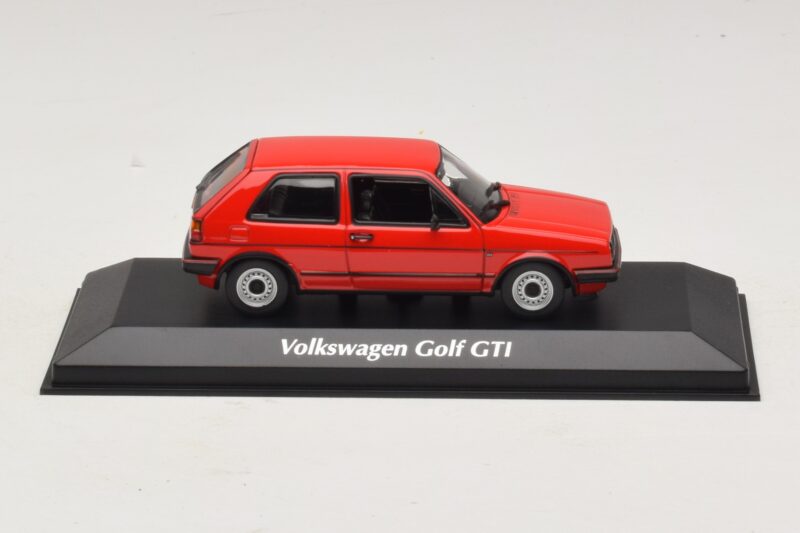
TL;DR: The Maxichamps Volkswagen Golf GTI Mk2 Red 1:43 is a diecast hot hatch from 1985 with a sealed one-piece body, about 9 cm long. Red paint and a squared-off Mk2 profile define the exterior, which is where all the detail sits. It anchors a 1980s performance shelf at an accessible price point.
Few cars shaped the idea of a fast everyday car like the Golf GTI, and the Mk2 is the one many drivers remember from their own driveway or an older cousin's. This Maxichamps Volkswagen Golf GTI Mk2 shrinks that memory to 1:43 diecast in red, a colour long tied to the GTI badge.
The Mk2 is larger and more upright than the Mk1, with a flatter roof, a straighter shoulder and a rear window that drops almost vertically. Those straight lines reward a diecast casting, because crisp edges read well and cannot be faked with curvature. Nothing opens on this model, so the shut lines run as continuous fine grooves around the doors and tailgate. Check the profile from the side: the roof should sit level, the C-pillar should carry its thickness, and the ride height should look purposeful rather than lifted. Metal mass lends the little hatchback an unexpected heft.
Red is unforgiving on a model. Orange-biased reds look cheap, cool cherry reds look wrong, and uneven coverage on a flat bonnet shows instantly, so study the paint under a lamp. Then look for the cues that separate a GTI from an ordinary Golf: the red-trimmed grille, the badges, the wheel design and the stance. At 1:43 these are tiny, and the test is crispness of edge rather than quantity of parts. A model that gets the red and the stance right will read as a GTI from across the room.
Volkswagen launched the second-generation Golf in 1983, and the GTI followed in 1984 with a fuel-injected 1.8-litre four-cylinder engine. A 16-valve version arrived in 1986, and the Mk2 stayed in production until 1992, a long run that made it a fixture on European roads. It was bigger, quieter and more refined than the Mk1, and that maturity is the reason it still looks like a modern car in a lineup of 1980s hatchbacks. The product data dates this model to 1985, squarely inside the early Mk2 GTI period.
In North America the Mk1 was badged Rabbit, and the GTI reached American buyers under that name, which gives the Golf story an unusual double identity on this side of the Atlantic. American collectors who specialize by marque often pair the two generations to show how the formula grew. The honest context: this is mass-market diecast for a mass-market car, and that fits. A car that made performance affordable does not need to be rendered in exclusive, expensive resin, and an accessible 1:43 diecast respects that philosophy.
At 1:43 the Golf sits comfortably among other compact performance cars, so a row of 1980s hatchbacks can stand on one shelf with matched heights and wheelbases. Red pairs well with white and silver neighbours and fades next to other reds, so vary the colours along the row. Keep it under a directed lamp to bring out the paint, and dust it with a soft brush rather than a cloth, which can drag grit across flat panels. Handle the model by the roof and sills. For buyers who want a Golf GTI Mk2 in 1:43 and are ready to buy, it is a practical entry piece for a larger hot hatch collection.