Used

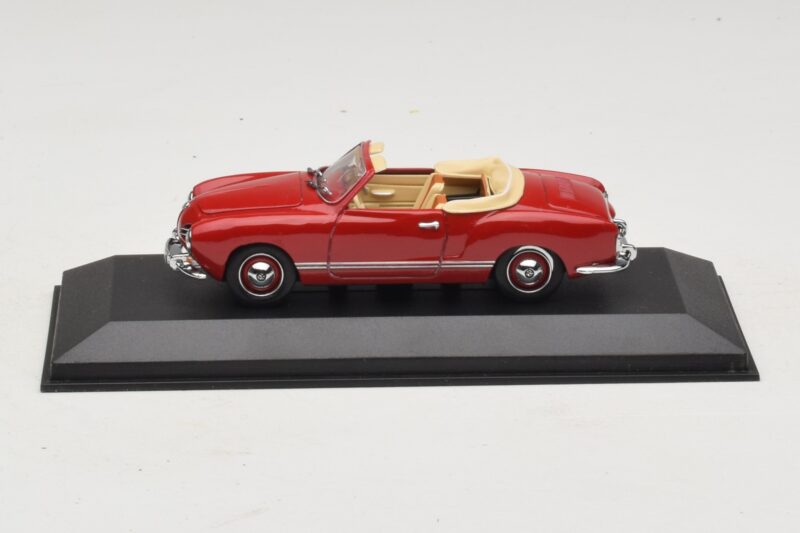
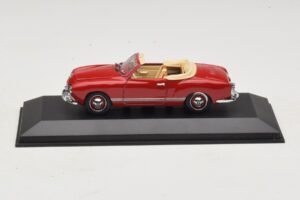
TL;DR: The Minichamps Volkswagen Karmann Ghia Cabriolet 1:43 is a diecast open-top classic from 1957, finished in dark red. It is a sealed one-piece casting, so the rounded fenders, beltline and paint carry the model, and the compact scale suits a shelf of air-cooled Volkswagen and 1950s European cars.
Few cars wear their borrowed styling as well as the Karmann Ghia. Beetle mechanics sit under a body that looks Italian and tailored, and Minichamps reproduces that contrast at 1:43 in the Cabriolet form. For a collector who likes soft curves over aggression, this is a quiet, rounded piece with plenty to study.
Volkswagen's Karmann Ghia paired the Beetle's platform and rear-mounted air-cooled engine with a body styled by Ghia and built by Karmann in Osnabrück. The coupe arrived in 1955 and the Cabriolet followed in 1957, the year this model represents. That heritage explains the proportions to check on the casting: a low, wide stance, long smooth fenders, and a modest, rounded nose with no hint of the bluff Beetle front. Volkswagen sold plenty of them in the US, so the shape is familiar to American eyes from period photographs.
A cabriolet body shows more of its structure than a coupe, and a diecast casting handles that well. Zinc alloy keeps the thin beltline and the door tops straight over years of shelf life, and the metal gives the model a satisfying heft for its size. Because the body style is open-top, check the product photos for how the roof is presented, since that decides how much of the cabin you can read from above. The trade-off with metal is softer edges than cast resin at the smallest details, such as hubcap rims and bumper edges, which is normal at 1:43.
Dark red is an unforgiving color on a model because it shows every flaw in surface preparation. Under a shelf lamp, look for depth rather than flatness, an even tone across the long fender curves, and no pooling in the panel lines. A deep shade also shows dust quickly, so a pass with a soft brush keeps the gloss honest. The listing calls the shade Dark Red, and the practical check is how it sits beside other 1950s paint colors on the same shelf: it should read warm and slightly muted rather than toy-bright.
This model has no opening parts, and for a car defined by smooth transitions that suits the subject. A one-piece body keeps the shut lines as single, consistent grooves with no hinge clearance to widen them, so the door and hood cuts follow the body curve cleanly. Judge the bright trim next: bumpers, hubcaps and window frames should be thin and clean without blobbing into the paint. Wheels should sit squarely in the arches with believable tire sidewall height. A car this low and rounded looks wrong fast if the stance is off.
At 1:43 the Karmann Ghia Cabriolet slots beside Beetles, vans and other 1950s European two-seaters, a coherent shelf for anyone following air-cooled Volkswagen history. Its soft curves also contrast nicely with angular 1970s sedans, which makes it a useful shelf breaker. American enthusiasts often specialize by marque, and for a Volkswagen row this is a natural step up from the Beetle. Handle it by the body and not by the wheels, keep it out of strong sunlight that can fade red pigment over the years, and store the box if you ever rearrange the cabinet. As an accessible small-scale classic, it is a sound way to buy into 1950s open-top collecting without committing to a large footprint.