Used

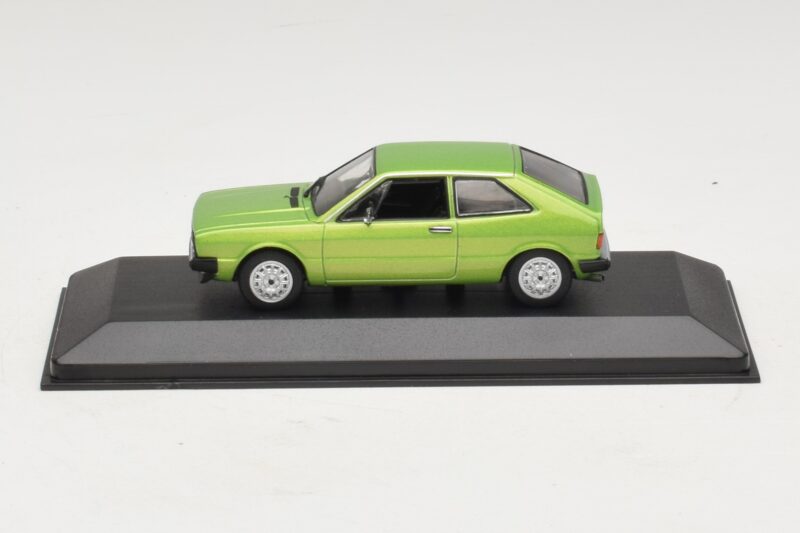
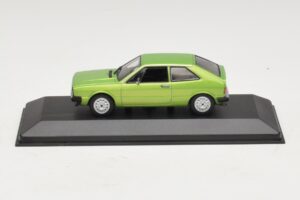
TL;DR: Maxichamps' 1:43 diecast VW Scirocco Mk1 reproduces Giorgetto Giugiaro's 1974 coupe in green metallic. The one-piece sealed body holds consistent shut lines along the hatch and doors, and this particular listing ships in a replacement presentation box rather than its original Maxichamps packaging.
Volkswagen launched the Scirocco months ahead of the Golf it would come to share a platform with, giving the brand its first front-wheel-drive sporty coupe before the hatchback that defined the next decade even arrived. This green metallic example captures the wedge-shaped Giugiaro profile that made the Scirocco look distinctly different from anything VW had built before.
Maxichamps builds this Scirocco as a sealed, one-piece diecast body with no opening doors, hood or hatch, the standard construction at this scale and price tier. That fixed shell is what lets the model hold a tight, consistent shut line along the hatchback's rear glass and the door cuts, lines that run evenly from top to bottom rather than widening the way a hinged panel sometimes does. The wedge profile Giugiaro drew keeps its crisp character in miniature, with the sharply raked rear hatch and the Scirocco's distinctive trim surround reproduced as molded detail rather than left as a flat color break.
Green metallic paint sits over the diecast shell with enough depth to show flake under direct light, a finish quality that separates a well-executed 1:43 from a flat, toy-like one. Maxichamps picks out the black window surrounds, bumper trim and lower rocker cladding separately from the body color, and the Scirocco's signature C-pillar louvers, where fitted, are molded in rather than printed flat. The wheels carry period-correct styling in miniature, small enough at this scale that clean, consistent casting around the rim edge matters more than it would on a larger model.
Giorgetto Giugiaro's Italdesign studio penned the Scirocco's body, and the result was sharper and more angular than anything Volkswagen had sold before, a clean break from the rounded shapes still common in the lineup. Mechanically, the Scirocco shared its platform, engines and front-wheel-drive layout with the Golf that followed it to market only months later, making the coupe something of a styling preview for the hatchback that would go on to define Volkswagen's next several decades.
Volkswagen built this first-generation Scirocco, internally the Typ 53, from 1974 through 1981, before a more rounded second generation took over for the 1980s. Despite the relatively short run, the Mk1 established the Scirocco as a credible sporting alternative to contemporaries from Ford and Opel, helped by the lightweight, front-wheel-drive layout borrowed from the Golf. Production numbers were modest compared to the Golf itself, which keeps a well-detailed Mk1 Scirocco a comparatively specialized pick.
At 1:43, the Scirocco's compact coupe proportions take up only a few inches of shelf depth, making it easy to build a dense run of 1970s European coupes in a single cabinet. Maxichamps sits in the accessible end of the diecast market, where sealed-body construction and tight casting tolerances deliver real accuracy without the part count of a premium release. Worth noting plainly: this particular listing comes in a replacement presentation box rather than its original Maxichamps packaging, a straightforward trade-off for buyers who want the model itself at a fair price. For display purposes the model performs identically, and it slots naturally alongside an early Golf or a period Ford Capri.