Back in stock

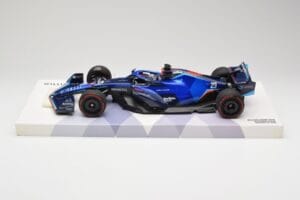
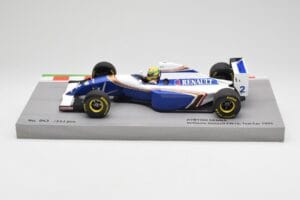
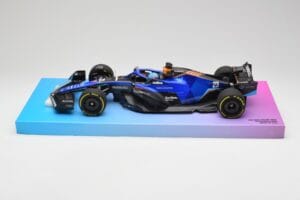
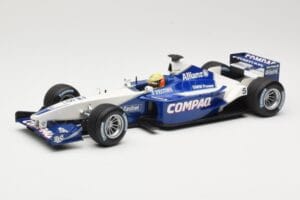
Williams FW11 Honda #5 N. Mansell F1 1986 MCG 1:18
Price:
55.00 €

This model is currently sold out. Enter your email and we'll let you know when it's back in stock.
TL;DR: Minichamps' 1:18 diecast reproduces Riccardo Patrese's number 6 Williams Renault FW14B from the 1992 season, the active-suspension car that dominated that year's championship. Diecast construction with opening cockpit detail and correct Camel livery registration suit an early-1990s Williams display at standard tier pricing.
The FW14B remains one of the most technically advanced cars to ever win a championship, its active suspension and semi-automatic gearbox years ahead of rules that would soon outlaw them. Patrese ran it as Mansell's teammate that year, and finished the season strongly.
The Camel-era Williams livery is a demanding subject for any diecast manufacturer: yellow and blue fields wrap around a narrow, curved nose and sidepods where a single misaligned decal ruins the effect. Minichamps keeps the sponsor graphics crisp and evenly registered across those curves, with the number 6 placed correctly ahead of the cockpit. Tampo printing rather than decals keeps the surface flat, so the livery reads as painted rather than applied when viewed under direct light.
Lifted from its case, the model's weight signals the zinc alloy body underneath, denser in the hand than the composite F1 miniatures some rivals build. The engine cover lifts to expose a simplified Renault V10 recreation, and the cockpit surround shows a molded tub with harness detail rather than a blank void. Panel fit around the opening sections stays tight for a mid-tier diecast, though the front wing and diffuser carry the simplification that keeps a piece like this affordable.
The FW14B's active suspension constantly adjusted ride height and damping through onboard computers, while its semi-automatic gearbox and early traction control removed much of the driver workload that rivals still carried by hand. The combination made the car close to unbeatable in 1992, taking the bulk of that season's races and settling both championships before the year was out. It stands as one of the clearest cases of a rulebook loophole producing outright dominance before regulators closed it.
Patrese, already a veteran by 1992, ran a supporting but genuinely competitive campaign alongside Mansell, banking enough points to finish runner-up in the drivers' standings. It was his last season at Williams before a move to Benetton the following year. That context matters to a collector building a Patrese-specific shelf: this FW14B represents the high point of his Williams tenure, not a footnote season.
At 1:18, an open-wheel car like the FW14B runs close to 25 centimeters nose to tail but sits low, so it needs shelf depth more than height, and pairs naturally beside other narrow-track early-1990s cars without crowding a cabinet row. Minichamps has built a long track record specifically in motorsport diecast, and this piece sits at the accessible end of that range rather than the limited-run tier some of its historic liveries reach. Judged against that segment, the value here is straightforward: a genuinely dominant car, a well-known driver, and a livery that still reads clearly across a room three decades on.