Back in stock

Williams FW11 Honda #5 N. Mansell F1 1986 MCG 1:18
Price:
55.00 €
This model is currently sold out. Enter your email and we'll let you know when it's back in stock.
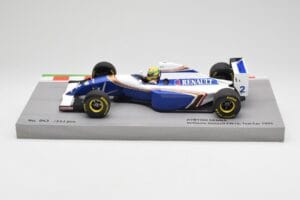
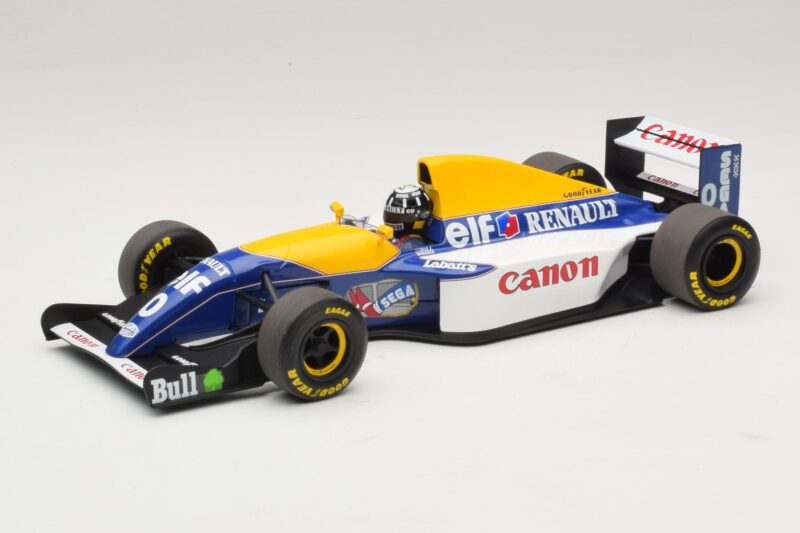
TL;DR: Minichamps' 1:18 diecast reproduces Damon Hill's #0 Williams Renault FW15C from the 1993 Formula 1 season, one of the most technologically advanced cars ever raced before active suspension and traction control were banned. The sealed body captures the FW15C's distinctive livery in printed detail, honest to a car built almost entirely around aerodynamic and electronic sophistication.
Few Formula 1 cars carry the technical mystique of the FW15C, a machine so advanced that its own governing body moved to ban most of its defining systems the following season. Damon Hill's rookie year at Williams put him behind the wheel of that exact car, and Minichamps' 1:18 casting gives the FW15C's clean, electronics-laden bodywork the careful surface treatment it demands.
The FW15C hid nearly all of its technical sophistication beneath a smooth, uninterrupted bodywork surface, which makes a sealed diecast shell an especially appropriate construction choice for this subject. Active suspension, semi-automatic transmission, traction control, and anti-lock brakes all operated invisibly from the outside, so the car's real drama lived in its electronics rather than in any visible mechanical flourish a model could showcase through an opening panel. Minichamps casts the body as one continuous piece, letting the FW15C's low, tightly wrapped bodywork read as a single clean form, exactly how the car appeared on a starting grid. The livery, Williams' period sponsor scheme with Renault engine branding across the sidepods, is applied in printed rather than decal form, holding sharp registration around the car's narrow, aerodynamically optimized surfaces. The number 0 on the nose and sidepod, a genuine period quirk explained by the reigning champion's absence from the grid that season, is rendered in clean, legible lettering rather than a smudged approximation. Wheel rims carry the correct period pattern, and tire sidewalls hold molded lettering true to the era's tire suppliers. Weight in the hand is appropriate for a diecast open-wheel casting at this scale, dense enough to feel substantial without exaggerating the real car's actual mass. For a chassis whose legend rests on invisible engineering rather than visible mechanical drama, a sealed body is not a limitation. It is the only honest way to build this particular subject.
Williams entered 1993 with Alain Prost as its lead signing and Damon Hill, promoted from test driver duties, as his rookie teammate, and the team ran car number 0 that season because reigning champion Nigel Mansell had departed for American open-wheel racing rather than defending his 1992 title with Williams. Under period numbering conventions, the reigning champion's number normally passed to zero when its holder left the sport rather than being reassigned outright, a quirk that gives this specific livery genuine historical texture beyond the car's raw performance. The FW15C itself represented the technical peak of Formula 1's active-suspension era, combining computer-controlled ride height, traction control, and anti-lock brakes into a package that dominated the 1993 season and helped Prost secure his fourth world championship. Hill, in his first full season, scored multiple race wins that year, an unusually strong rookie campaign that set up his own eventual championship years later. The FIA moved to ban most of these driver-assistance technologies for 1994, citing cost and a desire to keep driver skill more central to competition, which makes the FW15C the definitive, final expression of a technological approach Formula 1 would not revisit for decades. Few single-season F1 cars carry this combination of dominant results and genuine engineering significance, which is exactly what makes a well-detailed FW15C casting worth seeking regardless of which specific livery a collector chooses.
An FW15C anchors a 1990s Formula 1 collection more convincingly than almost any other single chassis from the decade, given its combination of dominant results and now-banned technology. At 1:18, its narrow, low-slung open-wheel footprint takes less shelf width than a modern F1 car's wider aero package, worth noting when planning a mixed-era display. Pairing this Hill-driven car with Prost's matching FW15C completes the full title-winning garage on one shelf, a natural next step for collectors who start with one and want the pair. Compared to boutique resin specialists covering historic F1 grids, Minichamps' diecast approach keeps this genuinely significant chassis at a more accessible tier without compromising on livery or bodywork accuracy.