Last one
New arrival
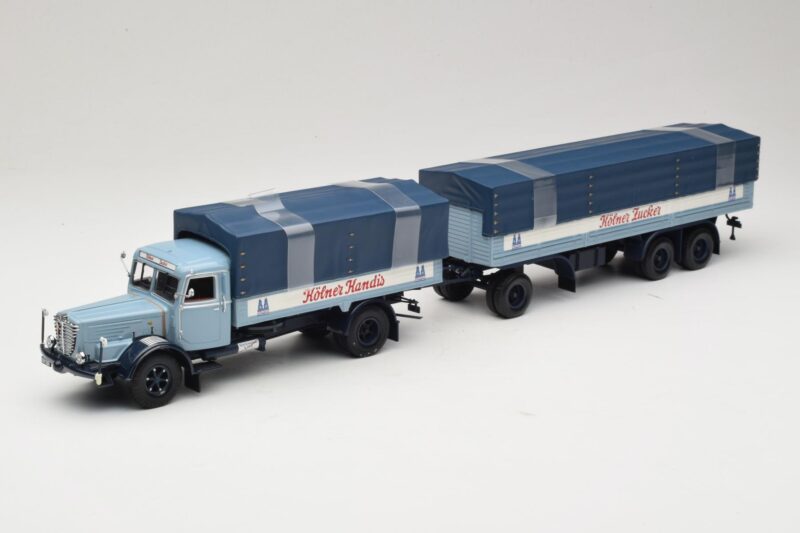
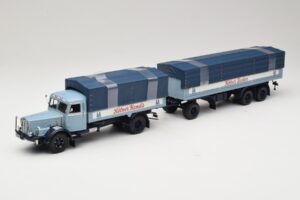
TL;DR: Minichamps' 1:43 diecast Büssing 8000S13 flatbed tractor-trailer combination reproduces the 1965 Kölner Zucker livery on a sealed body. Zinc alloy construction holds tight panel lines and deep-gloss paint, built for collectors assembling German commercial-vehicle lineups rather than sports car displays.
German truck collecting sits apart from sports car and racing shelves, with its own devoted following. Büssing's lion-badge trucks anchor that corner of the hobby, and this 8000S13 Pritschenzug carries a period sugar-trade livery that turns a working long-haul rig into a genuine slice of regional German commercial history worth displaying.
Büssing built trucks under the lion emblem from its Braunschweig works starting in 1903, and by the 1960s the marque stood among the pillars of West Germany's postwar commercial vehicle industry before its 1971 merger into MAN folded the brand into a larger group. The 8000S13 belonged to Büssing's heavy-duty long-haul range, built as a Pritschenzug: a flatbed tractor unit coupled to a matching flatbed trailer, the standard configuration for hauling palletized and bulk goods on West Germany's expanding autobahn network through the mid-1960s. Büssing's postwar trucks earned a reputation for load capacity and durability on routes that still mixed cobbled town streets with new autobahn sections, a duality the 8000S13's chassis and cab proportions were built to handle.
This particular example carries the Kölner Zucker livery, a period sugar-trade fleet scheme typical of the regional distribution liveries that decorated German trucks before national carriers standardized their fleets. Cab doors and trailer sides both display the operator's name and lettering, a continuity that a single fleet operator demanded across every vehicle in its yard. For a collector building a themed run of 1960s German commercial vehicles, that kind of regional, single-operator livery is harder to find reproduced accurately than a national brand's fleet colors, which makes this Büssing a genuinely distinctive addition rather than a generic truck wearing an unfamiliar paint job.
Minichamps casts this Büssing combination in zinc alloy, and the weight of both tractor and trailer units registers immediately when lifted from their tray, a density no lighter material replicates. The body is a sealed, one-piece casting on both the cab and the flatbed trailer, with cab doors, hood, and trailer panels molded shut rather than hinged. That construction choice suits a commercial vehicle subject particularly well: it lets the shut lines around the cab doors and the trailer bed run as continuous, even grooves rather than accommodating the wider tolerances an opening mechanism would demand. Paint sits on the hard metal shell with the deep, even gloss that zinc alloy allows under direct light.
The lettering that carries the Kölner Zucker livery across the cab doors and trailer flank stays crisp at the panel lines rather than blurring where two body sections meet. The cab-to-trailer coupling is a mechanical link between two separately cast units, not an opening feature, and it lines up the load bed correctly behind the tractor without any give in the joint. Wheels carry defined tread and hub detail on both axle sets, and the glazing sits flush in the cab's window openings rather than standing proud. At 1:43, the full tractor-trailer combination reaches a length that few other scales let a collector fit on a single shelf run without dominating the whole display.
Truck and commercial vehicle collecting runs as its own discipline within the diecast hobby, built around period liveries, regional operators, and the tractor-trailer combinations that once worked German roads rather than around racing history or supercar styling. At 1:43, a full flatbed combination like this Büssing fits a standard cabinet shelf without requiring the extra depth an F1 car display or a 1:18 sports coupe would need, which makes the scale the practical choice for anyone building a lineup of several trucks side by side. This 8000S13 pairs naturally with other 1960s and 1970s Minichamps commercial subjects carrying different regional liveries, letting a themed shelf grow one operator at a time. It rewards a buyer more interested in transport history than in horsepower.



You save 16.00 €
Lowest price in the 30 days before the reduction: 123.00 €