Last one
Used
This model is currently sold out. Enter your email and we'll let you know when it's back in stock.
TL;DR: Kyosho's 1:18 diecast Audi R8 4.2 FSI reproduces the 2007 mid-engine coupe in Blue, with opening doors and interior detail scaled to Audi's aluminum-spaceframe supercar. The R8 marked Audi's first genuine supercar, a departure from its sedan-heavy lineup that reshaped the brand's image, now a compact anchor for a modern supercar collection.
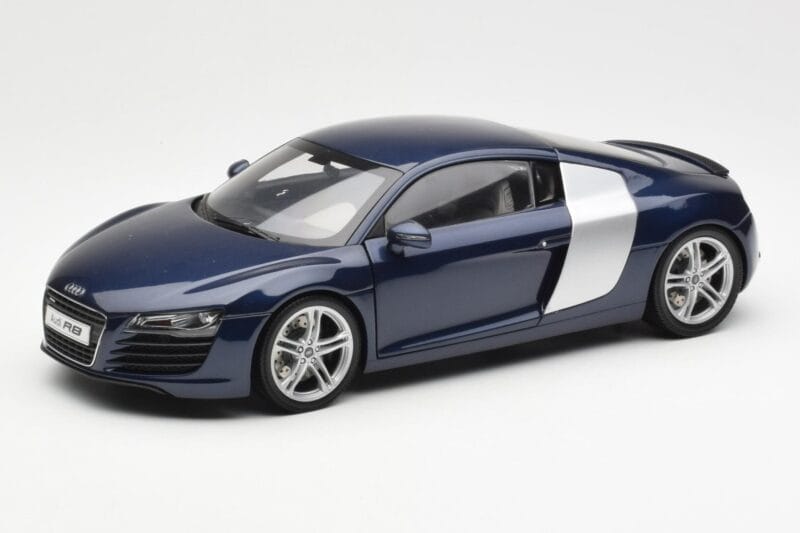
Audi built its reputation on quattro sedans and wagons, which made the R8's arrival genuinely surprising: a mid-engine, aluminum-bodied supercar wearing the four-ring badge. Kyosho's diecast in Blue captures that unexpected shape, the low nose and side blade intakes that announced Audi's arrival in an entirely new category.
The R8's low, wide stance leaves almost no flat surface untouched by a curve or an intake, and this Blue finish tracks those changes in light convincingly, deepening across the character line that runs from the front fender into the distinctive side blade. That side blade, one of the R8's signature styling cues, is picked out in a contrasting finish rather than painted over in a single flat color, preserving the visual trick that made the original car's silhouette so immediately recognizable. Panel gaps around the rear engine cover stay tight, no small feat given how many angled surfaces meet in that area of the body.
Both doors open on functioning hinges, and the interior behind them reflects the R8's driver-focused cockpit, a low dashboard, prominent gauge cluster, and none of the excess ornamentation that heavier luxury coupes carry. Kyosho's diecast construction gives the small coupe real weight in hand, distinct from the sensation of holding a comparable resin casting, since the metal body communicates the same solidity Audi engineered into the real car's aluminum spaceframe. That correspondence between real construction and model construction, both prioritizing lightweight rigidity over mass, is a detail that rewards a collector who understands what they are actually looking at.
Audi built the R8 around an aluminum spaceframe chassis, the same lightweight construction philosophy the brand had already proven on the A8 sedan, but applied here to a mid-engine layout that put a 4.2-liter FSI V8 directly behind the driver's seat. That engine placement, borrowed conceptually from Audi's own Le Mans-winning R8 race car, which lent the road car its name, gave the production version genuine motorsport-derived handling balance rather than a marketing veneer. It was, in every sense, Audi's declaration that it could build a proper supercar, not just a fast sedan.
The R8's mainstream visibility got an unexpected boost when the car appeared as Tony Stark's personal vehicle in the 2008 film Iron Man, introducing Audi's supercar to audiences who had never considered the brand alongside Ferrari or Lamborghini. That exposure, combined with the R8's genuine daily-usability compared to more temperamental exotics, helped the car build a following well beyond traditional Audi buyers. It remains one of the clearest examples of a single model reshaping a brand's public image almost overnight.
At roughly 22 centimeters long, the R8 fits comfortably alongside other modern supercars in a standard display cabinet, its proportions closer to a compact coupe than to the sprawling length of an American muscle car or a full-size luxury sedan. Set beside period rivals from Italy and Britain, the R8 reads as the understated option, a supercar that never needed outrageous styling to make its case. For a collector building a modern-era supercar shelf, this Blue example offers a genuinely different design language than the usual wedge-shaped exotics, proof that Audi's first attempt at the category landed closer to the mark than many expected at the time.