Last one
Used

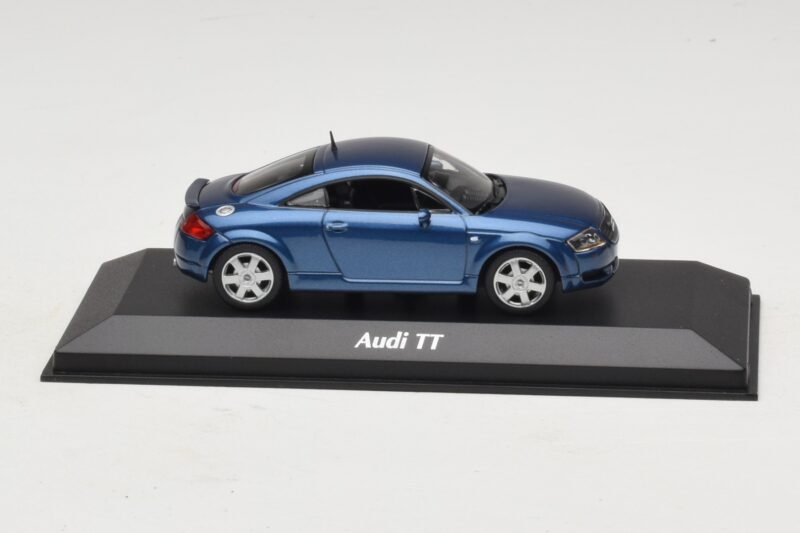
TL;DR: The Maxichamps Audi TT 8N in Blue Metallic is a 1:43 diecast replica of the 1998 coupe. A sealed one-piece body lets the rounded roofline, arches, and metallic paint carry the display. Just under 10 cm long, it suits 1990s design-led car shelves and Audi lineups.
Audi's TT started as a show-stand coupe and arrived in showrooms almost unchanged, which is rare. Its rounded arcs, circular motifs, and tight proportions were a break from the angular coupes of the era. The Maxichamps Audi TT 8N 1:43 turns that shape into a compact shelf piece in Blue Metallic, with a sealed casting that keeps the curves unbroken.
The TT's whole identity is the arc: a roofline that curves like a single stroke, arches that repeat the curve, and a short tail that drops sharply. A one-piece casting suits that. No seam interrupts the roof or the flanks, and the shut lines read as clean single grooves that follow the curves. Diecast gives the car a firm weight for something just under 10 cm long. The trade-off is that nothing opens, so the car is judged from the outside. Check the symmetry between the front and rear arches, the shape of the glasshouse, and how evenly the wheels sit in their arches.
Metallic blue gives the TT's curves something to catch. A good finish throws a smooth highlight along the roof arc and a darker band along the lower flanks, and the highlight should travel without breaking. At 1:43 the flake has to be fine, or the paint looks grainy instead of deep. Check that the trim, mirrors, and window frames stay crisp against the blue, because sloppy edges are the first sign of a rushed finish. Under a spotlight, rotate the car slowly and watch how the highlight moves across the body.
Audi showed the TT as a concept at the Frankfurt motor show in 1995, with design credited to Freeman Thomas and Peter Schreyer, and production began in 1998. The close match between show car and showroom car helped establish the TT as a design statement, not just a sporty coupe. The shape drew on Bauhaus ideas of simple geometry and honest form, which collectors often cite when discussing the car. In the United States the TT reached showrooms around the turn of the millennium, so American buyers often associate it with the early 2000s.
Underneath, the TT shared its platform with the Volkswagen Golf of its day, and quattro all-wheel drive was offered. The design hid that kinship so well that few buyers noticed. For collectors, that is a useful reminder that shape, not mechanical novelty, was the TT's selling point, and it explains why a replica rewards a close look at the exterior. The compact coupe pairs well with other 1990s design-led cars, or with later TT generations to show how Audi's idea of the shape changed.
At 1:43, the TT fits a standard cabinet row and works as a small design statement among sports cars. It pairs with other Audi coupes for a brand shelf, or with Italian and German coupes of the late 1990s for a design-led group. Keep it out of direct sun, and dust it with a soft brush; metallic paint shows swirl marks if wiped with a dry cloth. Because the body is sealed, the model handles easily, and the detail lives in the exterior finish. For anyone who values simple geometry, this blue TT is an easy model to order.