BMW X6M F86 Red Norev 1:18
Price:
94.00 €
This model is currently sold out. Enter your email and we'll let you know when it's back in stock.
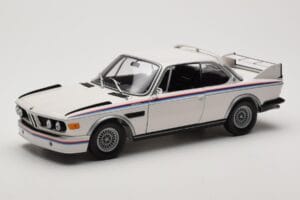
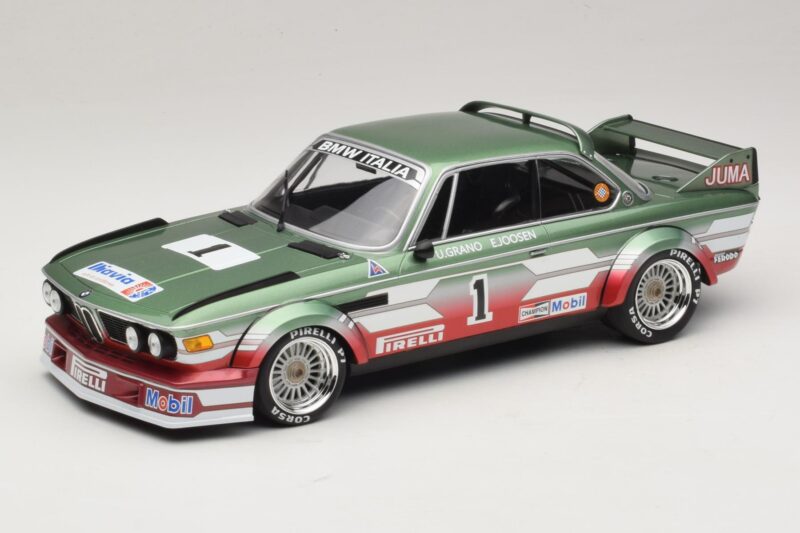
TL;DR: Minichamps' 1:18 diecast BMW 3.0 CSL reproduces Umberto Grano's #1 BMW Italia entry in the 1979 ETCC round at Zandvoort. The sealed one-piece body carries the flared arches, spoiler kit, and livery that made the CSL an icon of 1970s Group 2 touring car racing.
Fans nicknamed the 3.0 CSL the "Batmobile" for its aggressive aerodynamic package, and no national team wore that package with more flair than BMW Italia. Minichamps' rendering of Grano's Zandvoort car keeps that theatrical bodywork intact on a sealed diecast shell.
The 3.0 CSL was BMW's homologation special built specifically to win the European Touring Car Championship, and its Group 2 aerodynamic kit, the deep front air dam, boxed wheel arches, and towering rear wing, existed purely for downforce and airflow rather than styling. BMW's national teams, including BMW Italia, campaigned the CSL through the late 1970s against Ford and other manufacturer entries, and the Zandvoort round in the Netherlands was a regular fixture on that championship's calendar. Umberto Grano was a recognized name in Italian touring car racing of the period, and his #1 entry reflects a top-seeded car within the BMW Italia squad rather than a backmarker.
This casting has no opening doors, hood, or trunk. Every element of the CSL's famous aero kit, the arch extensions, the front splitter, and the multi-element rear wing, is reproduced as fixed cast-in exterior detail rather than a separately fitted or hinged part. That is the right call for a subject defined by its silhouette: the CSL's whole visual identity is the aero kit, and a sealed body lets Minichamps hold crisp, undistorted wing elements and sharp arch edges without hinge tolerances interrupting the lines. Livery accuracy matters as much as shape here, since period touring cars carried dense sponsor and number graphics that need to sit flat and correctly registered on the flared bodywork.
At 1:18 scale the CSL's coupe body, arches and all, runs close to 24 centimeters, and the width added by the arch extensions makes it read wider on a shelf than a standard 3.0 CS road car of the same scale. This is a subject with real motorsport pedigree behind it rather than a livery applied to a generic shape, and it holds its own next to Ford Capris and other period Group 2 rivals on a 1970s touring car shelf. The bright BMW Italia colors and prominent number panel give it strong shelf presence even among a crowded row of similarly sized coupes.
When evaluating a CSL replica, check the wing mounting points and arch-to-body transitions first, since these are the areas where cast detail can look soft on lesser reproductions. Diecast's structural strength suits this subject well, since the arch extensions and wing add surface area that a lighter material can flex under over time. Period touring car liveries like this one sit in a specialized but well-supported corner of the hobby, generally priced below top-tier Le Mans prototypes but above generic street-car diecast, reflecting the tooling work the aero kit demands.
No. The body is sealed as a one-piece diecast casting, with the entire aero kit, wing, and arch detail cast into the fixed exterior shell.
Fans gave it the nickname because of its dramatic factory aero package, including flared arches, a front splitter, and a tall multi-element rear wing developed for Group 2 downforce.
The CSL's arch extensions make it read visibly wider than a stock 3.0 CS at the same 1:18 scale, even though the overall length stays close to a standard coupe.
Yes, 1970s ETCC liveries like this one are a specialized but active collecting niche, sitting above generic street diecast in price due to the aero kit's tooling complexity.