Last one
Used

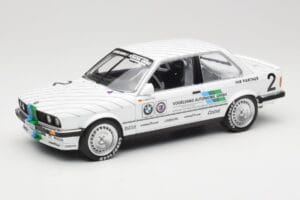
BMW M3 E30 #2 Warsteiner E. van de Poele DTM Champion 1987 Minichamps 1:18
Only 1 left
Price:
237.00 €
This model is currently sold out. Enter your email and we'll let you know when it's back in stock.
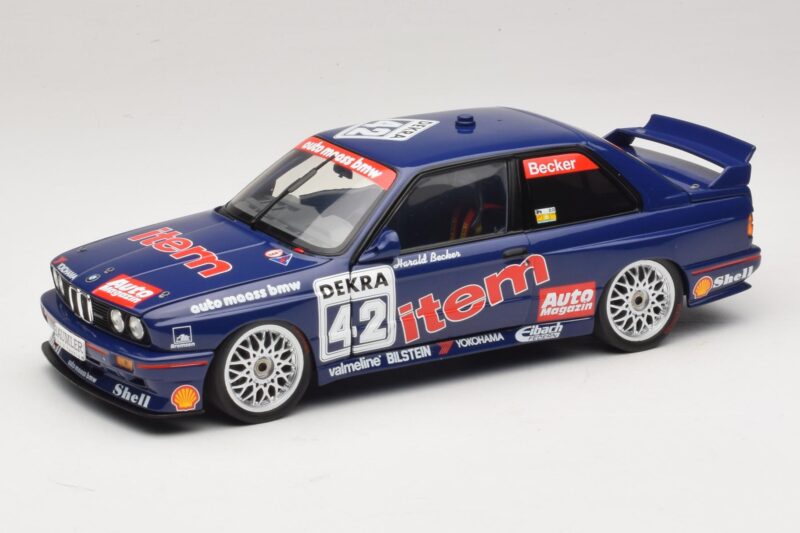
TL;DR: Minichamps' 1:18 diecast reproduces H. Becker's #42 BMW M3 E30, run by the Auto Maass team in the 1992 DTM season against factory Mercedes and Audi efforts. The doors open on this privateer touring car, exposing its roll cage, while tampo-printed graphics carry the Auto Maass livery across the boxed racing arches.
By 1992 the E30 M3 was fighting an uphill battle in DTM, giving away power and sophistication to Mercedes' 190E Evolution II and Audi's V8 quattro as the series pushed toward a new high-revving formula arriving the following year. Privateer teams like Auto Maass kept the aging chassis competitive on grip and driver skill rather than raw horsepower. Minichamps captures Becker's #42 car from that final privateer-era season.
DTM ran under Group A-derived rules through 1992, the final year before the series adopted the new Class 1 formula in 1993, a shift that brought purpose-built high-revving engines and effectively ended the era of showroom-related touring cars. The E30 M3, homologated years earlier around a naturally aspirated four-cylinder, was giving away real power to Mercedes' turbocharged 190E Evolution II and Audi's V8 quattro by this point in the season. Teams running the M3 in 1992 leaned on the chassis's balance and the driver's ability to carry corner speed rather than outright straight-line power, a very different picture from the car's earlier DTM dominance.
Not every DTM entry in this era came from a full factory program. Privateer teams filled out the grid running cars a season or two behind the newest factory machinery, competing on preparation and driver skill rather than manufacturer budgets. Auto Maass fielded the #42 M3 in that tradition, giving Becker a competitive platform even as the writing was on the wall for the naturally aspirated four-cylinder chassis against the coming Class 1 generation. Minichamps' tampo-printed livery reproduces that specific team's colors, a detail that matters to collectors tracking privateer entries rather than only the podium-finishing factory cars.
Opening this M3's doors reveals the roll cage and stripped interior that Group A rules permitted beneath the road-derived shell, a stark contrast to the boxy, production-based bodywork visible from outside. That interior view matters more on a privateer car than a factory one, since it is exactly the kind of detail a smaller team would have built and maintained by hand rather than through a manufacturer's engineering department. The cage bracing, tunnel-mounted roll bar, and single racing seat all sit visible once the door swings open, giving a genuine sense of what a privateer DTM cockpit looked like in 1992.
A door hinge on a diecast this size should hold its position with a defined resistance rather than swinging freely or drooping shut under its own weight, and that resistance is worth testing directly rather than trusting from a listing photo. Minichamps keeps the tampo-printed Auto Maass graphics registered correctly across the door's shut line, so the sponsor lettering does not visibly shift or misalign whether the door sits closed against the body or open to show the cage inside. That registration accuracy across a moving panel is harder to achieve than on a sealed body, and it is one of the details worth checking closely on arrival.
The E30 M3's touring car identity comes from its boxed wheel arches, flared wider than the road car specifically to clear racing-width rubber, and Minichamps keeps that geometry accurate on this casting rather than softening it toward a generic saloon shape. Zinc alloy diecast construction gives the model real heft the moment it clears its packaging, a density that settles it solidly on a shelf and signals the metal build before a buyer even checks the specification. That weight also lets the casting hold the arch's sharp box edges without the risk of warping over years of display that a lighter material might carry. Paint sits on the hard metal shell with a deep, even gloss, and the Auto Maass livery's tampo-printed graphics register directly against that painted surface rather than sitting as a separate decal layer that could lift at the edges. The wheels fill the flared arches at a period-correct racing offset, matching how the real 1992 car sat on its rubber rather than looking tucked under the bodywork. Small details like the correctly boxed rear deck lip and shallow windscreen rake carry through from the road car's homologated shape.
Becker's #42 Auto Maass car fills a specific gap that factory-liveried M3s do not: the privateer side of DTM's final Group A season, when smaller teams kept an aging chassis competitive through preparation rather than budget. Collectors tracing the E30 M3's full touring-car career, from early DTM dominance through BTCC success to this later privateer chapter, will find this livery a documented step in that story rather than a repeated factory scheme. At 1:18, the model holds a standard shelf row comfortably next to other early-1990s touring cars, and the opening doors give it the same inspection value as the factory-backed entries from the same era. For a buyer building a season-specific 1992 DTM grid, a privateer entry like this one rounds out the field in a way factory liveries alone would leave incomplete.