BMW X6M F86 Red Norev 1:18
Price:
94.00 €
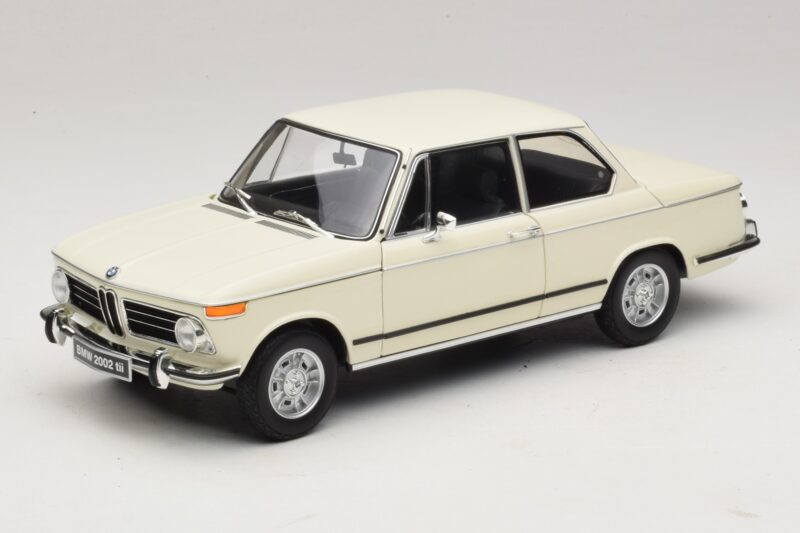
TL;DR: The Kyosho BMW 2002 tii E10 in 1:18 is a white diecast replica of the 1972 compact sport sedan, the fuel-injected version of BMW's small two-door. It carries opening parts, the weight of a metal body, and a slim-pillared stance that anchors a 1970s BMW lineup.
Before the M cars and the wide-bodied performance coupes, a small white two-door with mechanical fuel injection showed BMW what its customers wanted. Kyosho's 1:18 BMW 2002 tii turns that moment into a diecast piece with opening parts, and it pays off most when you pick it up and turn it under a lamp.
Lift it from the foam and the weight is the first thing you notice. A metal body gives a small car real heft, far more than its roughly 23 cm length suggests. White is a demanding finish on a car like this because it shows every reflection and every panel seam, so the coat has to lay down evenly over the roof and shoulder curves. The 2002 was always a light-looking car with a tall greenhouse and thin pillars, so glazing and pillar thickness are the first things to compare against photographs of the real car. Slim chrome bumpers and compact wheels complete a stance that sits upright rather than low, which is correct for a sedan of the early 1970s.
This model has opening parts, and that changes how you handle it. Hinged panels on a diecast body swing through their travel and settle where you place them, with seam lines a little wider than a sealed casting would hold. That is the standard trade of the material: metal tolerances favor durability and movement over razor-thin gaps. Support the body by the sills rather than the roof, open panels gently, and the hinges will outlast years of display handling. Resin alternatives can show crisper shut lines, but this approach suits a collector who likes to inspect a model rather than only look at it.
BMW launched the 2002 in 1968 as a two-liter version of the 1602, and the tii followed in 1971 with Kugelfischer mechanical fuel injection, lifting output to around 130 PS from the same four-cylinder engine. It was a small, light sedan with a sharp engine and a shape built around visibility, and it gave BMW a reputation the company still trades on: a compact car that drives like a larger sports machine. The 2002 grew out of the Neue Klasse family that restored BMW's fortunes in the 1960s, so the model carries real company history well beyond its size. It also helped build BMW's following among American drivers, which is why it draws interest from collectors who never saw one in Munich.
On a shelf, the 2002 tii works as an origin point. The E21 3 Series replaced the 02 range in 1975, and from there the line runs through the E30 M3 to the current M cars. A white 2002 beside a modern white M4 shows how a compact, upright sedan became a wide, low performance coupe in five decades. Because both exist in 1:18 diecast, the proportions line up, which keeps a multi-generation display coherent rather than a jumble of sizes.
Choose this model for period character and handling, not for sealed-body perfection. If shelf-perfect shut lines are your priority, a resin piece will hold tighter gaps; diecast like this gives weight, durable chrome and panels you can actually move. At 1:18 a compact sedan takes far less shelf depth than a modern coupe, so several 1970s cars fit on one cabinet shelf. Keep it out of strong sunlight, which is hard on any painted surface and on clear plastic, and dust it with a soft brush. Anyone ready to buy should decide whether they want a model to handle or one to leave alone; this one is clearly the former.