Last one
Used
This model is currently sold out. Enter your email and we'll let you know when it's back in stock.
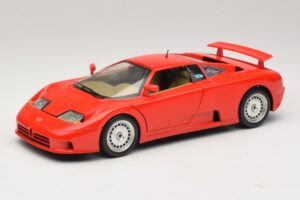
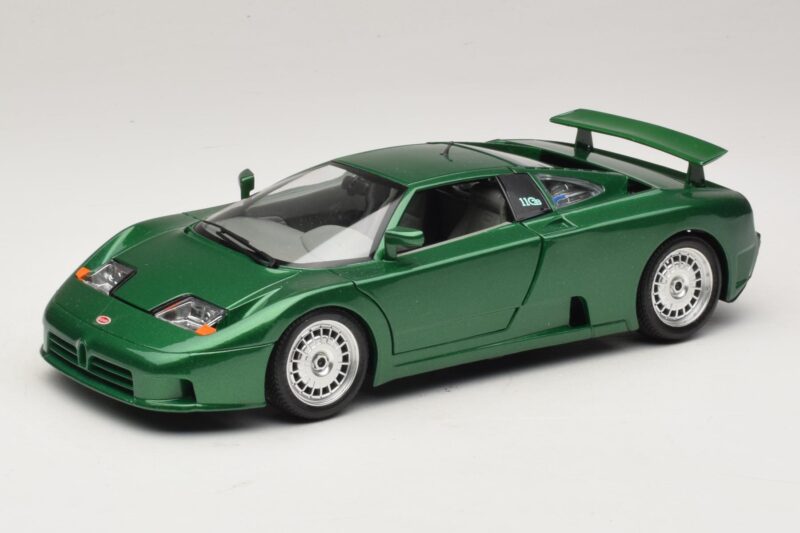
TL;DR: Bburago's 1:18 diecast Bugatti EB110 reproduces the quad-turbocharged V12 supercar Romano Artioli built to relaunch the Bugatti name in 1991, one of the first production cars with a carbon-fiber monocoque. Finished in green metallic with an opening body, the diecast captures a genuinely obscure, technically radical 1990s supercar most collections lack entirely.
Romano Artioli revived the dormant Bugatti name in 1991 with a car built to prove the marque could still push automotive engineering further than anyone else, targeting the EB110's launch for the founder's 110th birthday. A carbon-fiber monocoque, quad-turbocharged V12, and all-wheel drive made it one of the most technically ambitious supercars of its decade, built in a purpose-built factory in Campogalliano before Bugatti's finances collapsed in 1995.
Romano Artioli, an Italian entrepreneur who had built his fortune importing Suzuki and Ferrari vehicles, bought the rights to the dormant Bugatti name and set out to relaunch it as a standalone manufacturer rather than a badge revived by an existing carmaker. He built a new factory in Campogalliano, Italy, and timed the EB110's unveiling for September 1991, marking what would have been founder Ettore Bugatti's 110th birthday, hence the model's designation. The car's engineering ambitions matched the occasion: a carbon-fiber monocoque chassis, one of the first ever used in a production road car, carried a quad-turbocharged V12 driving all four wheels, a combination no other manufacturer offered at anywhere near the EB110's price point. Marcello Gandini produced early design proposals, though Artioli reportedly found them too aggressive and had the exterior reworked under Giampaolo Benedini before production began, a rare instance of a legendary design house's work being substantially revised before reaching the road. Michael Schumacher owned an EB110 SS during his early Formula 1 career, a detail that has followed the car ever since. Bugatti's ambitious factory and low production volumes could not sustain the business, and the company collapsed into bankruptcy by 1995, ending the EB110's run after a genuinely short production life.
Bburago has spent decades making diecast supercars accessible to a mass-market audience, an Italian manufacturer whose catalog leans heavily on Ferrari, Lamborghini, and other exotic marques at price points well below hand-built resin competitors. This EB110 reflects that approach: a zinc-alloy diecast body with real weight in the hand, cast at a scale and price that let far more collectors own a Bugatti in miniature than could ever consider the real seven-figure original. The doors open on a hinge that holds its set position, revealing a cabin trimmed to follow the EB110's low, driver-focused cockpit, with the analog gauge cluster and toggle switches that gave the real car's interior an almost aircraft-like character. Panel gaps run at typical mass-market tolerances rather than the razor-thin lines a limited hand-finished resin build might achieve, a fair trade for a price point this accessible. The wheels are cast with the EB110's distinctive five-spoke design, and the rear engine cover, a panel that had to accommodate the quad-turbo V12's plumbing on the real car, carries the correct louvered detailing rather than a simplified flat panel. For a supercar this obscure, having any well-detailed 1:18 reproduction available at all is itself notable.
Green metallic is an unusual choice for a car most commonly photographed in red or blue, and it suits the EB110's understated, almost restrained shape better than a louder color might. Unlike the angular wedge shapes Lamborghini and Ferrari favored for their contemporary flagships, the EB110's body used softer, more rounded surfaces, a design language that reads differently depending on the finish applied to it. The EB110 launched into a supercar field crowded with the Ferrari F40, Lamborghini Diablo, and Jaguar XJ220, each chasing outright speed records with a completely different engineering philosophy, and the EB110's carbon monocoque and all-wheel drive set it apart technically from all three even if its sales never matched theirs. Diecast paint sits on a hard metal shell, giving the green a deep, consistent gloss across the EB110's large, unbroken rear haunches, panels where any inconsistency in the finish would be immediately visible. Getting this shade right matters more than it might on a more commonly reproduced supercar, since there are few other green EB110 diecasts to compare against, and that scarcity of reference points makes an accurate, well-applied metallic finish a genuine point of pride for this particular casting.
Bugatti's collapse in 1995 kept total EB110 production low, and that same scarcity carries over into the scale model world, where far fewer manufacturers have tackled the car compared to the F40s and Countaches that dominate 1990s supercar diecast catalogs. Bburago's accessible price point makes this one of the more attainable ways to own an EB110 in any form, sitting well below what a hand-built resin alternative would command for the same subject. At roughly 24 centimeters long in 1:18, the EB110's proportions hold their own next to more familiar supercar reproductions from the same era. For a collector building a comprehensive 1990s supercar shelf, this EB110 fills a genuine gap that a Countach, F40, or Diablo cannot, representing a chapter of Bugatti's history that most car enthusiasts know by reputation rather than by having actually seen one.