Last one
Used

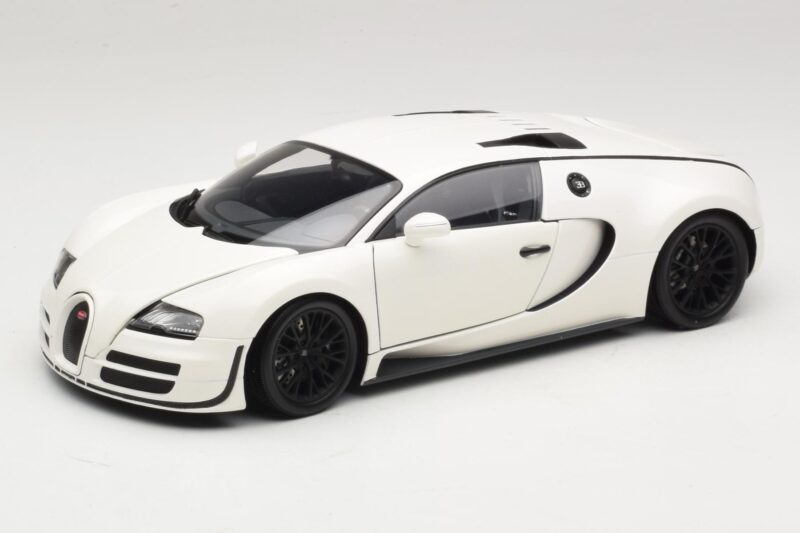
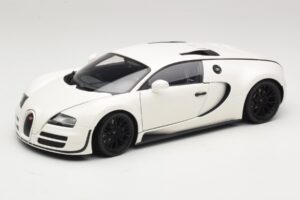
TL;DR: Minichamps' 1:18 diecast Bugatti Veyron Super Sport in white reproduces the quad-turbo W16 hypercar that set the production car speed record near 431 km/h in 2010. The diecast zinc alloy body opens at the doors, exposing the cabin, while the white finish sets off the Veyron's horseshoe grille and side intakes in sharp relief.
Few production cars have ever forced the record books open the way the Veyron Super Sport did, its 8.0-liter quad-turbo W16 pushing past 430 km/h under Guinness supervision in 2010. Minichamps renders that hypercar in white, a color that throws the Veyron's horseshoe grille, dual intake scoops, and centerline seam into sharp contrast rather than letting them blend into a darker body.
The Veyron's W16 layout, effectively two narrow-angle V8s sharing a common crankshaft, let Bugatti fit sixteen cylinders and four turbochargers into a footprint no conventional V12 or V10 could match. In Super Sport tune the engine produced around 1,200 horsepower, a figure that required a reworked cooling package, ten radiators in total, and a stronger structure to handle the aerodynamic loads at the car's top speed. That complexity is part of why the Veyron remained in limited production for years rather than scaling up: every unit demanded extensive hand assembly that no volume manufacturer's supply chain was built to support.
Bugatti capped the road-legal Super Sport's top speed electronically below the car's true capability for safety certification, but the record-run variant, stripped of that limiter under controlled conditions, reached figures that stood as the production car benchmark for years afterward. That achievement is why the Super Sport, more than any other Veyron variant, carries genuine motorsport-adjacent significance despite never entering competition. Minichamps' white casting doesn't chase that speed record directly, but it reproduces the aerodynamic details, the rear wing, the diffuser, the side scoops, that made the record possible in the first place.
With the doors built to open on this casting, lifting one reveals a cabin shaped entirely around the Veyron's engineering demands: a wide center tunnel routing cooling lines toward the engine bay, a dashboard dominated by an oversized speedometer calibrated well past what any other production car needed, and door panels sculpted around intake ducting that feeds the W16 mounted behind the cabin. Minichamps reproduces that specific interior architecture rather than reusing a generic supercar cabin mold.
The doors swing outward on a conventional hinge rather than anything exotic, a detail some buyers find surprising given the car's theatrics elsewhere, and Minichamps captures that ordinary hinge geometry accurately rather than inventing drama the real car doesn't have. Diecast zinc alloy handles the added engineering of a moving door well, holding its shape at the hinge point through repeated handling in a way a lighter material would struggle to match over years of display. The white paint continues onto the door's inner panel and sill, a detail easy to skip but one that shows clearly when the door is raised.
White is an uncommon choice against the two-tone black-and-color liveries most Veyrons wore from the factory, and it changes how the car reads on a shelf. The horseshoe-shaped grille, Bugatti's signature since the 1920s, stands out far more clearly against white than it does against darker factory colors, and the side strake that splits the door panel becomes a visible line rather than a subtle shadow. Minichamps' paint sits with a bright, even gloss across the body, and the wheels, finished in a contrasting dark tone, anchor the color scheme against the lighter body. At roughly 24 centimeters in 1:18, the Veyron commands real shelf presence next to more conventional supercars, its low, wide stance reading as distinctly different from anything with a more upright cabin.
The Veyron Super Sport occupies a strange place in automotive history: a car built in tiny numbers whose speed record still gets cited more than a decade later, despite dozens of newer hypercars chasing the same benchmark since. Minichamps prices this in the premium diecast tier, appropriate for an opening-door build with this level of engineering to reproduce, sitting comfortably above mass-market Veyron replicas that skip the moving panels entirely. For a collector building a hypercar shelf around genuine speed-record machinery, white is a distinctive, less common choice that stands out from the darker liveries most collections already have several of.