Used

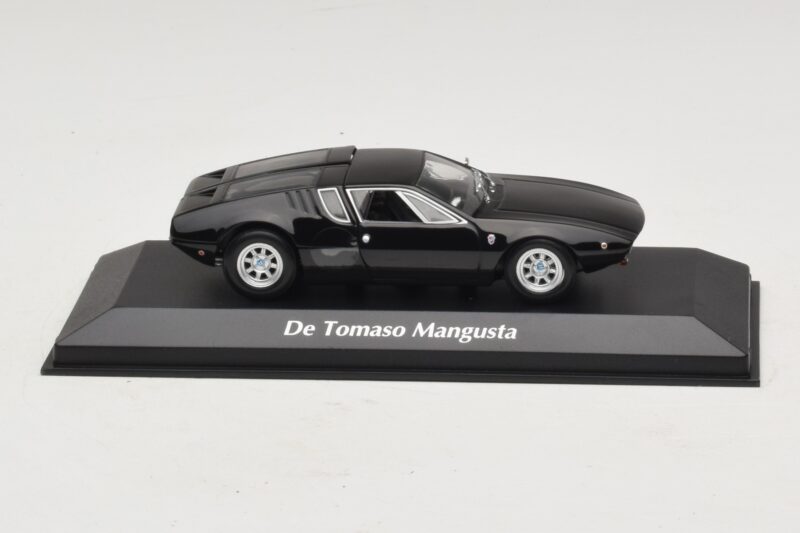
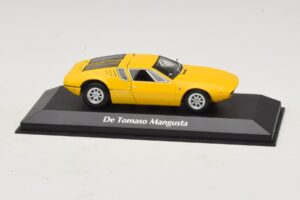
TL;DR: The Maxichamps De Tomaso Mangusta Black 1:43 is a diecast replica of the 1967 Italian mid-engine coupe, cast as a sealed one-piece body. Its appeal sits on the exterior: the low wide stance, Black paint, glazing and wheels. It suits collectors of 1960s Italian sports coupes who want a compact, display-ready piece.
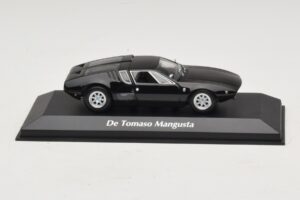
Italian styling and an American V8 sat together in the Mangusta, a pairing that still stands out among 1960s sports coupes. De Tomaso's mid-engine car is modeled here at 1:43 in Black, a color that stresses its low, wide shape and gives the sealed body a graphic, sculptural look.
This Mangusta has no opening parts, which suits a car famous for its flat, wide posture. At 1:43 it measures about 10 cm and sits very low, with a shallow windshield, a thin roof section and a wide, squat tail. The key checks are the height of the beltline, the slope of the rear deck and the width of the track. A correct model looks hunkered down, not tall.
With a sealed body, there are no hinge allowances to open up the surface around the rear section, so the cast detail along the tail and the panel grooves can stay crisp and continuous.
Black is the least forgiving color on a model because it exaggerates every fault, but a well-finished piece repays inspection with a deep, mirror-like gloss. Zinc-alloy diecast adds real heft, and a rigid shell supports a smooth coat. Under a lamp, watch the reflection travel over the roof and rear deck; it should bend smoothly with no ripples.
The trade-off is that diecast edges are slightly softer than cast resin's, so thin trim and lamp details can read a little thick under magnification. Printed badges should remain legible and free of halos. Black also shows dust fast, so a closed cabinet matters more here than with lighter colors.
The Mangusta was styled by Giorgetto Giugiaro at Ghia and built by De Tomaso, with a Ford V8 mounted behind the cabin. The rear engine cover of the real car used gull-wing style panels, one of its signature features, though this model reproduces the car as one fixed shell. The 1967 production year places it at the start of the car's run, when the mid-engine layout was still rare outside exotic territory.
Mangusta is Italian for mongoose, and widely repeated lore says the name was a nod to the mongoose's reputation as a snake hunter, aimed at Shelby's Cobra. Treat that as period lore rather than settled record. It does explain why the car's identity is tied to its Italian-American mix.
That mix appeals strongly to US collectors, who often specialize by marque and who follow V8-powered European cars with interest. A Mangusta fits as an exotic counterpart to American muscle on the same shelf.
The Black Mangusta works as a counterpoint on a 1:43 shelf of muscle cars and European sports cars alike: it shares the V8 culture of the former and the styling heritage of the latter. Pair it with other 1960s Italian coupes to compare how different styling houses handled low, wide shapes. Place the case away from direct sun and use a soft brush for dust, which shows quickly on black. As an accessible diecast piece with a sealed body, it is a low-risk, easy-to-handle model. Anyone who wants to order a compact Mangusta will find its appeal lies entirely in stance and finish, which is how this car has always been judged.