Last one

Subaru Impreza #5 C. Sainz / L. Moya 2nd Place Rally Monte Carlo 1995 Kyosho 1:18
Only 1 left
Price:
252.00 €
This model is currently sold out. Enter your email and we'll let you know when it's back in stock.
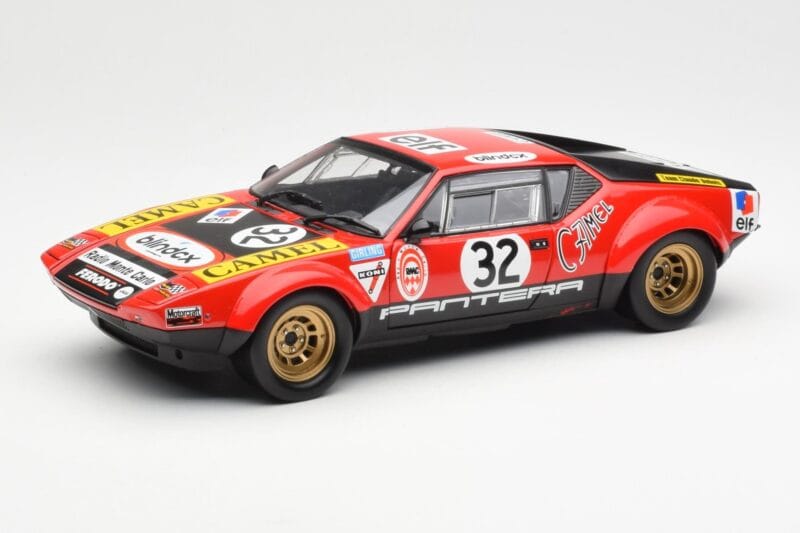
TL;DR: Kyosho's 1:18 diecast De Tomaso Pantera reproduces the #32 GT-class entry driven by Jaquemin and Deprez at the 1972 24 Hours of Le Mans, with widened arches, a roll cage interior, and racing livery graphics over the standard road car shell. A distinct companion piece to the road-going Pantera for an endurance-racing shelf.
Endurance racing pushed the Pantera's already dramatic wedge shape further, widening arches and stripping interiors for a 24-hour fight rather than a road trip. Kyosho's diecast captures that transformation directly, reproducing car #32's specific Le Mans livery rather than a generic racing paint job on the road-car shell.
Car #32's number and sponsor graphics sit exactly where they ran at Le Mans in 1972, registered cleanly across the flanks and hood in the tampo-printed detail Kyosho uses to keep edges sharp over years of display. Getting a specific historic race livery right means matching not just the number but its exact placement and size relative to the arches and door lines, details period photographs and race documentation confirm, rather than approximating a generic period racing scheme applied to the standard road car. The zinc alloy body's weight matches Kyosho's road-going Pantera exactly, a useful reminder that the two share underlying tooling even as their surface treatment diverges completely.
GT-class regulations at Le Mans allowed genuine bodywork modification over the road-going Pantera, and this model shows the widened arches, deeper front spoiler, and simplified racing wheels those rules permitted. Inside, a stripped cabin with a roll cage, racing seat, and fire extinguisher replaces the road car's leather-trimmed interior, since endurance regulations prioritized safety equipment over comfort. Judging a race-liveried model's authenticity starts with checking arch width against the road car and confirming the roll cage geometry looks structurally plausible rather than decorative, since a poorly proportioned cage is one of the easiest tells of a rushed motorsport casting.
Le Mans' GT class in the early 1970s was built around endurance rather than outright speed, rewarding cars that could survive 24 hours of racing without mechanical failure over cars that were simply fastest for a single lap. Endurance racing's demands on privateer machinery also meant many entries in this class never saw the finish, which is part of why documenting any specific historic entry accurately, rather than inventing results, matters more than it might for a car with a clean, well-recorded championship history.
Jaquemin and Deprez shared driving duties on car #32 through that 1972 race, a typical arrangement for endurance events where teams rotated drivers across the full 24 hours to manage fatigue. Kyosho's reproduction ties the model directly to that specific entry rather than a generic Pantera racing scheme, which is what separates a genuinely historic race-liveried diecast from a paint job invented for visual variety.
At roughly 22 centimeters, this Le Mans Pantera shares its footprint with the standard road car, making the two easy to display side by side to show exactly how far GT-class rules pushed the design. The widened arches and racing wheels stand out immediately next to the cleaner road-going bodywork, a direct visual lesson in what endurance-racing modification actually looked like on this platform. Store the model out of direct light despite the darker livery base, since sponsor decal inks can fade at different rates than the body paint beneath them, and dust the widened arches carefully since their recessed shape traps grit more than flat panels. For collectors building a Historic GT and GTE display, this Pantera adds genuine 1970s privateer racing context most road-car-only collections don't cover.