Last one
Used

This model is currently sold out. Enter your email and we'll let you know when it's back in stock.
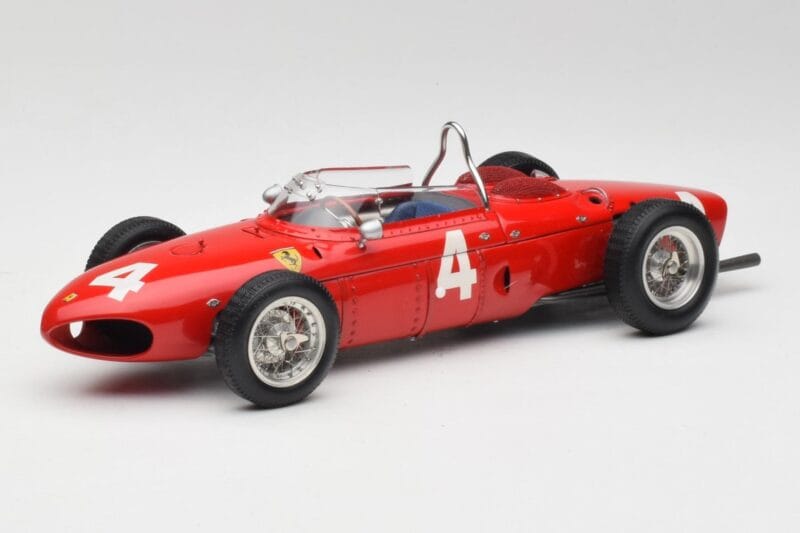
TL;DR: CMC's 1:18 diecast Ferrari 156 Sharknose reproduces the Phil Hill and Wolfgang von Trips 1961 Belgian Grand Prix entry, the season Ferrari swept the constructors' and drivers' titles. This is a used model with functioning body panels; the box shows storage marks, the casting is unaffected.
The 156's twin-nostril nose became one of Formula 1's most recognizable shapes, and 1961 was the season it delivered on every promise that design implied.
Open-wheel racers pose a different challenge than closed bodywork: there is nowhere for a maker to hide a shortcut, since the entire mechanical layout sits in plain view. CMC answers that by building the 156 from individually fitted metal components, exposed suspension arms, a detailed engine, and body panels that lift to show construction most GP diecast leaves sealed. The result carries genuine heft for its size and rewards close inspection rather than distant shelf viewing, which suits a subject whose engineering was the actual story of its era.
Ferrari's 156, powered by a rear-mounted V6 rather than the front-engine layout rivals still ran, took Phil Hill to the 1961 World Championship, with teammate Wolfgang von Trips as his closest challenger for most of the season. The distinctive dual-nostril nose gave the car its enduring nickname and made it instantly identifiable on any period grid. That championship-winning context gives this Belgian Grand Prix livery real weight among Formula 1 collectors, not just as a shape but as a documented moment in the sport's transition to rear-engine design.
As a used model, this piece carries a box showing storage marks while the casting remains sound, a fair trade for owning a documented CMC build at a lower entry point than new stock. It anchors a 1960s Formula 1 shelf particularly well alongside other rear-engine pioneers from the same transitional period, giving a collection real chronological weight.