Last one
Used
This model is currently sold out. Enter your email and we'll let you know when it's back in stock.
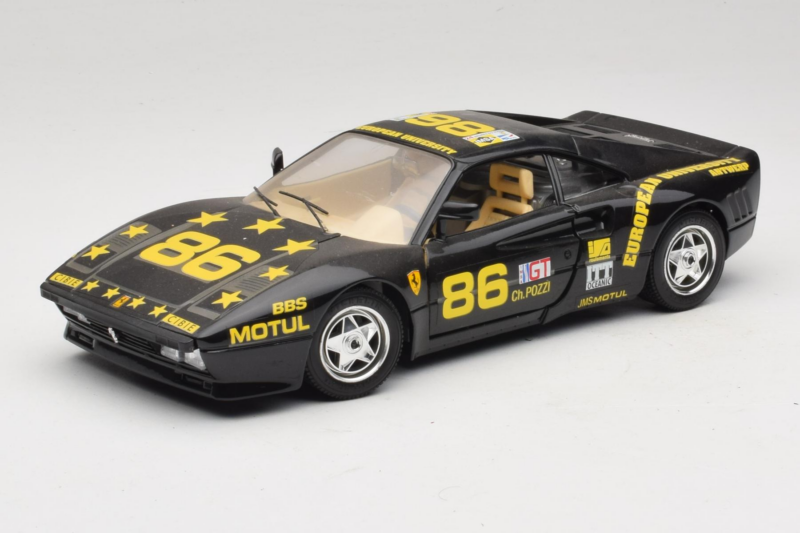
TL;DR: Bburago's 1:18 diecast reproduces the Ferrari 288 GTO in a race-liveried #86 black finish, based on the 1984 Group B homologation special that Ferrari built ahead of the F40. Only 272 road-going examples exist, making an accessible replica genuinely valuable for most collections.
The 288 GTO rarely gets the recognition the F40 does, despite being the car that made the F40 possible in the first place.
This black #86 racing presentation gives an already muscular body, wider arches, deeper front air intakes, and a subtly raised rear spoiler, an extra layer of visual aggression over a standard road-going 288 GTO livery, and Bburago's diecast tooling holds that widened stance clearly at 1:18. The car's turbocharged V8 sat behind the cabin in a genuinely different layout from Ferrari's more common V12 flagships of the era, a mechanical distinction the shape itself hints at through its proportions. As an entry-tier diecast, the model favors that overall stance and finish over intricate mechanical reproduction, a sensible trade for a subject defined by its silhouette.
Ferrari built the 288 GTO to homologate a Group B racing program, with only 272 road-going examples produced, and the car's turbocharged, mid-engine layout directly informed the design and engineering that would become the F40 just a few years later. That lineage makes the 288 GTO essential context for anyone collecting F40 models, since it explains where that car's turbocharged DNA actually came from rather than treating the F40 as an isolated design exercise. For a Ferrari flagship timeline, this piece belongs directly before the F40 on the shelf.