Last one
Used
This model is currently sold out. Enter your email and we'll let you know when it's back in stock.
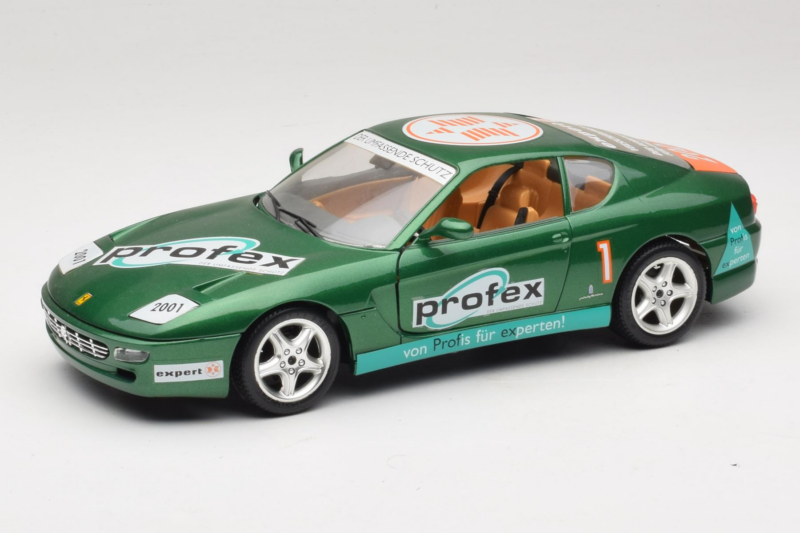
TL;DR: Bburago's 1:18 diecast reproduces the #1 Profex-liveried Ferrari 456 GT in green, a racing-dressed variant of Ferrari's road-going 2+2 grand tourer from 1992. Number graphics and competition styling separate it from the standard street 456 casting.
Putting a race number and livery on a car built as a road-going grand tourer is an unusual move, and it makes this 456 a curiosity worth explaining rather than a straightforward street replica.
This model shares its underlying body tooling with Bburago's standard 456 GT castings, but the #1 number and Profex graphics push it toward the marque's GT racing subculture rather than its street lineup. Green is not a color typically associated with Ferrari road cars, which reinforces the sense that this piece is meant to be read as competition livery rather than factory color. The diecast build follows the same entry-tier approach across the range: functional opening doors and hood, simple hinge mechanisms, and solid paint application rather than deep tampo layering. It is a distinctive piece specifically because it departs from what a 456 GT normally looks like.
The 456 GT was never a dedicated racing platform in the way the 348 Challenge or 355 Challenge were, so a race-liveried example like this one works best as a conversation piece within a broader Ferrari display rather than as an anchor for a serious motorsport collection. Set beside a standard-liveried 456, it demonstrates how far a livery can shift a car's visual identity without touching the body underneath, a useful lesson for any collector learning to evaluate scale models by more than just the base casting.