Used
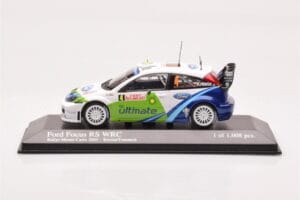
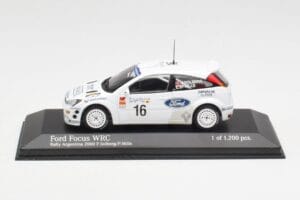
Ford Focus RS WRC #4 R. Kresta / J. Tomanek Rally Monte Carlo 2005 Minichamps 1:43
Only 2 left
Price:
103.00 €
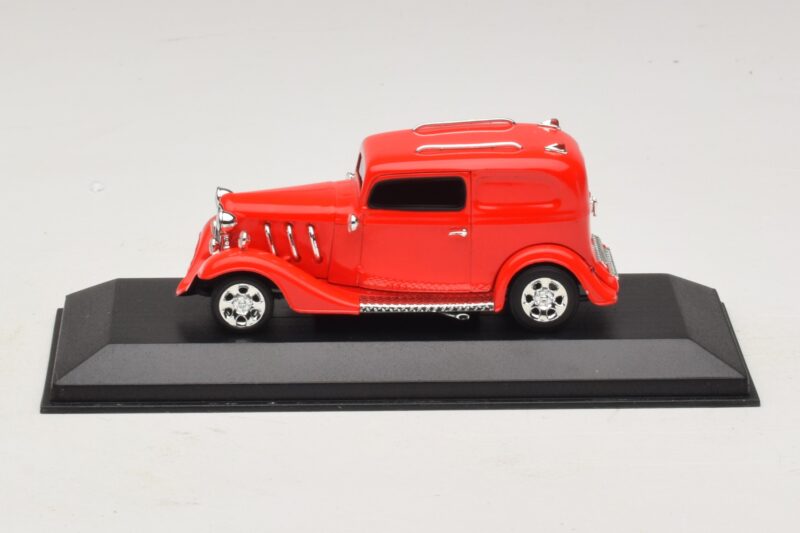
TL;DR: The Minichamps Ford Hot Rod Red 1:43 is a diecast model built on the 1932 Ford, the starting point of American hot rod culture. The body is a sealed one-piece casting, so red paint depth, stance and proportion define it. It suits collectors of custom cars and pre-war American subjects on a compact shelf.
Hot rods are the American hobby car in its purest form: stripped, lowered and made loud. Minichamps gives the 1932 Ford that treatment at 1:43 in red, a subject that is custom by nature rather than a catalog model. The product sits outside the usual stock-car shelf, closer to the car-show crowd.
A red hot rod lives or dies by its paint. The body is a sealed one-piece casting, so the finish runs unbroken across the shell, and under a spotlight you can judge depth, evenness and any trace of orange peel. Good red diecast paint shows a wet, saturated gloss rather than a flat, chalky tone. Because nothing opens, there is no engine bay to inspect and none to be disappointed by: the story is stance, proportion and surface. Rake, wheel size and the relationship between body and tire are what a hot rod enthusiast reads first.
Metal gives the model a reassuring heft for something that fits in the palm, and that mass keeps a lowered, narrow-footprint shape planted on a shelf. The paint sits on a hard shell, which suits a high-gloss finish. Chrome-effect trim, wheels and lamp details are printed or applied at 1:43, so check that their edges are clean and that the wheels sit evenly, since a hot rod with one tire out of line looks wrong from across a room. Glazing, where present, should sit flush.
Ford introduced its flathead V8 in 1932, putting eight cylinders within reach of ordinary buyers. Because the car was light, cheap and plentiful, it became a favorite starting point for young builders after the war, who stripped it down and tuned it for dry-lake speed runs in Southern California. The nickname Deuce came to stand for the whole style: lowered, simplified, loud. A scale model carries that history in its proportions, even when the exact build is a matter of the model's own styling.
Hot rod and custom-car culture is distinctly American, and its models form a segment apart from muscle cars and stock racers. Collectors who attend car shows often want a miniature that echoes what they see in the parking field. At 1:43, a red hot rod makes a vivid counterpoint to chrome-heavy muscle cars, and it pairs well with other pre-war American subjects. Because the original was a mass-produced Ford, the shelf story runs from factory floor to garage conversion.
At this price tier, expect a casting that prioritizes silhouette, stance and clean paint, with fine parts printed rather than separately fitted. For a hot rod that is a sensible compromise, because the character lives in the overall shape. Display it under direct light to show off the gloss, but away from windows that bring strong sun, which dulls red paint faster than most colors. Handle the model by the body sides and avoid pressing on wheels. It sits comfortably next to other 1:43 American cars, and a few more custom pieces would build a proper show-field row. For buyers drawn to the DIY spirit of American car culture, it is an easy first step into that segment.