Used

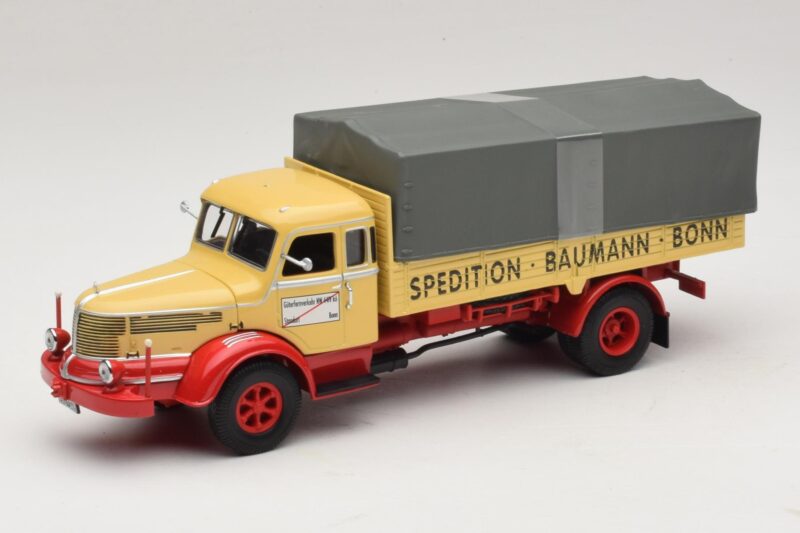
TL;DR: Minichamps' 1:43 Krupp Titan flatbed truck reproduces a postwar West German heavy hauler in the Baumann Bonn commercial livery, cast as a sealed one-piece diecast body with correct cab proportions and flatbed detailing. A niche subject for collectors who build commercial-vehicle displays rather than sedan-only shelves.
Heavy trucks rarely get diecast treatment at all, let alone from the smaller manufacturers that built West Germany's postwar commercial fleet. Krupp's Titan line filled that role through the 1950s, and Minichamps documents a working example here, liveried for the Baumann Bonn haulage operation and cast at 1:43.
Commercial trucks present a different challenge than a sedan or a sports car: the cab, the chassis rails, and the flatbed all need to read as functional equipment rather than styled bodywork, and Minichamps treats the Titan accordingly. The cab and load bed are cast as one sealed zinc-alloy shell, with no doors or tailgate designed to open, which at this scale keeps the proportions honest rather than compromising the cab shape around a hinge mechanism. That construction lets the model hold tight panel lines around the cab corners and a flat, true load bed rather than the slightly warped surface a moving tailgate would require. The Baumann Bonn livery is applied with tampo-printed lettering along the cab doors, holding sharp edges rather than the soft, slightly blurred look cheaper pad-printing produces. Paint depth on the cab panels reads flat and utilitarian, appropriate for a working vehicle rather than a showroom car, and the wheels carry the dual rear axle configuration a heavy hauler of this class actually used. Chassis rails and the underside of the load bed show molded detail rather than a smooth, unfinished slab, a small touch that separates a serious commercial-vehicle casting from a toy-grade one.
Krupp is better known globally for steel and heavy industry, but the company also built commercial trucks from before the war through the 1960s, with the Titan forming part of its postwar heavy-duty range as West Germany rebuilt its domestic haulage capacity. These were working vehicles first, engineered for durability and diesel efficiency over styling, and they carried liveries for the regional hauliers and municipal operators that bought them rather than any factory-applied showroom finish. Krupp's truck division eventually left the market as the West German commercial-vehicle industry consolidated through the following decades, which means surviving examples and the liveries they carried are documented far less thoroughly than the sedans and sports cars of the same period. Regional operators like Baumann typically ran mixed fleets covering local delivery and longer-haul contracts, and a truck liveried for one specific company gives a collector a genuine, dated artifact rather than a generic unbranded casting.
At 1:43, this Titan sits comfortably alongside period sedans without dominating a shelf, despite representing a genuinely large vehicle in real life. Commercial trucks make an effective contrast piece in a 1950s-themed display, breaking up a run of passenger cars with the working vehicles that actually shared the roads with them. Because heavy-truck diecast turns up far less often than passenger-car subjects, a Krupp Titan in a specific regional livery like Baumann Bonn is worth securing when available rather than assuming a similar piece will surface later. Pair it with contemporary vans or light commercials from the same era to build a rounder picture of postwar German road transport.