Last one
Used

Lamborghini Murcielago R-GT #53 Reiter Engineering 24 Hours of Le Mans 2007 GT Spirit 1:18
Only 1 left
Price:
189.00 €
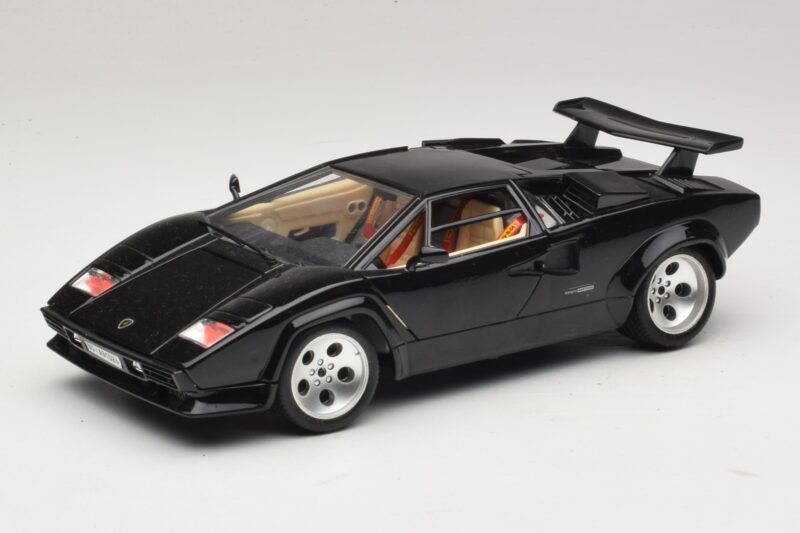
TL;DR: Bburago's 1:18 diecast Lamborghini Countach 5000 Quattrovalvole reproduces the 1988 wedge supercar in black, with an articulated body and the flat-plane proportions that made the Countach the defining bedroom-poster car of the 1980s. A mass-market casting that puts Bertone's angles within reach of a standard budget.
No car defined the 1980s supercar silhouette quite like the Countach. Marcello Gandini's wedge, scissor doors, and NACA ducts turned Lamborghini's flagship into a shape traced in countless notebooks long before most of its admirers ever saw one in person. Bburago's diecast rendition puts that geometry on a shelf at a fraction of the original's cost.
Angular, creased bodywork is friendlier territory for a die than a rounded shape, and the Countach's flat planes and sharp creases let Bburago's zinc alloy casting hold crisp panel lines along the full length of the body. The black paint reads deep and glossy on the hard metal shell, and the wedge profile, low nose, and signature NACA ducts along the flanks come through clearly even at this entry tier. Mass helps here too: the model carries real weight off the shelf, which suits a car whose entire reputation rested on looking impossibly low and wide. Resin specialists can chase even sharper edges on a casting like this, but the difference shows mainly under raking light rather than from normal viewing distance.
The body articulates, and the Countach is one of the rare subjects where opening a door is actually part of the car's own story rather than an added feature. The real car's scissor doors swing upward rather than outward, and Bburago's casting mirrors that motion, lifting on its hinge and holding its position rather than swinging loose. It is a small mechanical detail, but on this particular car it is also the single most famous party trick in the supercar world, and seeing it reproduced at 1:18 is part of why this casting has stayed in catalogs for so long. Keep the hinge area free of dust buildup, since that is where a diecast joint shows wear first over years on a shelf.
Marcello Gandini drew the original Countach for Bertone in the early 1970s, and the car stayed in production with steady updates through the 1980s. The 5000 Quattrovalvole, built from 1985, added four valves per cylinder to the V12, a larger 5.2 liter displacement, and more aggressive NACA duct intakes feeding the engine bay. By the time this 1988 example rolled off the line, the Countach had spent nearly two decades as the car every poster on a bedroom wall seemed to feature, output and drama outweighing outright practicality at every turn. Few other supercars managed to stay visually relevant across that long a production run without a full redesign, which is itself part of the car's standing today.
Bburago has cast the Countach for decades, and it remains one of the brand's longest-running tools precisely because the shape still sells on sight. Collectors wanting a hand-finished resin alternative will find pricier specialist options elsewhere, built with tighter tolerances and smaller production runs, where every seam and NACA duct edge gets individual attention. What this casting offers instead is the same unmistakable silhouette at a price that lets a newer collector start an exotic shelf without committing investment-tier money to a single car, and the zinc alloy build means it survives handling at car shows and swap meets better than a delicate resin piece would.
Black is a less common finish for Countach diecast than the reds that dominated period marketing, which makes this casting a useful contrast piece next to a red example or a Testarossa in a themed Italian wedge-car display. At 1:18 the long, low proportions command real shelf length despite the model's modest price, so plan cabinet space accordingly before ordering. Judge fidelity first at the nose and the door line, where a cheaper casting usually loses crispness before anywhere else, and this piece holds that line well. For a collector building a run of 1980s exotics on a realistic budget rather than chasing investment pieces, this is where that shelf starts, and it pairs naturally with later Lamborghini diecast as the collection grows.