Last one
Used

Lamborghini Murcielago R-GT #53 Reiter Engineering 24 Hours of Le Mans 2007 GT Spirit 1:18
Only 1 left
Price:
189.00 €
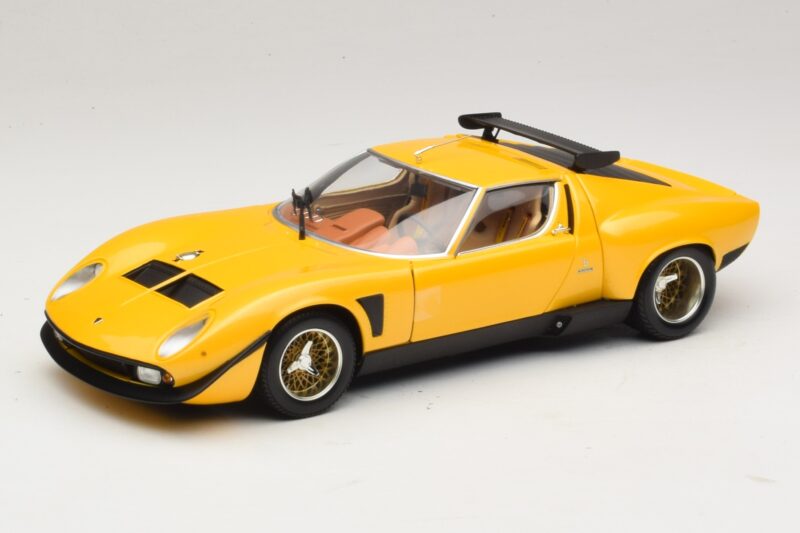
TL;DR: The Kyosho Lamborghini Miura SVR 1:18 is a diecast replica in Yellow & Black, representing the 1970 factory special version of the mid-engine V12 supercar. It combines metal weight with opening parts, measures about 24 cm long, and suits collectors building a 1970s Italian supercar shelf.
Few shapes sit as low and wide as the Miura's, and the Kyosho Lamborghini Miura SVR 1:18 leans into that with a Yellow & Black scheme that stresses every crease of the body. Lamborghini turned its V12 sideways behind the seats, a layout that explains the compact nose and the long, sloping tail any replica has to get right.
When the Miura appeared in the mid-1960s it rearranged what a road-going supercar could be. Marcello Gandini's work at Bertone wrapped a mid-mounted V12, installed transversely, in a body barely taller than a person's hip. Mounting the engine across the chassis shortened the car and pulled its mass inside the wheelbase, so the Miura carries its weight low and central instead of out front like the grand tourers of its day. That packaging is exactly what a 1:18 casting must convey: a nose that drops away quickly, a cabin pushed forward, and a rear deck stretching behind the roofline. Judge any Miura replica first from the side profile.
The SVR designation belongs to the Miura's factory-special branch, the cars that stepped beyond the standard road-going formula. For a collector the point is variety of subject. Standard Miura replicas are plentiful across scales, while an SVR gives a reason to own another Miura rather than a duplicate. The differences from a standard coupe live in details rather than in the overall silhouette, so keep reference photographs of the real car beside the model when you compare. Check the wheels and the stance first, then move to the finer exterior hardware. That order catches most inaccuracies quickly.
Lift the model clear of its packaging and the zinc-alloy body announces itself: a 1:18 diecast this size is dense and cool in the hand, with a heft resin pieces of the same scale do not carry. That mass has a practical side. Metal tolerates handling and holds its shape for decades, and a hard metal shell supports a deep, even gloss. Yellow is a demanding color because it exposes every ripple in the surface, so inspect the finish under a direct lamp. The black areas of the Yellow & Black scheme make a useful test, since crisp edges between the two colors say more about finishing than any catalog photograph. The honest trade-off: diecast tolerances run broader than resin, so expect panel gaps a shade wider than on a sealed resin casting.
This model has opening parts, and that changes how you evaluate it. A hinged panel at this size should travel through its arc without wobble and return flush to the body. Cycle each panel a few times and check that the shut lines close evenly, because a gap that looks fine closed can reveal a mismatch once opened. Handle the model by the body, never by a hinged panel, since small hinges carry little load against so much metal. Display it closed for dust protection and open it only for photography or inspection. That routine keeps the paintwork at the edges, where fingers touch most, in good condition for years.
At 1:18 a Miura comes out near 24 cm in length, which slides comfortably into a standard cabinet row with room for a neighbor on each side. The scale is large enough to carry fine exterior detail, from the slatted rear treatment to the lamp surrounds, yet small enough that a collector can build a genuine run of cars without surrendering a whole wall. Compared with 1:43, the 1:18 format gives you wheel and glass detail you can actually study, and the weight gives the piece a presence a smaller model cannot match.
Lighting decides how this livery reads. A single directional spotlight lifts the yellow and deepens the contrast with the black panels, while flat overhead light washes the shape out. Keep the model away from direct sunlight, which is hard on any painted surface, and dust it with a soft brush rather than a cloth. Leave a few centimeters of clearance on each side so the wide stance has room to read as a silhouette.
A Miura SVR rarely sits alone. Its natural neighbors are other Gandini and Bertone shapes from the same decade, and a wedge-profile rally car beside it makes a pointed contrast between road-going excess and competition purpose. A Lamborghini row built across several models shows how quickly the brand's design language evolved after this car. In tier terms this is mid-tier diecast: more refined than mass-market pieces, below hand-assembled investment-grade work, with moving parts as the practical bonus. Buyers who want a 1:18 Miura with real mass and something to handle will find it a sensible choice, and anyone ready to order should confirm the Yellow & Black scheme is the version they want, since the SVR is a distinct variant rather than a recolored standard car.