New arrival
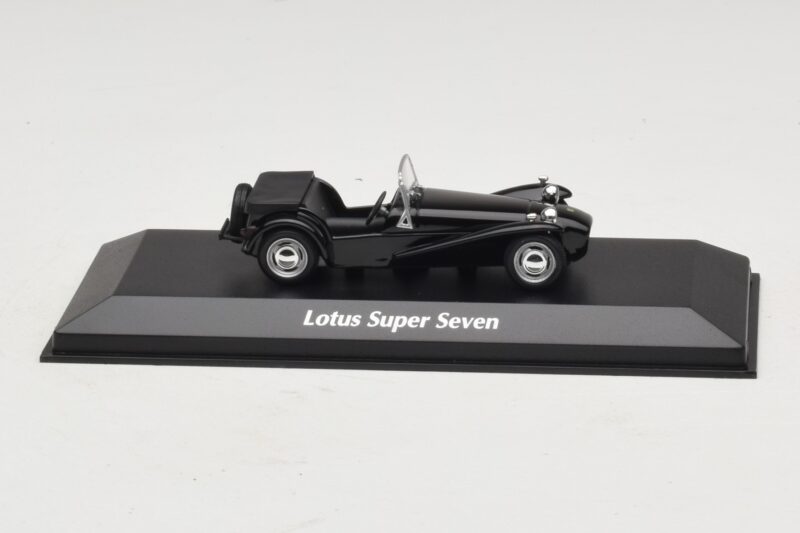
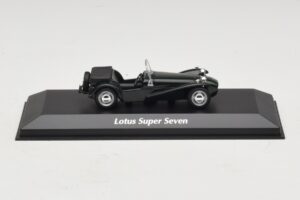
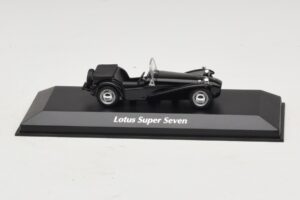
TL;DR: The Maxichamps Lotus Super Seven Black 1:43 is a diecast replica of the 1968 open-top roadster, cast as a sealed one-piece body. Its appeal sits on the outside: the exposed wheels, slim cycle-style wings, Black paint and minimal cockpit. It suits collectors of lightweight British sports cars who want a compact, display-ready piece.
Few cars state their purpose as plainly as the Seven. Colin Chapman's roadster was stripped to what a driver needs, and the Super Seven name was carried by the higher-specification cars. Maxichamps models the 1968 car at 1:43 in Black, where a minimal subject is shown at its most graphic.
The real Seven carries almost no bodywork, which suits a sealed model well. This casting has no opening parts, so the evaluation falls on layout: the long hood line, the cutaway cockpit sides and the short tail. At 1:43 the whole car is only about 8 cm long, and everything depends on how cleanly those few shapes are drawn.
Exposed wheels are the test. With no full-width fenders hiding them, the front wheels, tires and thin cycle-style wings form the front of the car's character. Check that each tire sits centered under its wing and that the thin wing edges stay uniform in thickness from front to back.
Black is the hardest color to judge on a diecast body, because it magnifies every surface flaw and shows dust within days. A good finish reads as deep and even, with the lamp reflection staying smooth as it crosses the hood and cockpit sides. Zinc-alloy diecast gives a small car real weight, and the hard shell holds paint without the flex of lighter materials.
Where cast resin would offer slightly sharper thin edges, diecast offers durability, and for a car this small and this simple, durability counts. Printed details such as badges or lamp rims should keep their outlines without bleed. Magnification along the shoulder and nose is the quickest check.
Colin Chapman introduced the Seven in 1957 as a stripped, lightweight road-and-track car, and the guiding idea of adding performance by subtracting weight is widely attributed to him. The design outlived its first producer: Lotus sold the rights to Caterham in 1973, and the Seven shape continues in the market in various forms. The 1968 date places this model firmly in the Lotus period, a few years before that handover.
Small cars gain from small scales. At 1:43 a Seven stays only a few centimeters tall, and a shelf of lightweight sports cars from this era sits comfortably in a single cabinet row. The format also flatters the car's simplicity: with no large body surfaces to detail, a good model can match the original's visual economy. Compared with 1:18 versions, you trade fine detail resolution for breadth, which suits collectors building a theme rather than a hero piece.
A sealed body also means fewer fragile elements stand clear of the casting, which makes handling less risky when you move the model between shelves.
A Black Super Seven makes a graphic centerpiece for a British lightweight row, where it contrasts with brighter colors and with larger grand tourers. It also pairs naturally with other 1960s roadsters, since the exposed layout of an open car shows its proportion at a glance. Place the case away from direct sun and keep a soft brush on hand, because black shows dust early. At an accessible diecast tier, it makes a sensible first Lotus for a small-scale shelf, or a counterweight to heavier subjects. Anyone who wants to order a simple, well-proportioned roadster will find the sealed body keeps the focus where this car's appeal has always lain: on its minimal shape.