Used

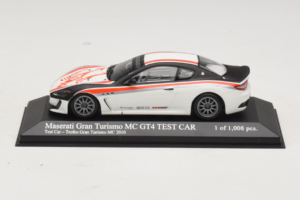
Maserati GranTurismo MC GT4 #6 Goldstein / Sumberg Trofeo GranTurismo 2010 Minichamps 1:43
Only 2 left
Price:
37.00 €
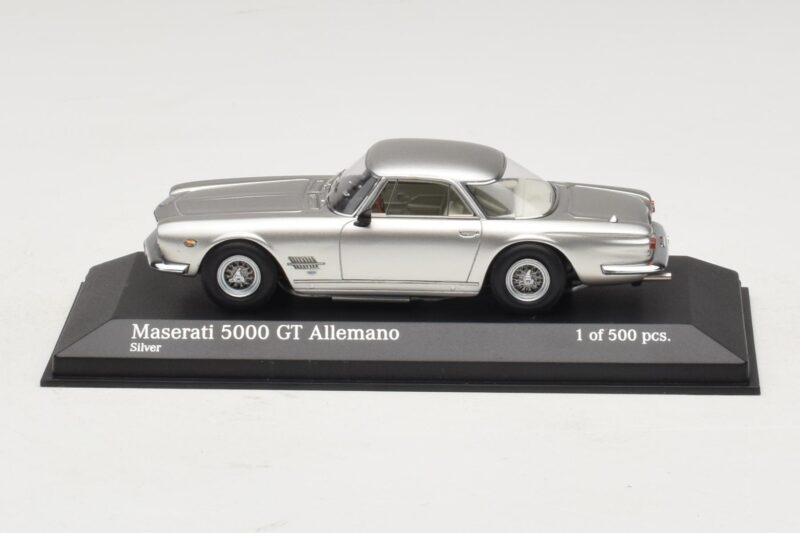
TL;DR: Minichamps' 1:43 Maserati 5000 GT reproduces the 1962 Allemano-bodied grand tourer in silver, cast in zinc alloy as a sealed one-piece body. Built originally in tiny numbers for private commission, the 5000 GT anchors a coachbuilt Maserati display with restrained proportions and deep, evenly finished paint.
Before Maserati standardized its GT bodywork, wealthy clients ordered the 5000 GT as a rolling commission, each example finished by a coachbuilder of the buyer's choosing. Allemano built more of these than any other house. Minichamps' 1:43 rendition puts that bespoke era on a shelf, small enough to display a dozen alongside it, precise enough to reward the closer look a coachbuilt Maserati deserves.
Maserati built the 5000 GT on the 3500 GT's platform but powered it with a V8 derived from the 450S racing program, tuned down for road use, and offered it only to private commission. There was no fixed catalog body. Buyers picked a coachbuilder, and the results ranged from Touring's flowing lines to Frua's sharper creases to Ghia's more angular treatment. That variety is part of why the 5000 GT still draws attention from collectors who specialize in bespoke commissioning carried into the postwar decades: no two cars from the run look quite alike, and each one reflects a client's specific taste rather than a factory brief.
Of the roughly three dozen 5000 GTs built through the early 1960s, Allemano bodied more than any competing house, and its interpretation became the closest thing the model had to a default look: a low, restrained roofline with a formal three-box profile that reads as understated rather than flamboyant. Minichamps chose the Allemano body for this reproduction, which places it closer to the mainstream of the run than a Frua or Ghia example would be. The silver finish suits that restraint, favoring the car's proportions over the flash a brighter color would invite.
At 1:43, a car this size comes out under 10 centimeters long, small enough that fine panel definition depends entirely on how tightly the die was cut. Minichamps casts the 5000 GT as a sealed, one-piece zinc alloy body, with no doors or hood hinged to open. That construction removes the tolerances a moving panel would demand, so the shoulder line above the rear wheel arch and the crease running the length of the door stay crisp rather than softened by a seam. The tradeoff is straightforward: no interior access, but a body that holds its shape and its lines through years of handling.
Zinc alloy takes paint differently than the resin used on many larger-scale reproductions. It sits on a harder, less porous shell, so the gloss reads deeper and more even, and at this size that matters more than it might on a 1:18: there is less surface area to carry the finish, and any inconsistency shows immediately under a light. The silver Minichamps applies here favors a slightly cool cast rather than a warm pearl, appropriate to a formal early-1960s Italian GT. Chrome window surrounds and the grille detail are picked out cleanly against it, which is where a small-scale casting either holds up or falls apart on close inspection.
The appeal of 1:43 for a subject like the 5000 GT is straightforward: it lets a collector build out Maserati's coachbuilt decade without needing a wall of shelving. A dozen 1:43 GTs from the late 1950s and early 1960s, each from a different coachbuilder, fit in the space a single 1:18 hero piece would need, and that density is exactly what makes the scale attractive to collectors who specialize by era rather than by single model. Display it at eye level rather than from across a room; the scale rewards close inspection more than distance viewing, and the silver finish shows its depth best under a focused light rather than ambient room lighting. Dust is the main enemy at this size, since small-scale detail hides less of it than a larger casting would, and a case or cabinet earns its keep here. Judging fidelity on a subject this obscure comes down to a few checkpoints: the roofline's rake, the placement of the Maserati trident badge, and whether the grille shape reads as Allemano's interpretation rather than a generic period grille. Minichamps has built a reputation on getting exactly those details right at small scale.
This is not a subject most collectors will already own. The 5000 GT sits well outside the Ferrari and Lamborghini names that dominate most GT collections, and that obscurity is precisely its value to a specialist shelf: it rewards someone building a Maserati chronology or a survey of Italian coachbuilders rather than someone chasing the most recognizable badge. At a mid-tier diecast price point, it offers a level of finish that a hand-built resin piece at several times the cost would only modestly improve on, given how little surface area a 1:43 model actually presents. Pair it with a Frua or Ghia-bodied 5000 GT from the same era, if one turns up, and the differences between coachbuilders become the display's entire point.