Used

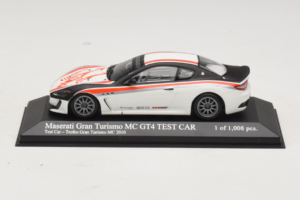
Maserati GranTurismo MC GT4 #6 Goldstein / Sumberg Trofeo GranTurismo 2010 Minichamps 1:43
Only 2 left
Price:
37.00 €
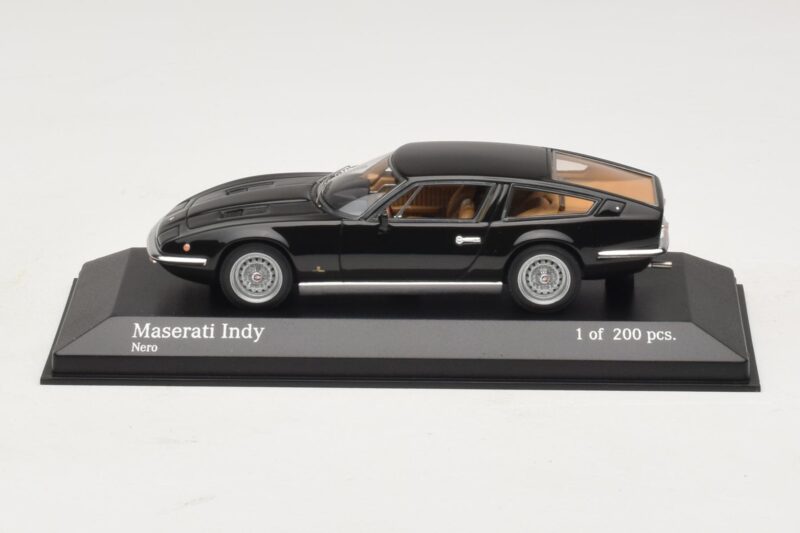
TL;DR: Minichamps' 1:43 diecast Maserati Indy in black reproduces the 1970 Vignale-styled 2+2 grand tourer, a front-engine GT named after Maserati's Indianapolis 500 wins. Cast as a sealed zinc-alloy shell with no opening panels, it favors tight, continuous shut lines and deep black paint over interior access.
The name is a tribute, not a place. Maserati called this 2+2 the Indy after Wilbur Shaw's back-to-back Indianapolis 500 wins in 1939 and 1940, driving an 8CTF built decades before this Vignale-bodied grand tourer took shape. Minichamps renders the production coupe in black, a color that shows off the Vignale roofline's long fastback taper better than almost anything else in the catalog.
Maserati built its Indianapolis reputation before the Indy road car existed. Wilbur Shaw won the 500 in 1939 and 1940 driving an 8CTF, the only European marque to win back-to-back at the Brickyard until an American streak was broken decades later. When Maserati needed a name for its new front-engine 2+2 in 1969, that Indianapolis history was the obvious choice, a nod to competition success rather than any connection to the city itself. The Indy carried that racing pedigree into a road car built for long-distance touring rather than lap times, a shift in mission the name quietly acknowledges.
Giovanni Michelotti penned the Indy's lines while working for coachbuilder Vignale, giving the car a long fastback roof and a low, wide grille distinct from Maserati's earlier Frua and Touring-bodied GTs. Unusually for the marque, the Indy used a steel monocoque rather than the tubular chassis that underpinned the Ghibli and Mexico, a construction choice that improved rigidity for a genuine four-seat cabin. The V8 sat well back in the engine bay, and the resulting weight distribution gave the Indy a more relaxed character than its two-seat siblings, a grand tourer built for covering distance rather than chasing a lap record.
Lift this model from its case and the zinc alloy announces itself immediately. It carries genuine heft for a 1:43 piece, denser than a resin casting of the same size, and that mass is part of what makes small-scale diecast satisfying to handle. Minichamps casts the Indy as a single sealed body, so no door, hood, or trunk panel breaks the surface. That construction choice removes hinge tolerances from the equation entirely, and the payoff shows in the shut lines: the door creases and trunk seam read as continuous, sub-millimeter grooves rather than gaps, running unbroken from the windshield pillar to the tail.
Black is an unforgiving color on a small-scale model, since every wave in a casting shows under a spotlight where a lighter shade would hide it. Minichamps' finish holds a deep, even gloss across the Indy's long hood and fastback roof, and because the body has no opening panels to interrupt it, the paint reads as one unbroken surface from nose to tail. Under a shelf light, that continuity is exactly where the Vignale roofline earns its keep: the taper from greenhouse to tail shows as a single clean line rather than a series of interrupted panels.
At 1:43, the Indy comes out to roughly 10 centimeters long, a footprint that fits a standard cabinet shelf several rows deep without crowding neighboring pieces. That compactness is the appeal of the scale: a collector can build out an entire Maserati road-car chronology, Indy alongside Mexico, Ghibli, and Mistral, in the space a single 1:18 grand tourer would occupy. The trade-off is detail resolution. A 1:43 casting simply cannot carry the same depth of interior trim or underbody detail that a larger scale allows, so the model's case rests on proportion, paint, and the accuracy of its exterior lines rather than cabin furnishing. Minichamps has built a long-standing reputation on getting those exterior proportions right across a wide range of postwar and classic-era subjects, and the Indy's long hood-to-cabin ratio and fastback taper are the kind of details that separate a well-judged 1:43 from a generic toy-scale approximation. Displayed under a single directed light, the black paint's depth and the unbroken shut lines are what a practiced eye checks first, well before questions of opening features even come up.
The Indy occupies a specific niche in Maserati's road-car history: a genuine four-seat GT built between the two-seat Ghibli and the more angular Bora that followed, proving the marque could build comfortable long-distance transportation without abandoning performance. For a collector assembling a Maserati chronology by decade, the Indy in black is a natural anchor for the early 1970s, sitting comfortably next to a Mistral from the prior decade or a later Bora. Minichamps' 1:43 diecast puts that history within easy reach at a price well below any 1:18 equivalent, without asking the collector to sacrifice the proportional accuracy that makes a small-scale grand tourer worth displaying at all. A sealed body and a deep black finish are the trade a buyer makes here, and for anyone building a themed shelf rather than a single hero piece, it is a trade worth making.