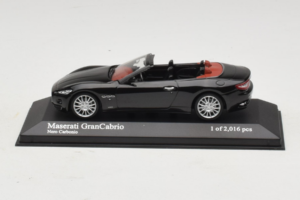
Used

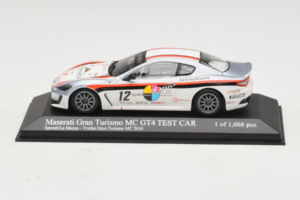
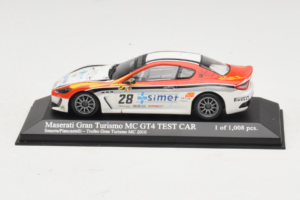
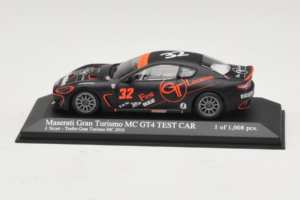
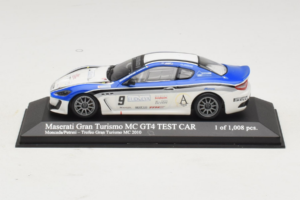
Maserati GranTurismo MC GT4 #6 Goldstein / Sumberg Trofeo GranTurismo 2010 Minichamps 1:43
Only 2 left
Price:
37.00 €
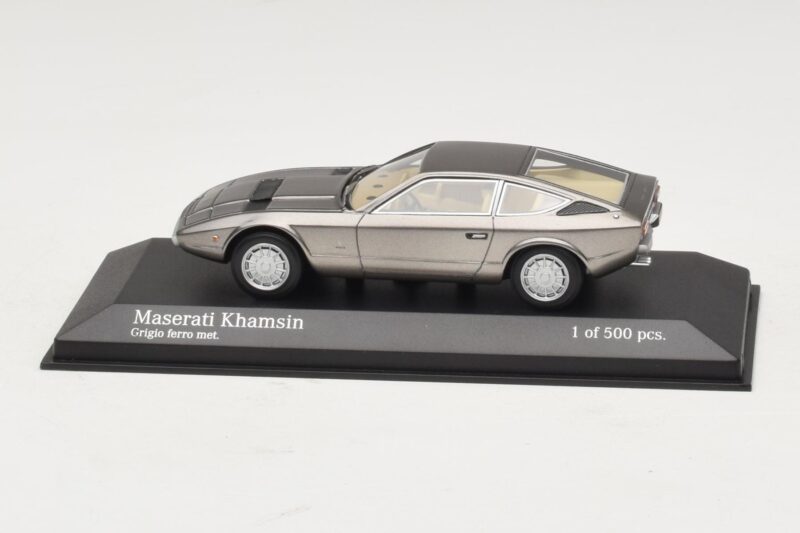
TL;DR: Minichamps' 1:43 Maserati Khamsin in grey metallic reproduces the Bertone-styled GT that Marcello Gandini designed in the early 1970s, cast in diecast with a sealed one-piece body. The wedge profile and glass-panel tail lamps carry cleanly at this compact scale, marking the era when Citroën ownership brought hydraulic assistance to Maserati's steering, brakes, and clutch.
Marcello Gandini spent the early 1970s reshaping Italian design at Bertone, and the Khamsin arrived alongside the Lamborghini Countach as one of his most uncompromising wedge shapes. Minichamps' grey metallic casting keeps that severity intact, and the sealed diecast body means the tail's glass panel, one of the Khamsin's signature details, sits fixed and undistorted rather than hinged.
The Khamsin replaced the Ghibli in Maserati's lineup in the mid-1970s, arriving during the period when Citroën held effective control of the marque and brought its own engineering philosophy into a traditionally Italian GT. Gandini's brief was to modernize the silhouette without abandoning the long-hood, short-deck proportions that defined every Maserati road car since the Frua-bodied cars of the 1960s. His solution was a sharper, more angular nose than the Ghibli's rounded front, paired with a distinctive rear treatment where the taillights sit visible behind a glass panel rather than mounted directly on the bodywork, a detail that still reads as unusual decades later.
Citroën's ownership left its clearest mark under the skin rather than on the surface. The Khamsin used Citroën-sourced hydraulics to power its steering, brakes, and clutch, a system borrowed from the SM and applied to a car with a traditional front-engine, V8 layout rather than the SM's own configuration. That combination gave the Khamsin unusually light controls for a car of its weight and era, a contrast to the heavier, more mechanical feel typical of Italian GTs from the same period. None of that hydraulic plumbing is visible on the exterior this casting reproduces, but it explains why period road testers described the Khamsin's controls as uncharacteristically effortless for a Maserati.
Gandini's wedge design relies on long, flat panel surfaces meeting at sharp, precisely defined creases, exactly the geometry a sealed diecast body reproduces most faithfully. Minichamps casts this Khamsin without a working hood, door, or trunk, which means there is no hinge tolerance to soften those creases or interrupt the line running from the leading edge of the front fender to the base of the glass tail panel. The rear treatment in particular depends on that continuity: the glass insert covering the taillights has to sit flush with the surrounding bodywork to read correctly, and a fixed one-piece casting achieves that flush fit more reliably than a hinged panel design would at this scale.
Grey metallic suits a design this sharp, since the flake catches light differently along each distinct plane of Gandini's creases, making the wedge shape more legible under a shelf spotlight than a flatter, non-metallic color would allow. The sealed body lets that paint run as a single unbroken coat across the hood, fenders, and roof, so the color reads consistently from the front splitter to the glass tail panel with no seam to catch a shadow or a dust line. It is a quieter choice than the reds more commonly associated with Italian GTs, and it lets the design itself, rather than the color, carry the model's presence on a shelf.
At 1:43, the Khamsin comes out to roughly eleven centimeters, long enough for Gandini's proportions, that long hood and short, sharply cut tail, to remain legible even at this reduced size. This is exactly the kind of design where scale matters: a wedge shape depends on clean, uninterrupted lines to read correctly, and any softening of those creases at a smaller scale can flatten the whole effect. Minichamps' resolution at 1:43 renders the character lines with enough sharpness that the design still communicates Gandini's intent, even though finer details like the grille mesh and the glass tail panel's texture are necessarily simplified compared to a 1:18 casting. Collectors assembling a survey of 1970s wedge-era design, spanning Bertone's work across Lamborghini, Maserati, and Lancia in the same period, find the Khamsin a useful anchor for that specific design movement rather than just another Maserati coupe. Anyone judging fidelity on this piece should start with the front fender crease and the glass tail insert, the two details that separate a faithful Khamsin from a generic 1970s coupe silhouette.
This Khamsin sits at an interesting hinge point in a Maserati collection, the last coupe designed before the marque's later, softer Biturbo-era styling took over, and one of only a few Maserati road cars to carry Gandini's signature rather than Frua's or Vignale's. Grey metallic gives this particular casting a restrained presence, useful for a collector who wants the design itself, rather than a bold color, to do the talking. Paired with a Mistral or Indy from the same era, it demonstrates how differently three Italian design houses interpreted the same basic GT formula within a few years of each other, and the sealed body's clean surfaces make photographing that comparison straightforward, with no panel gap or shadow line breaking up the silhouette in a group shot.