Used

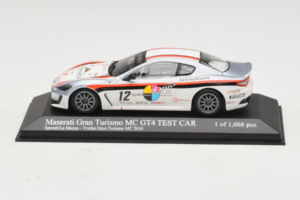
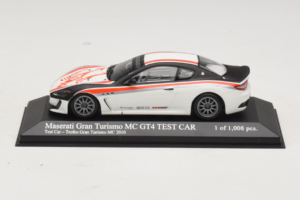
Maserati GranTurismo MC GT4 #6 Goldstein / Sumberg Trofeo GranTurismo 2010 Minichamps 1:43
Only 2 left
Price:
37.00 €
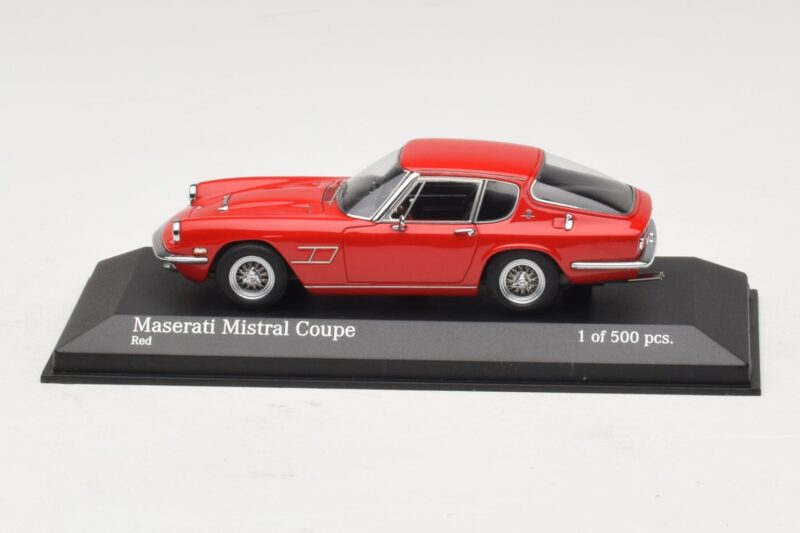
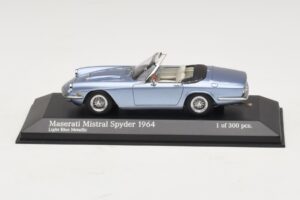
TL;DR: Minichamps' 1:43 Maserati Mistral in red reproduces Pietro Frua's early 1960s GT coupe, the last Maserati road car powered by a straight-six engine before the marque committed to V8s. Cast in diecast with a sealed one-piece body, this Mistral opened the wind-naming tradition that Maserati continued through the Ghibli and later the Khamsin.
Maserati's tradition of naming road cars after winds started here, with a coupe styled by Pietro Frua rather than the Bertone studio that later shaped the Khamsin. Minichamps casts this Mistral in red, and the sealed diecast body carries Frua's rounded, restrained surfacing without a single panel gap to interrupt its clean lines.
Pietro Frua styled the Mistral in the early 1960s with rounded, restrained surfacing that stood in deliberate contrast to the sharper, more angular Bertone designs that would define Maserati's next generation of coupes. The Mistral's long hood and tapering tail previewed proportions the Ghibli would later refine into a lower, more aggressive shape, making this coupe a useful transitional marker between Maserati's earlier, more conservative styling and the wedge-influenced designs Gandini would bring to the marque later in the decade. Where the later Khamsin leaned into sharp creases and a glass-paneled tail, the Mistral's surfaces flow more gently, a difference immediately visible when the two are set side by side.
Under that Frua bodywork sat a straight-six engine derived from Maserati's earlier racing programs, the last time the marque built a road car around an inline-six rather than the V8s and V6s that would define its later lineup. That engine choice reflects Maserati's engineering roots more directly than the V8-powered Khamsin or Indy that followed it, tying the Mistral to a mechanical lineage stretching back to Maserati's competition cars of the 1950s. For a collector interested in engineering history rather than just styling, the Mistral marks a genuine turning point in what a Maserati road car mechanically was.
Frua's surfacing depends on subtle, continuous curvature rather than the sharp creases a Gandini design demands, and a sealed one-piece body serves that kind of shape particularly well, since there is no hinge line to interrupt a curve that is supposed to read as one smooth transition from fender to door to rear quarter panel. Minichamps casts this Mistral without a working hood, door, or trunk, letting the roofline sweep down into the tail exactly as Frua intended, with no panel gap breaking the profile at any point along the car's length. That continuity matters more here than on a sharper-edged design, where a slight gap would be less noticeable against an already broken-up surface.
Red paint suits the Mistral's rounded surfacing differently than it does the Khamsin's angular creases, since gentle curves catch light in soft gradients rather than sharp highlights, giving this casting a warmer, more classical presentation than a wedge-shaped contemporary would offer in the same color. Because the body is sealed and cast as a single piece, that red runs continuously from the nose to the tail with no seam anywhere along Frua's flowing lines, letting the paint's depth carry the full length of the design without interruption. It is a color choice well suited to a coupe whose appeal always rested more on proportion than on aggression.
At 1:43, the Mistral measures close to ten centimeters, a size that renders Frua's gentle curves faithfully even at reduced fidelity, since rounded surfacing generally translates more forgivingly to smaller scales than a design dependent on razor-sharp creases. This compact footprint suits a collector building a chronological survey of Maserati coupes across three design eras, Frua's rounded 1960s work, Gandini's angular 1970s wedges, and the later, softer Biturbo generation, without needing the shelf space a full 1:18 set of the same subjects would demand. Detail resolution at this scale simplifies elements like the wire wheel covers and grille slats into fine relief, a normal compromise that a design this smoothly surfaced absorbs better than a sharper-edged coupe would. Judging this casting's fidelity starts with the roofline's taper toward the tail and the proportion of the greenhouse relative to the hood, the two elements that most clearly signal Frua's hand rather than a generic 1960s GT silhouette, and getting that taper right is what separates a convincing Mistral from an anonymous period coupe at this scale, a distinction worth checking closely before adding this piece to a serious design survey.
This Mistral matters to a Maserati shelf as the origin point of the wind-naming tradition that the Khamsin later carried forward, and as the last road car built around the straight-six engine that defined the marque's earlier competition heritage. Set beside a Khamsin or an Indy, it demonstrates how far Maserati's design language and engineering both traveled within a single decade, from Frua's rounded restraint to Bertone's sharp wedges and the switch to V8 power. Red gives this particular casting a classic presence that suits the coupe's straightforward, unpretentious proportions. At this scale and diecast construction, tracing that whole design and engineering arc across several Maserati generations costs a fraction of what assembling the equivalent full-size or 1:18 lineup would require, making it an efficient way to build real automotive history into a shelf rather than just a collection of pretty shapes.