Used

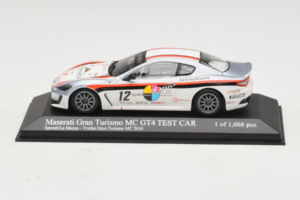
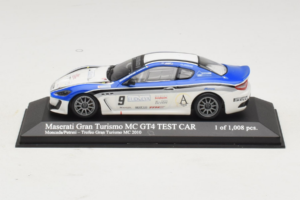
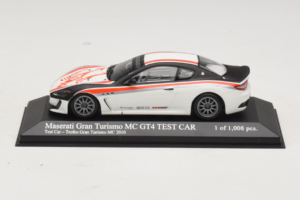
Maserati GranTurismo MC GT4 #6 Goldstein / Sumberg Trofeo GranTurismo 2010 Minichamps 1:43
Only 2 left
Price:
37.00 €
This model is currently sold out. Enter your email and we'll let you know when it's back in stock.
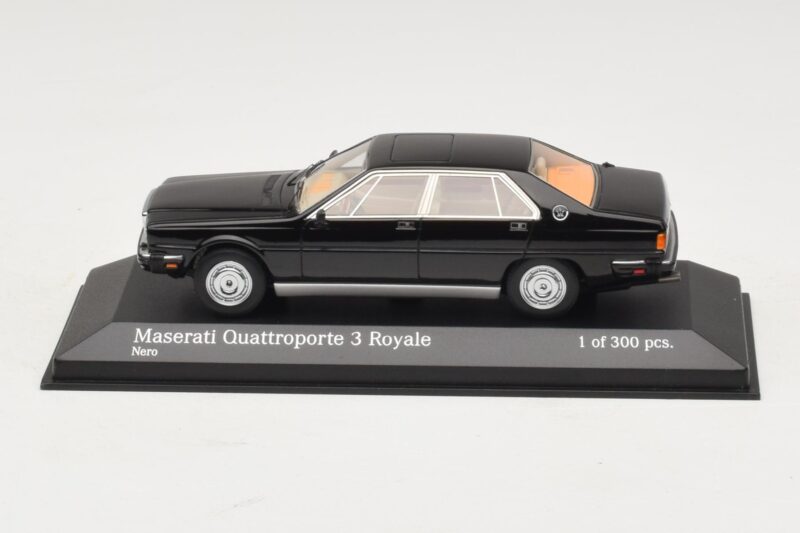
TL;DR: Minichamps' 1:43 Maserati Quattroporte III Royale reproduces the 1989 flagship sedan in black, a Marcello Gandini-styled De Tomaso-era Maserati cast in sealed one-piece zinc alloy. The Royale was the range's top trim, and this diecast anchors a formal luxury-sedan display distinct from typical GT shelves.
The Quattroporte III rarely gets discussed alongside Maserati's sports coupes, yet it was the marque's flagship for over a decade, and the Royale sat above even that as the most lavishly trimmed version De Tomaso-era Maserati offered. Minichamps' 1:43 diecast puts that formal presence in black, the color most Royales actually wore, on a shelf built for stately rather than sporting Italian iron.
Maserati built the Quattroporte III from 1979 to 1990, under Alejandro de Tomaso's ownership of the marque, and commissioned the body from Marcello Gandini working through Italdesign. Gandini's brief here was restraint rather than the wedge-shaped drama he brought to the Countach or the Stratos: long, flat flanks, a formal grille, and a low beltline that reads as executive transport rather than sports car. The V8 under the hood, a 4.9-liter unit shared conceptually with Maserati's coupes, gave the sedan real performance for its size, but the styling never advertised that fact. It is one of the more understated designs in Gandini's catalog.
Maserati introduced the Royale trim partway through the Quattroporte III's run, positioning it above the standard car with a more heavily upholstered interior, additional wood trim, and equipment aimed at buyers who wanted the most formal version available. By 1989, when this example was built, the Royale represented the final, most fully developed expression of the model before the Quattroporte IV replaced it. Black was a natural color choice for a car pitched at this level. It is the shade most period Royales left the factory wearing, and it matches the sedan's role as formal transport.
A sedan this size presents long, flat door and quarter panels, and holding those surfaces straight is a harder test for a die than the curved bodywork of a coupe. Minichamps casts the Quattroporte in zinc alloy as a sealed, one-piece body, with no doors or trunk that open. Without hinge clearances to account for, the die can hold those long panels dead flat, and the shoulder line running from the headlight to the taillight reads as one continuous edge rather than a line broken by a seam. That heft in the hand, typical of zinc alloy at any scale, suits a car built to feel substantial rather than light.
Black is an unforgiving color on any model, because a flat panel shows every imperfection in a way a curved, brightly colored surface can hide. On zinc alloy, which takes gloss more evenly than resin thanks to its harder shell, black paint sits deep and reflective if the casting underneath is clean. Minichamps' Quattroporte holds that test reasonably well: the panel gaps that exist elsewhere on the body read as fine lines rather than shadows, and the chrome window surrounds and grille stand out sharply against the dark paint rather than disappearing into it.
Most Maserati collections lean toward the Ghibli, the Bora, or the Merak, cars built to go fast and look the part. A Quattroporte III Royale does neither, and that is precisely its value on a themed shelf: it represents the side of Maserati's business that funded the sports cars, sold to executives who never intended to see a racetrack. Displaying one alongside a 1960s coupe or a Biturbo makes the point that Maserati was never only a sports car maker, and a 1:43 scale keeps that contrast compact. At roughly 11 to 12 centimeters for a car of this length, it sits comfortably among other sedans without dominating the display. Judging the fidelity of a formal sedan like this comes down to details a sports car does not have to get right: the straightness of the beltline, the crispness of the grille slats, and whether the proportions read as long and low rather than tall and boxy. Gandini's design gives Minichamps a genuinely distinctive shape to work from, not a generic three-box silhouette.
This is a model for a specific kind of collector: someone building a Maserati display broad enough to include the marque's formal side, not just its sports cars. At Minichamps' mid-tier diecast pricing, it costs considerably less than a hand-built resin luxury sedan and delivers finish that holds up at 1:43 scale, where the smaller surface area works in the model's favor. It will not anchor a display the way a 1:18 hero piece would, but it does something a sports car cannot: it explains why the marque could afford to build the Bora and the Ghibli in the first place.