Last one
Used
TL;DR: The Maxichamps Mercedes 180 W120 Blue is a 1:43 diecast sedan of the postwar Ponton, dated 1955. The body is a single casting with no opening parts, so slab sides, bumpers and paint carry the model. A quiet counterpart to the 300 SL of the same decade for 1950s Mercedes shelves.
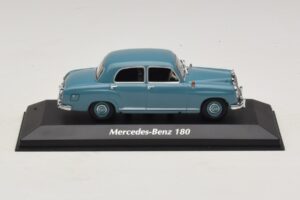
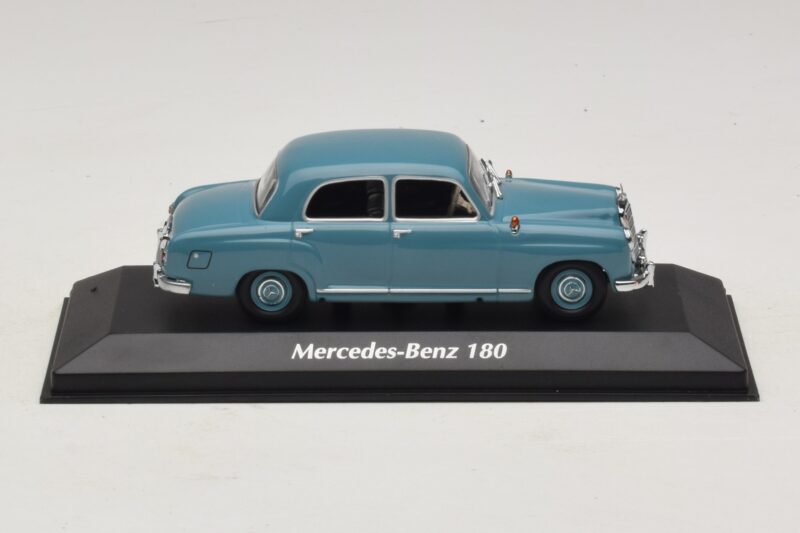
Flat, full-width flanks make the Ponton a demanding subject at any scale. The Maxichamps Mercedes 180 W120 1:43 in blue has large unbroken panels with nowhere for a poor paint job to hide, so it rewards a careful look. It is a postwar family sedan, not a showpiece, and the model treats it that way.
The nickname Ponton refers to the pontoon-style body, with the fenders merged into one continuous flank rather than standing apart as separate wings. On a 1:43 model, that continuous side is where the casting earns its keep: look along the beltline for an even crease, and check that the roof sits at the right height over the glass. The model has no opening parts, so doors and trunk are fixed grooves, and brightwork such as the bumpers and grille surround should stay crisp rather than melting into the body color. A large, simple surface makes any wobble visible.
Diecast gives the 180 a density that suits a car built to last. The zinc alloy shell holds its shape and keeps blue paint glossy over years, and the base sits flat on a shelf without rocking. Because the casting is one piece, no panel can sag or loosen with age, a small long-term advantage of a sealed shell. Casting edges are slightly softer than resin would deliver, so very fine details like window frames are simplified; judge them from normal viewing distance rather than macro range, where nearly every 1:43 model reveals compromises.
Mercedes launched the 180 in 1953 with a self-supporting body, a clear break from the separate-chassis construction of the prewar cars. The W120 designation belongs to the 180 sedan line, and the Ponton shape defined the company's family cars for the better part of a decade. It is the sedan that carried Mercedes through the postwar reconstruction years, and its calm, rounded form is the visual bridge between upright prewar cars and the sharper-edged sedans that followed. At 1:43 it runs roughly 10 cm long, compact enough that a full decade of Mercedes sedans fits one shelf.
The 1950s were also the decade of the 300 SL gullwing, introduced in 1954, and a shelf that holds both tells the era's two sides: the everyday sedan and the halo sports car. The brand sold them at the same time to very different buyers. Blue is a calm color that keeps the 180 from competing with a silver or red gullwing nearby. Placed together at 1:43, the sedan's height and width make the sports car look low and wide, which is the proportion lesson worth having on a shelf.
A 1950s Mercedes shelf built at 1:43 needs contrast, and the blue 180 supplies it. Alongside the 300 SL it gives the everyday half of the decade; alongside a later sedan it shows how quickly the shape moved from rounded to finned. Diecast at this accessible level is an easy route into postwar German sedans, and anyone who plans to buy a blue Ponton for such a run should look first at the flanks, since flat surfaces expose the paint. The limits are honest ones: no opening parts, simplified small details, and a color the listing gives only as Blue. Handle it by the base, and keep it out of direct sun.