Last one
Used
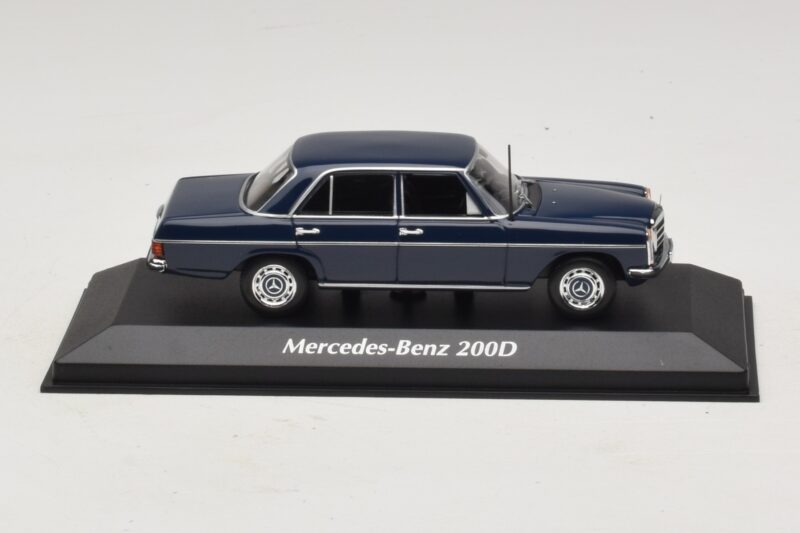
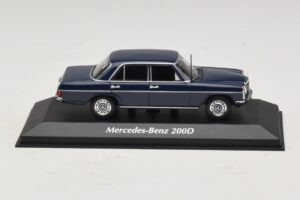
TL;DR: The Maxichamps Mercedes 200D W115 Blue is a 1:43 diecast sedan of the 1973 four-cylinder diesel in the Stroke Eight range. A sealed one-piece casting with no opening parts, it puts its quality in outline, wheel stance and blue paint. A lighter-toned companion to the dark green 200D for 1970s sedan shelves.
Blue changes the 200D's personality. Where dark green leans sober, the Maxichamps Mercedes 200D W115 1:43 in blue reads brighter and more civilian, closer to the family cars that filled German streets in 1973. It is the same compact diesel sedan, now in a color that stands out against beige and brown on a crowded shelf.
Mid-tone blue is a revealing color on a boxy sedan. The W115 has large, flat doors and a broad trunk lid, and the paint should lay down with an even gloss across them, without ripples or thin patches at the edges. Tilt the model beneath a lamp and follow the highlight along the beltline; it should run straight, not wander. Diecast supplies a hard, stable surface for the finish, which is why gloss on metal tends to look deeper than on lightweight plastic bodies. Wheel design and tire texture also separate one casting from another at this scale.
With no moving panels, quality is a matter of silhouette and fine edges. Compare the model to photographs of the real sedan in side view: roofline height, window shapes, the proportion between wheels and arches. Check that the glazing is flush and that the grille and bumpers carry crisp edges. Printed lights and badges are tiny at 1:43, so a modest magnifier helps. The sealed construction keeps cut lines uniform, a quiet strength of one-piece casting, and it means there is nothing to loosen or sag over the years.
Mercedes introduced the W114 and W115 family in 1968, and the Stroke Eight nickname comes from the /8 in the designations. The four-cylinder W115 sedans formed the volume end of that range, and the 200D was a diesel version. The product data dates this example to 1973, deep into a run that lasted until the mid-1970s, when the cars had already proven themselves as durable daily transport. None of that hardware shows on a sealed casting, but it explains the plain, practical look the model reproduces.
Most Mercedes shelves lean toward six-cylinder sedans, sports cars and limousines, so a four-cylinder diesel is a thoughtful contrast: it shows what the brand built for ordinary buyers. At 1:43 the body is about 11 cm long, small enough that a full decade of sedans from different marques fits comfortably in one case. Put it near a 1960s fintail and the shift from decorative chrome to plain flat surfaces becomes obvious. Keep it away from direct sunlight, which fades cardboard packaging and warms paint over time.
The blue and dark green 200D listings share a casting and differ by color, so the decision is about palette. Blue brightens a shelf of dark classics and photographs well; dark green suits a sober, period-correct mood. Either gives you the same sealed body, the same simplified small details and the same metal heft at an accessible price level. The trade-off is the usual one for 1:43 diecast: no opening parts and fine print that stays approximate. Buyers who want to buy this blue sedan to round out a 1970s lineup should check the stance and the window trim before anything else.