Last one
Used

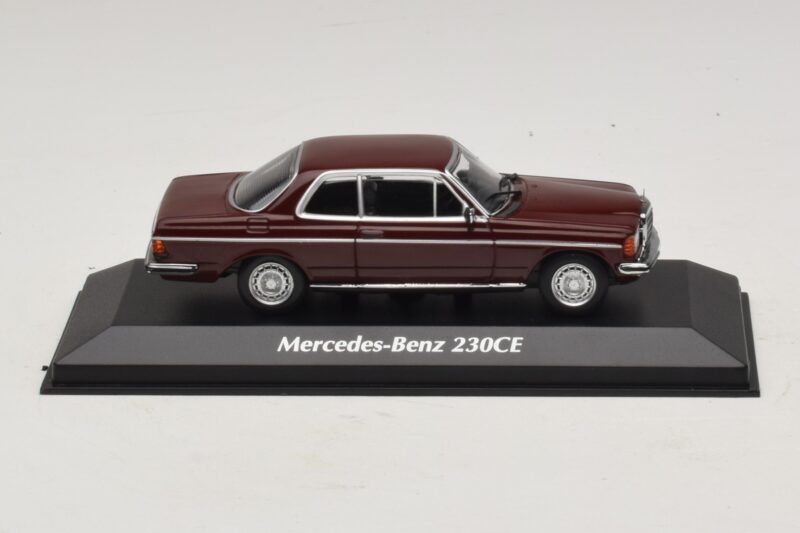
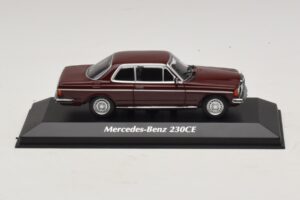
TL;DR: The Maxichamps Mercedes 230 CE C123 is a 1:43 diecast coupe in red, based on the 1980 two-door built on the W123 platform. The body is a one-piece casting with no opening parts, so its value sits in stance, glazing, trim and paint. A compact piece for 1980s German luxury shelves.
Red suits the C123. The Maxichamps Mercedes 230 CE C123 1:43 takes the coupe that Stuttgart sold alongside the W123 sedan and shrinks it to a size that fits a single cabinet shelf. It is a car of straight lines and low-key elegance, and 1:43 is a scale that lets you line several of them up.
This model has no opening parts, so the inspection happens on the outside. Start with the side view. The C123 rode a shorter wheelbase than the W123 sedan, and the balance between roofline, glass and rear overhang tells you quickly whether the casting is faithful. The real coupe had no B-pillar, so the side glazing should read as one long, clean opening, and the window frames and chrome surrounds deserve a close look. Doors, hood and trunk lid appear as fixed grooves in a single casting rather than working gaps. At 1:43 the car measures about 11 cm, so hold it near the eye.
Diecast brings mass that lighter plastic pieces lack: lift it and the weight is immediate for something this small. Paint sits on a hard metal shell, so the red reads deep and even under a display lamp, and the gloss keeps its shape over years. Zinc alloy casting tolerances run slightly wider than hand-cast resin, so edges are a shade softer, a fair exchange at this accessible segment. Red also shows dust and fingerprints faster than darker colors, so handle the model by its base and keep a soft brush nearby.
Mercedes built the C123 on the W123 platform, yet the coupe was a distinct body rather than a sedan with a door removed: shorter wheelbase, lower roofline and hardtop side windows without a center pillar. That is what makes it worth shelf space next to a W123 sedan. The two share a family face but not a silhouette, and at 1:43 the difference is easy to see side by side. American buyers often specialize by marque, and a run of 1980s Mercedes sedans and coupes is an easy chronology to build one car at a time.
The letters carry the engineering: C for coupe, E for Einspritzung, the German word for fuel injection, and 230 for the 2.3-liter four-cylinder engine. The product data places this car in 1980, in the 1980s era. The finish is a straightforward red, and no edition information is supplied, so this page claims no numbering or limited run. To judge authenticity, compare the wheel design and bumper trim against photographs of the real coupe. Those are the details a casting at this scale simplifies first, and they are quick to check.
The 230 CE suits a shelf of 1980s German luxury cars, or a Mercedes timeline that runs from the Ponton years through the W123 era. At 1:43 a dozen cars occupy the space of two or three larger models, so a row of coupes and sedans stays coherent rather than crowded. The honest trade-off is plain: the body is sealed, so there is no interior to open and no engine bay to study, and the appeal lives in outline and finish. Diecast at this level is an accessible way to own that outline. Anyone planning to buy this red coupe for a Mercedes lineup should look first at the stance and the glass; both are visible the moment the model leaves its case.