Last one
Used

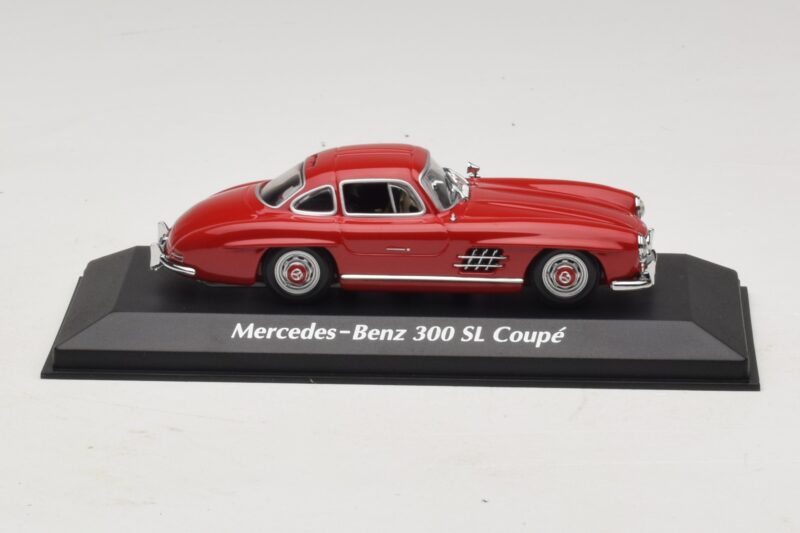
TL;DR: The Maxichamps Mercedes 300 SL W198 1:43 in red is a diecast model of the 1955 coupe. The body is one sealed casting, so the roofline, stance, paint and wheels carry the story. At roughly 10 cm it is a compact way to put a 1950s Mercedes sports car on the shelf.
The 300 SL is remembered for gullwing doors, yet on this Maxichamps casting nothing opens: the body is one sealed piece. That puts the weight of the model on its proportions, and the W198 has plenty to offer, with a long hood, a low nose and a roof that rises over the cabin like a cap.
On the real W198 the doors hinge from the roof, a solution forced by a tubular spaceframe whose high sills left no room for conventional doors. That is why the door cut climbs into the roof edge, and it is the first fidelity check on any 300 SL replica. Here the doors do not move, so the cut line has to do all the talking. Follow it with a fingertip and it should read as one continuous groove, with no step where the door meets the roof. A single casting keeps that groove even from end to end, because there is no hinge slack to widen it. Check the small brows above the wheel arches too.
Red on a 300 SL shows curvature better than most colors, since highlights slide along the fenders and hood in long unbroken streaks when the surface is smooth. Under a lamp, look for even coverage across the tops of the fenders, where paint tends to thin. Chrome trim and the grille are printed or applied at this scale, so judge them by crisp edges and correct placement rather than depth. Wheel and tyre fitment matters just as much: the car should sit low and level, tyres filling the arches without gaps that make it look jacked up. Zinc alloy gives a body of this size real heft.
Mercedes-Benz introduced the 300 SL coupe in 1954 as a road version of its racing sports car, and the W198 chassis code covers the gullwing production run. Its inline-six used fuel injection, advanced for a road car of the time, and the tubular spaceframe that stiffened the structure gave the car its signature doors. Those engineering choices explain the silhouette collectors want on a shelf: the doors, the long hood, the compact cabin. A sealed model reduces all of that to the exterior, which is why proportions are the thing to judge.
Roughly 10 cm long at 1:43, the model is small enough to stand beside other 1950s sports and touring cars without needing a large cabinet. A smaller scale means simplified interiors, so the cabin is seen through the glass as a color and a shape rather than a stitched leather space. That suits a sealed body well, since nothing invites you to look deeper. Shelf it where light can graze the hood and roof, which is where a 300 SL's curves are most legible.
Red is the natural color for a 1950s sports coupe, and it works as a focal point among darker grand tourers and silver cars from the same decade. Because the model is sealed, it handles easily and tolerates being moved between shelves, though a soft brush is still the right way to remove dust from the hood and glass. The honest trade-off is the one the product states: no moving doors, so the famous gullwing action is something you picture rather than perform. If you value shape, paint and shelf presence in a small package, it is a considered buy for a 1950s-era display.