Last one
Used
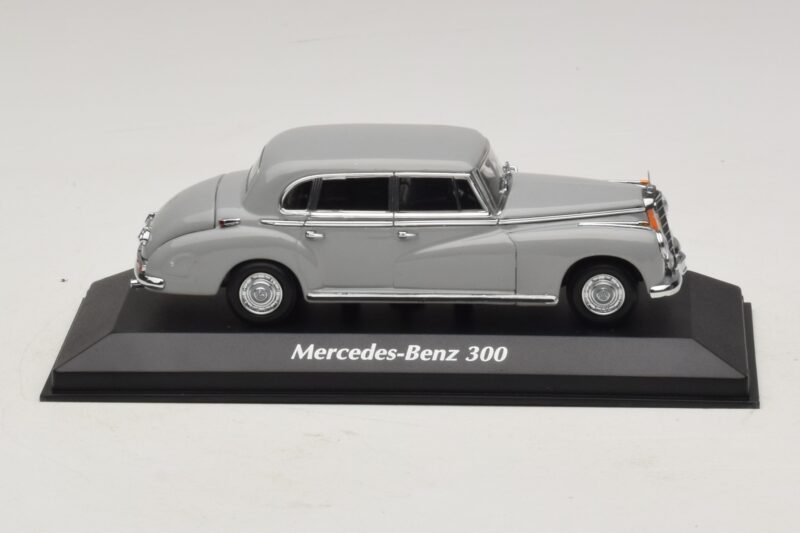
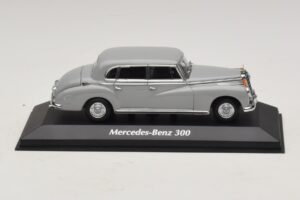
TL;DR: The Maxichamps Mercedes 300 W186 is a 1:43 diecast sedan in grey, modeling the 1951 flagship nicknamed the Adenauer Mercedes. The body is a sealed one-piece casting, so stance, grille, and paint depth carry the display. A formal postwar luxury piece for compact Mercedes shelves.
Few postwar German cars carried as much official weight as the 300. Introduced in 1951 as Mercedes' top sedan, it earned its nickname from Chancellor Konrad Adenauer, who used one. That upright, formal silhouette is quite different from the later Pontons, and in 1:43 grey it reads as sober and authoritative.
The W186 was a six-cylinder car of three liters, aimed at buyers who wanted the best Stuttgart offered in the early 1950s. Its styling still belongs to the prewar tradition: a tall greenhouse, a prominent grille, and fenders that flow rather than fold into the body. That makes it a useful contrast with the rounded 180 and 220 that followed. On a shelf, the 300 shows where the Ponton idea came from and how much the proportions changed within a few years.
Grey suits a formal car, and it works with the light rather than against it. A zinc alloy shell gives the paint a rigid base, so the surface tends to read smooth, with highlights tracing the long hood and fender lines. Lifted from its box, the model feels dense for its size. Mid-tier diecast does not match the razor-sharp edges of small-batch resin, so trim and lamp edges may look a shade softer, but the metal handles years of display and occasional rearranging without complaint.
This model has a fixed body with nothing that opens, so every judgment happens on the exterior. Begin with the height of the roof relative to the wheels, which defines the 300's formal stance. Then check the grille, bumpers, and headlamps, since a flagship sedan of this era relies on bright trim for its presence. Glazing should sit evenly in its openings, and the wheels should look tall and narrow rather than wide and modern. Get those right and the car reads as period correct from across the room.
Resin can hold finer edges and thinner window frames, which suits a tall greenhouse, while diecast offers weight, durability, and an accessible entry price. Neither approach is wrong. The buyer here is choosing robust metal and a sensible tier over the last degree of crispness.
At 1:43 the 300 is about a hand's width long, small enough to sit among a dozen other Mercedes without crowding. It works best as the earliest anchor in a chronological row, with rounded Ponton sedans, fintails, and later cars showing how the brand's idea of luxury changed. Grey keeps it understated, which means it pairs with almost anything and does not compete with brighter colors nearby. Expect clean proportions and honest finish at this tier, not hand-built micro detail. Collectors who focus on German luxury history will find it a pivotal, easy-to-place piece.