Last one
Used
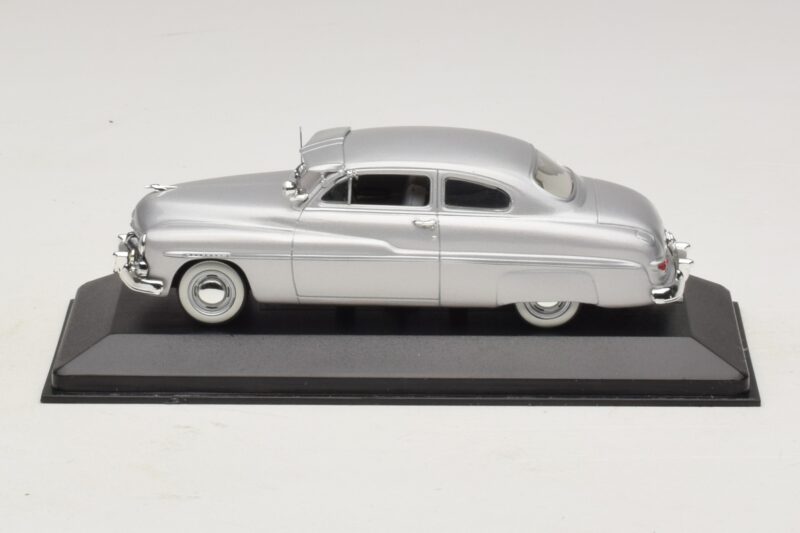
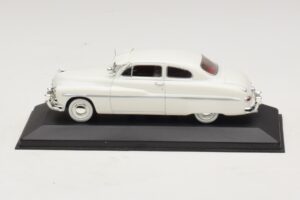
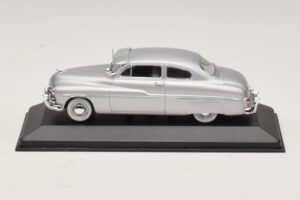
TL;DR: Minichamps' 1:43 diecast Mercury Monterey recreates the 1950 hardtop coupe in Silver, part of Mercury's early response to the pillarless hardtop body style GM popularized that era. The sealed one-piece body holds chrome window surrounds and period trim intact for a compact 1950s display piece.
Hardtop coupes were still a novelty in 1950, a body style GM had introduced only the year before to give buyers convertible looks without the top. Mercury answered quickly with the Monterey, a pillarless coupe wearing extra brightwork to mark its place atop the Mercury Eight range.
General Motors reshaped the mid-price field in 1949 when Buick, Oldsmobile, and Cadillac introduced pillarless hardtop coupes, cars that kept a convertible's open-window look while retaining a fixed steel roof. Ford's Mercury division moved fast to match the format, and the Monterey arrived in 1950 as its response, a top-trim hardtop built to look as expensive as the body style allowed. The absence of a B-pillar meant the side glass had to be engineered to seal properly without a frame to lean on, a genuine styling and engineering departure rather than a simple trim upgrade. Mercury's version carried extra brightwork around the roofline and windows to make the new silhouette feel intentional rather than stripped down.
Within the 1950 Mercury range, the Monterey sat at the top as the halo hardtop, priced and trimmed above the standard coupe and sedan body styles the Eight offered that year. It borrowed its mechanicals from the rest of the lineup, the flathead V8 and column shift familiar to Mercury buyers, while reserving its distinction for the roofline and interior trim. Collectors assembling an early-hardtop theme often pair the Monterey with its GM contemporaries to see how quickly the format spread across the industry.
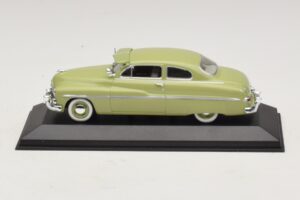
Minichamps' casting reproduces the Monterey's defining feature, the pillarless glass area, as a sealed shape with chrome surrounds standing in for the missing frame structure. That consistency matters more on a hardtop subject than on almost any other 1950s body style, since the whole design argument rests on how clean the glass area reads. The roofline carries its correct low profile without the thickened pillar a lesser casting might add for structural simplicity. Door creases and trim lines run as single continuous grooves rather than interrupted shutlines, keeping the hardtop's open, airy look intact at 1:43.
The Silver finish sits on a zinc alloy body, producing a cooler, flatter reflection than a lighter pastel would, appropriate for a color Mercury buyers actually ordered in volume that year. Metal casting brings real weight to a coupe this compact, a density collectors feel immediately next to a resin piece of similar size. Tolerances on a sealed body run tighter than on an articulated one, since nothing has to be left loose enough to swing open, and that tightness shows most clearly around the grille and bumper where brightwork meets body color.
The Monterey never carries the name recognition of a Cadillac or a finned late-decade classic, which is exactly why it suits a collector building a lineup around automotive turning points rather than celebrity cars. At 1:43, it sits comfortably alongside other early hardtops from the period without demanding a larger cabinet footprint, and its mid-tier diecast construction delivers accurate brightwork and panel lines without the premium price of hand-finished resin. Displayed next to a GM hardtop from the same year, the comparison tells its own story about how fast a styling idea traveled across Detroit in 1950.