Last one
Used
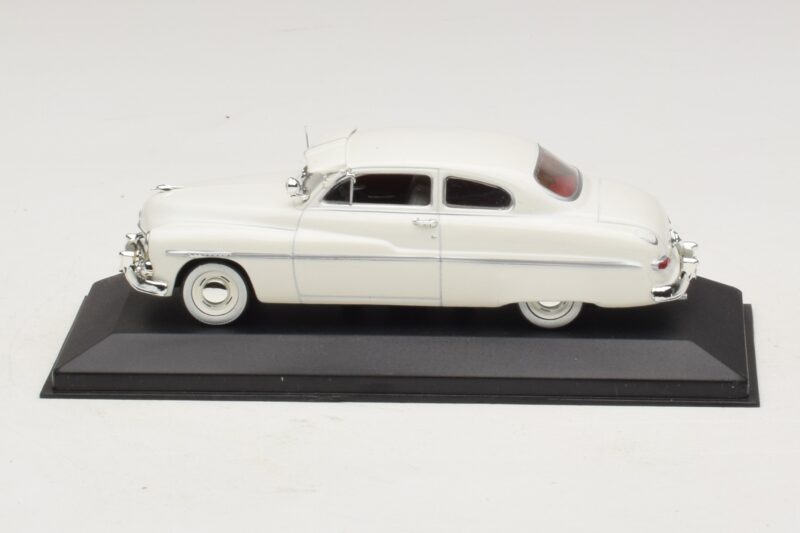
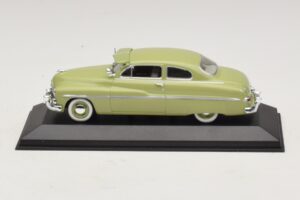
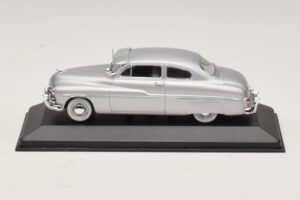
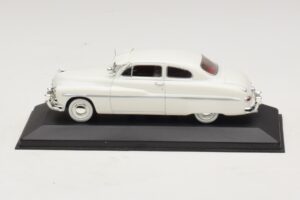
TL;DR: Minichamps' 1:43 Mercury Monterey in white diecast reproduces the 1950 coupe with a sealed one-piece body, rounded postwar styling, and deep gloss paint. A quiet, honest entry point for collectors building an early-1950s American shelf beyond the better-known Ford and Lincoln badges.
Mercury occupied the middle rung of Ford's postwar ladder, priced above a standard Ford but below a Lincoln, and the Monterey name marked the top trim within that lineup when it debuted in 1950. Minichamps renders the coupe as a sealed, one-piece diecast, where rounded fenders and a wide chrome grille carry the entire period identity.
This Monterey carries the heavy, rounded fender forms typical of early-1950s American styling, a shape built from flowing, continuous curves rather than the sharper creases that would arrive later in the decade. A sealed, one-piece body suits that shape well, since there is no door or trunk seam to interrupt the fender's sweep from headlight to taillight. Minichamps holds that curve cleanly at 1:43, with the beltline and roofline reading as one unbroken form rather than a collection of separate panels.
White paint sets off the Monterey's substantial chrome grille and bumper work clearly, a combination that was common on American cars of this period and one that photographs well under cabinet lighting. The grille bars, headlight surrounds, and side trim are picked out in separate plated finish rather than left as part of the molded body color, and the whitewall-style tires add another period-correct detail that a more generic casting might skip. It is a straightforward, honest execution of a straightforward, honest car. Nothing here needed to move to tell this car's story, and the sealed body makes that story a little more durable, a small but real advantage for a subject built on surface shape rather than mechanical drama.
The Monterey name began in 1950 as Mercury's top trim designation, applied to the brand's most luxuriously equipped hardtop and coupe variants within an otherwise fairly conventional postwar lineup shared closely with contemporary Ford models. Mercury's position in Ford's broader hierarchy made it the step above a standard Ford without reaching Lincoln's full luxury territory, and the Monterey name represented the most dressed-up expression of that middle-tier identity. Over the following years, the name would eventually grow into a full model line of its own.
Mercury's early postwar cars rarely carry the headline recognition of a Thunderbird or a Lincoln Continental, and the Monterey is no exception, but that relative obscurity is part of what makes it an interesting, honest subject for a diecast collection. It represents mainstream, accessible American design of its moment rather than a halo product, which is exactly the role a complete vintage shelf needs filled alongside its more famous contemporaries. There is real value in a model that tells the ordinary story as faithfully as the extraordinary one. That honesty is the whole case for owning one, a quiet counterpoint to the louder, more celebrated nameplates that usually dominate a vintage American display, and a reminder that the everyday cars of any era deserve their place in a serious collection too.
A white Monterey works best as a supporting piece in a broader early-1950s American collection, filling out the ordinary middle ground between budget Fords and showcase Lincolns. Its rounded, sealed body means the finish will stay clean and undisturbed indefinitely, with no hinge points to loosen over years of display, and the white paint pairs easily with darker or brighter contemporaries on the same shelf. It is not a flashy centerpiece, and it does not need to be. Its value lies in rounding out a decade's story honestly rather than chasing a single showpiece, and for collectors building toward completeness rather than spectacle, that honesty counts for a great deal, leaving plenty of room for louder pieces to stand out elsewhere on the same shelf.