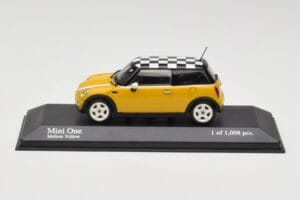
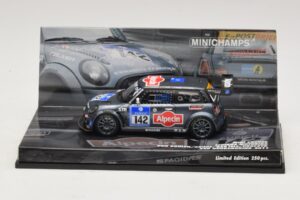
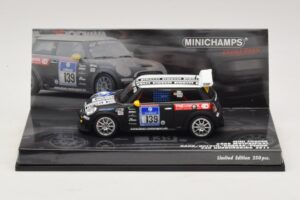
MINI Cooper R50 Black Minichamps 1:43
Price:
55.00 €
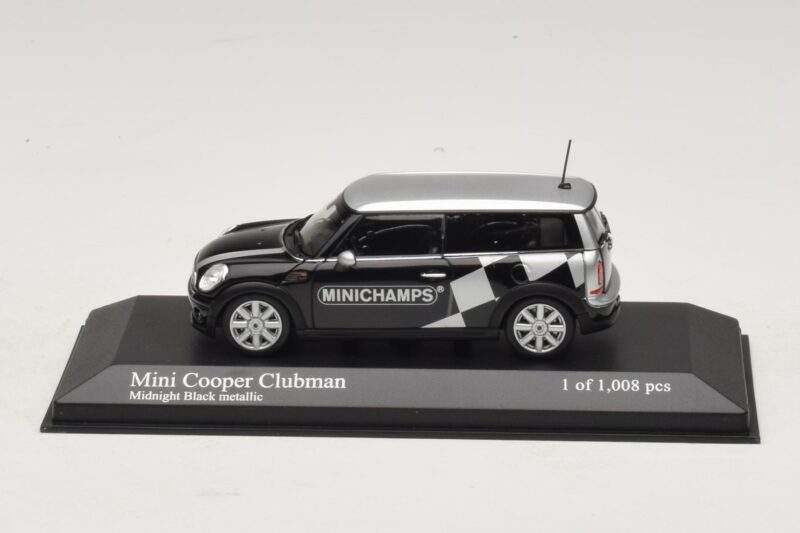
TL;DR: Minichamps' 1:43 diecast Mini Cooper Clubman R55 wears a Black Metallic finish over the model's stretched estate body and distinctive split rear doors. The sealed zinc alloy shell carries tampo-printed badge and trim detail, a street-model counterpoint to the racing liveries that otherwise dominate most Mini-focused shelves.
Not every Mini on a collector's shelf needs a race number. The Clubman R55 took the Cooper's city-car character and stretched it into a small estate, complete with a pair of side-hinged rear doors unlike anything else in the range, and this Black Metallic casting captures that everyday variant on its own terms.
This Clubman is cast as a sealed zinc alloy shell at 1:43, the split rear doors and roof rails molded into the body rather than hinged or fitted separately. That construction puts the emphasis squarely on the exterior: the Black Metallic finish carries a deep, even gloss typical of zinc alloy, and the panel lines around the split doors and rear hatch stay crisp and consistent since there's no opening mechanism to account for. Chrome trim and badging are tampo-printed rather than applied as separate pieces, holding sharp edges under close inspection. That focus on exterior finish is a fair trade at this scale, since a street car's story is told almost entirely by its paint, trim, and proportions rather than by an opening bonnet or trunk.
The Clubman's defining trait, extra overall length compared with the standard Cooper, translates into a noticeably longer rear overhang and roofline at 1:43, and a faithful casting needs to hold that stretched proportion rather than simply scaling up a regular Cooper mold. Checking the wheelbase-to-overhang ratio against a real Clubman is the clearest way to judge whether a casting has genuinely tooled the estate body or just extended a shorter one. Minichamps' handling of that extended rear section matters more on the Clubman than on almost any other Mini variant, since the stretched proportion is the car's entire visual identity.
The Clubman's split rear doors, hinged at the sides rather than lifting as a single hatch, were a genuinely unusual design choice when the R55 launched in the mid-2000s, and they remain one of the more distinctive details in the wider Mini range. Combined with the model's extra length and a roofline that stayed low despite the added cargo space, the Clubman carved out its own identity rather than simply playing as a longer Cooper. That combination of stretched proportions and an unusual door layout is part of why the Clubman still reads as its own model rather than a footnote to the standard Cooper, even years after production ended.
Where the standard Cooper traded almost entirely on go-kart handling and city-car footprint, the Clubman added genuine small-estate practicality without abandoning that character, extra luggage space and rear-seat access without inflating the car into something bulkier. That balance between practicality and the brand's compact, agile identity is exactly what makes the Clubman a worthwhile subject for a casting, distinct enough from the regular Cooper to justify its own place on a shelf. A shelf built entirely around Cooper hatchbacks misses that broader story, and the Clubman is the clearest way to add it without straying outside the Mini badge. Black Metallic is also a genuinely flattering finish for a car defined by its lines rather than aggressive styling, since the deep gloss lets the extended roofline and door creases read clearly under display lighting.
Placed beside rally-liveried Escorts or DTM-era touring cars, this Clubman offers a deliberate change of pace, no sponsor graphics, no race number, just a well-finished street car in a flattering color. Check the panel line consistency around the split doors and the proportion of the rear overhang, the details that matter most on a casting with no livery to distract from them. It's a quiet, honest addition to a shelf otherwise built around competition history. That contrast is worth having, since a collection built entirely around race liveries can start to feel one-note after a while. A single well-executed street model changes the rhythm of a shelf in a way another rally car simply can't. This Black Metallic Clubman does that job cleanly, without needing a race result to earn its spot.