Last one
Used
Back in stock
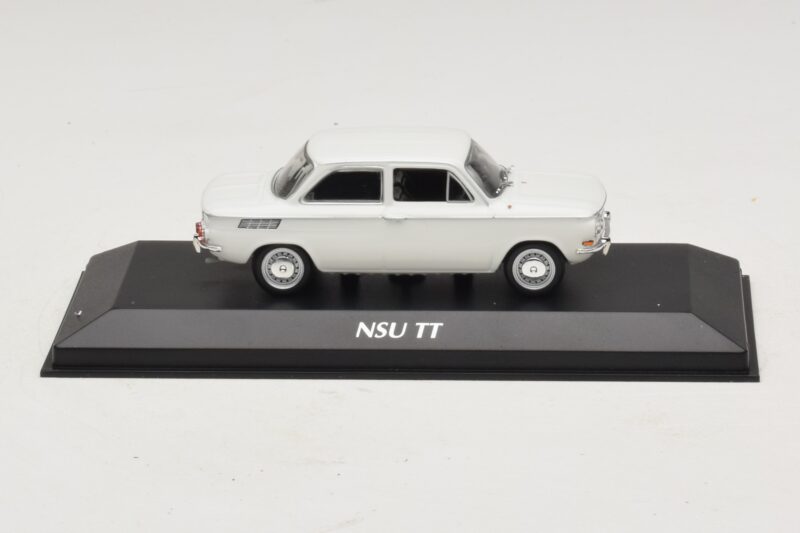
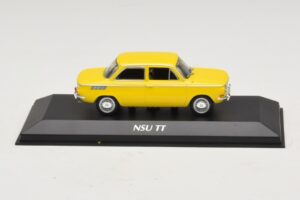
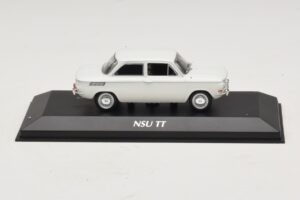
TL;DR: The Maxichamps NSU TT 1:43 is a diecast sport compact sedan from 1967, finished in white. The body is a sealed one-piece casting, so the boxy proportions, rear-engine stance and paint carry the model, a distinctive 1960s German piece for a compact shelf.
NSU is a name most American hobbyists meet late, usually through a Wankel story. The TT is the earlier surprise: a small rear-engined sedan that raced like it meant it. Maxichamps casts it at 1:43 in white, a scale and color that suit its plain, upright lines and make it easy to place on a shelf.
The TT builds on NSU's Prinz small-car line, with an air-cooled four-cylinder engine mounted in the rear and a sporting bent that made it a favorite of club racers in the 1960s. The TT badge is generally read as a nod to the Isle of Man Tourist Trophy, where NSU's motorcycles had earned their name. NSU later became part of the Auto Union group, the forerunner of today's Audi, so the TT's story touches the origins of that brand. On a model, the clues to look for are the compact greenhouse, the plain nose and the rear air intakes.
Slab-sided cars suit diecast. Zinc alloy keeps flat panels flat and roof edges straight, and the weight gives a small model a surprising presence for its footprint. The compromise is a slightly softer finish on the smallest parts, such as door handles and badge edges, than cast resin would hold. At 1:43 the TT is only a few inches long, so judgment comes from the whole: the upright stance, the thin pillars and the wide-set wheels with short overhangs should read at once as a small, light, rear-engined car.
White hides nothing. Flaws in the casting, tiny waves in the paint and uneven trim all show up under a lamp, which makes a clean white model a good sign of tooling and finishing care. Look for a uniform tone that does not drift cream or blue, and for crisp color breaks where bright trim meets the body. Because the body is one casting, the paint runs unbroken across the roof and fenders. White also photographs honestly and shows fingerprints, so a soft brush and clean hands are worth the effort.
This model has no opening parts, so the shut lines are single cast grooves with no hinge gaps to vary the width. The rear is where a rear-engined car announces itself, with vents and tail lamps that should sit cleanly in their openings. Check the wheels for squareness and the tire sidewalls for proportion, because a 1960s compact looks wrong quickly if it sits too high or too low. Glazing should be flush and clear. The thin pillars show any distortion immediately.
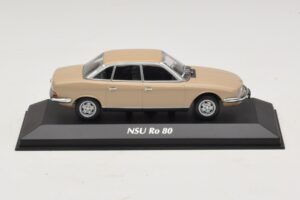
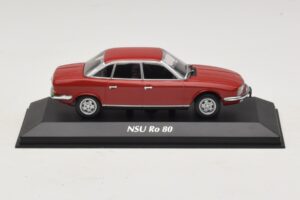
In a small cabinet the NSU TT sits happily beside other German compacts of the 1960s and, within the same Maxichamps NSU releases, the Ro 80 for a pair that spans the company's sporting small-car and rotary-sedan sides. NSU is rare on American roads, which makes the TT a conversation starter. The model also suits themes beyond marque: racing-bred small sedans, rear-engine cars, or pre-Audi corporate history all give it a place. At this size a dozen cars fit on a single shelf. Keep it out of strong light, dust it with a soft brush, and handle it by the body. For a buyer curious about lesser-known marques, an affordable 1:43 diecast is a low-risk way to start.