Last one
Used
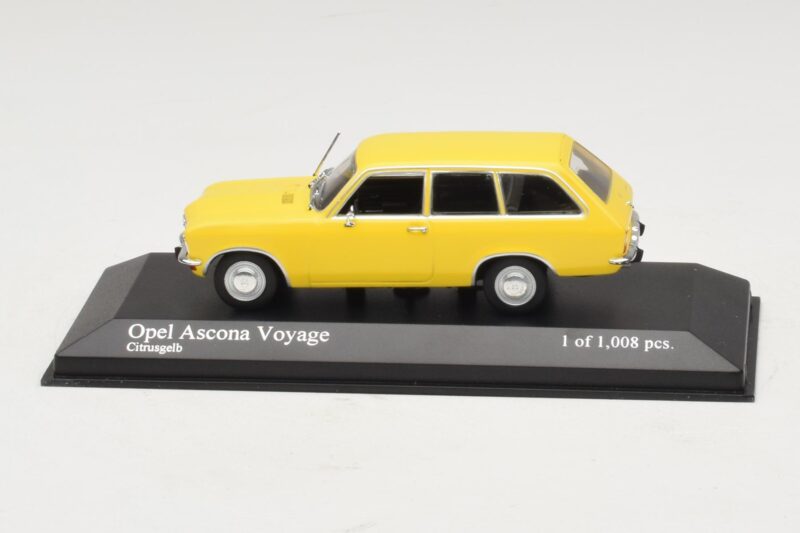
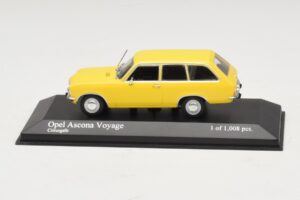
TL;DR: Minichamps' 1:43 diecast Opel Ascona A Voyage reproduces the 1970 estate wagon body in cheerful Voyage Yellow, a color that suited a car built for practical family duty rather than flash. Cast as a sealed one-piece diecast body, the wagon's proportions and paint depth carry the model, with no opening panels.
Opel positioned the Ascona A as a straightforward alternative to the Ford Cortina and Taunus, a compact family car without pretension, and the Voyage estate stretched that formula into genuine load-hauling territory. Minichamps' 1:43 reproduction captures the wagon in a bright yellow that few surviving originals wear today, a shade that photographs well against the era's more common browns and greens on a themed 1970s shelf.
Opel introduced the Ascona A in 1970 to sit above the smaller Kadett and below the larger Rekord, aiming squarely at buyers who needed a genuine family car but had no interest in anything flashy. The formula worked: straightforward four-cylinder engines, conventional rear-wheel-drive engineering, and a body that prioritized interior space over styling drama.
Where the sedan handled everyday commuting, the Voyage estate widened the car's appeal to buyers who needed to move more than passengers, whether that meant weekend cargo, work equipment, or simply a family that had outgrown a smaller wagon. Opel built the Ascona A alongside the closely related Manta A coupe, sharing mechanical underpinnings but aiming at a completely different buyer. Ford's Cortina and Taunus were its direct rivals in period, and the comparison mattered to buyers cross-shopping practical family transportation across brand lines.
Voyage Yellow is the kind of color choice that tells you something about how Opel positioned this car: bright, cheerful, and entirely unafraid of standing out in a parking lot full of beige and brown competitors. On the wagon body specifically, that yellow runs across a much larger uninterrupted surface than it would on the sedan, since the estate's flat rear flanks and extended roofline give the paint more room to read as a single continuous panel.
Minichamps holds that color consistently across the body, with the gloss depth sitting even from the front fenders back to the tailgate, a result the sealed one-piece diecast construction makes easier to achieve than a body with hinged panels would allow. The wagon's roofline has to extend at the correct height and angle to avoid looking like an afterthought grafted onto a sedan, and Minichamps gets that roofline right, making the whole shape easier to read from across a room than a more common, darker period color would.
This Ascona is cast in zinc-alloy diecast as a sealed, one-piece body, meaning no doors, hood, or tailgate open on this particular model. That construction choice puts the entire burden of authenticity on exterior detail: panel lines, glazing fit, wheel and tire proportion, and the crispness of any badging Opel applied to the Voyage trim. Diecast at this scale carries real weight for its size, a density that comes from metal casting tolerances wider than resin allows but that also gives the model a reassuring solidity in the hand, unlike lighter plastic toys aimed at a younger market. A sealed body isn't a compromise here so much as a design decision suited to the price point: without hinge mechanisms to engineer around, Minichamps can hold tighter, cleaner shut lines across the body than a functioning door would require, and the yellow paint shows those lines without interruption. For a 1:43 family wagon aimed at collectors who want an accurate period piece rather than an interactive toy, that trade-off makes sense. Buyers who want to see under the hood or inspect an interior in detail are better served by larger-scale or opening-panel alternatives, and that's a fair reason to look elsewhere if hands-on interaction matters more than shelf presence.
At 1:43, the Ascona A Voyage takes up minimal shelf space, which makes it easy to build a full lineup of 1970s European family wagons without running out of room, pairing naturally with contemporaries like a Rekord Caravan or a Kadett wagon from the same decade. Minichamps' diecast sits at a dependable mid-tier finish level, appropriate for a car whose real-world appeal was never about extravagance. Choose this piece for the color alone if nothing else: Voyage Yellow is a genuinely uncommon shade among Ascona A survivors, and that rarity of finish rewards a collector building a themed 1970s European wagon shelf rather than chasing headline sports cars. It's an honest, unglamorous piece, and that honesty is precisely its appeal.