Last one
Used
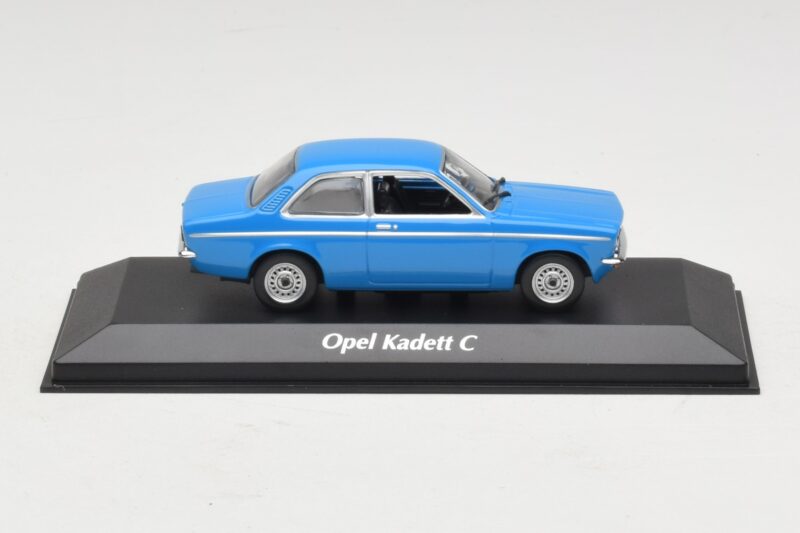
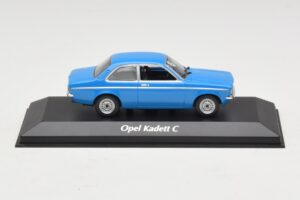
TL;DR: The Maxichamps Opel Kadett C is a 1:43 diecast sedan in blue, modeling the 1974 small Opel from the rear-wheel-drive Kadett generation. A sealed one-piece casting, it relies on compact proportions, paint, and glazing. A small-car piece for 1970s German collections.
Small cars show character in their proportions. The Kadett C was Opel's compact of the mid-1970s, rear-wheel drive, neat, and square-shouldered. At 1:43 the model measures under ten centimeters long, a size that sets it apart in a cabinet of larger sedans and makes its proportions the point of interest.
The Kadett C belonged to General Motors' broader push into small cars in the 1970s, and it kept a conventional layout: engine at the front, drive to the rear. That configuration affects how the car looks, with a modest overhang and a straightforward stance. A collector looking at the model can see the sensible, upright shape of a car designed for efficient packaging. Check the hood length against the cabin, and see whether the roofline looks tidy rather than pinched; small cars show proportion errors more quickly than big ones.
Blue is a color that reads cleanly on a small body, with highlights tracing the shoulder line and roof edge. A zinc alloy shell gives paint a hard base, so gloss tends to look smooth, and the model carries a satisfying weight for its size. Diecast at this tier has slightly wider tolerances than small-batch resin, so panel lines are a shade more visible and edges a shade softer. The benefit is toughness: a small metal model survives handling and rearranging with less worry about snapped parts.
This model has a sealed body, so nothing opens and the exterior tells the whole story. On a compact car, small differences carry more weight: a millimeter of ride height changes the stance, a slightly wrong bumper shape changes the face, and thick window frames spoil the glasshouse. Check the glazing, the lamps, the grille, and the wheels. When these line up with photographs of the real car, the model earns its place; when they drift, the whole impression suffers. A one-piece casting keeps its shut lines even from one end to the other.
Small cars look best near eye level, where their details are not lost. Group by decade rather than by size, and give it a little space so the outline reads against the backdrop.
The Kadett C works well as the small half of a pair, set beside a mid-size Opel sedan of the same decade to show the range of cars a German family might have chosen. It also fits a broader theme of 1970s compacts, where small-scale models show how much variety existed before cars grew in size. This is an accessible diecast, not a hand-built resin piece, so judge it on honest proportion and clean finish rather than micro detail. For collectors who like everyday cars with real period character, it is an easy, uncluttered purchase that rewards a closer look.