Last one
Used

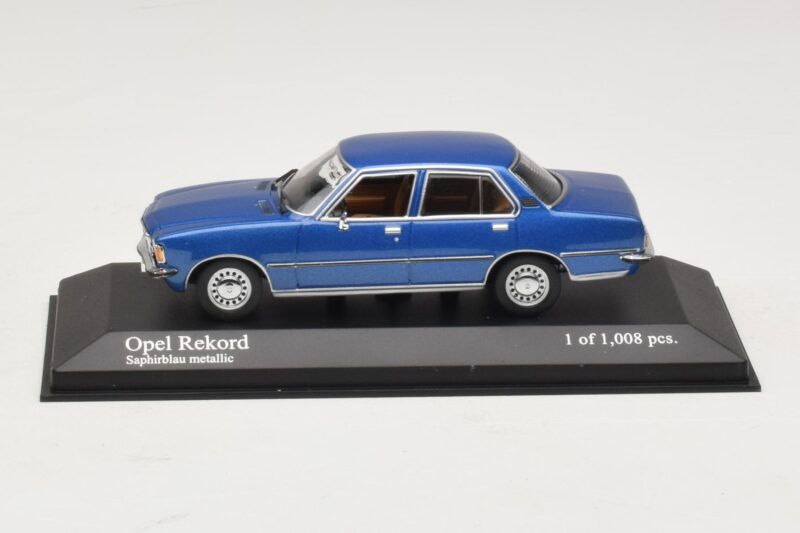
TL;DR: Minichamps' 1:43 Opel Rekord D sedan in blue metallic reproduces the fourth-generation Rekord, GM Germany's mainstream family car of the mid-1970s, cast in diecast with a sealed one-piece body. The boxy, upright styling and continuous shut lines make it an honest everyday classic rather than a glamour piece, priced accessibly against sportier shelf companions.
Not every diecast on a collector's shelf needs a racing pedigree or a wind-inspired name to earn its place. Opel's Rekord D carried German families through the mid-1970s in unglamorous sedan form, and Minichamps' blue metallic casting captures that ordinariness deliberately, right down to the flat hood line and upright chrome grille that defined GM's European mainstream at the time.
Opel introduced the Rekord D in 1972 as the successor to the Rekord C, carrying the model line into a new decade with sharper, more angular sheet metal that traded the previous generation's rounded surfaces for GM's contemporary European design language. It shared underpinnings with the larger Opel Commodore B, giving the mid-size Rekord a stiffer platform than its predecessor without pushing the car into a different market segment. This was never meant to be an aspirational purchase. The Rekord D sold on practicality, fuel economy for its class, and a service network that made it a default choice for German families cross-shopping against Ford's Taunus in the same period.
Opel offered the Rekord D across body styles including a conventional sedan, a longer-roofed Caravan estate for cargo duty, and a two-door Coupe aimed at buyers who wanted the same mechanicals in a sportier shape. Minichamps casts this example as the standard sedan, the volume seller of the range and the body most families actually drove. Blue metallic was a common factory shade of the period, favored for its restraint next to the brighter, more saturated colors Opel reserved for the sportier Coupe variant, and it suits the sedan's role as the sensible, high-volume member of the Rekord D family.
The Rekord D's body panels were flat and simply creased by the standards of later GM designs, and Minichamps' zinc alloy casting reproduces that simplicity with a sealed, one-piece shell rather than a working door or trunk. No hinge tolerance interrupts the shoulder line running from headlamp to tail lamp, and the greenhouse reads as a single, upright box the way the real sedan's glass area did. That fixed construction actually flatters a design this plain, since there are no compound curves or hidden creases for a panel gap to disguise, and the diecast's structural rigidity keeps those flat surfaces reading true even after years of handling.
Blue metallic on this casting carries a modest flake that reads mostly flat under everyday room light and only shows its sparkle under a direct shelf spotlight, consistent with how GM applied metallic paints to mainstream cars in the mid-1970s rather than the deeper, more saturated metallics reserved for premium marques. Because the body is a single sealed casting, the color runs unbroken across hood, fender, and door with no seam to catch a shadow, which suits a car whose original appeal rested on straightforward proportions rather than sculpted surfacing. The result is a modest, honest paint job that matches the honest car underneath.
At 1:43, the Rekord D sedan measures around ten centimeters, a size that lets a collector line up an entire 1970s European sedan segment, Ford, Opel, and their contemporaries, on a single cabinet shelf without the space demands a 1:18 fleet would require. This scale has long been the European tradition for exactly this kind of everyday classic, where the point is coverage of a period and a market rather than a single hero piece commanding its own display case. Detail at 1:43 is necessarily simplified compared to 1:18, so items like the door handles and window trim read as fine relief rather than separately applied parts, a compromise every 1:43 buyer accepts for the format's compactness. The Rekord D benefits from this trade-off more than a curvier design would, since its flat panels and simple creases translate cleanly even at reduced detail resolution. For a collector building a shelf around ordinary European family cars of the 1970s rather than exotica, this sedan is exactly the kind of grounded, accurately proportioned piece that anchors the collection without dominating it. Priced well below any hand-built resin equivalent, it also gives a newer collector an inexpensive way to test whether period-correct European sedans hold appeal before committing to a pricier GT or sports subject.
This sedan works best as context rather than centerpiece, the ordinary car that makes a collection's sports and GT pieces look faster by comparison. Set beside a Caravan wagon or Coupe from the same generation, it completes a family portrait of what Opel actually sold to actual buyers during the Rekord D's run, a contrast most Maserati or Ferrari shelves never attempt. Blue metallic keeps the piece visually calm, letting it sit at the edge of a display without competing for attention with brighter subjects. At an accessible 1:43 diecast price point, it costs little to add this kind of honest, unglamorous history to a collection, and that low barrier to entry is precisely the point: not every shelf slot needs a supercar to earn its keep. Minichamps applies the same construction standard here as it does to its premium subjects, so the sealed body and paint quality hold up under close inspection even though the car itself never chased headlines.