Used
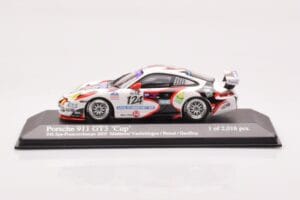
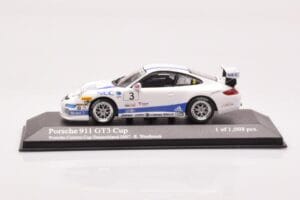
Porsche 911 997 GT3 Cup #124 Mattheus / Geoffroy / Vanbellingen / Fumal 24 Hours of Spa 2005 Minichamps 1:43
Only 2 left
Price:
33.00 €
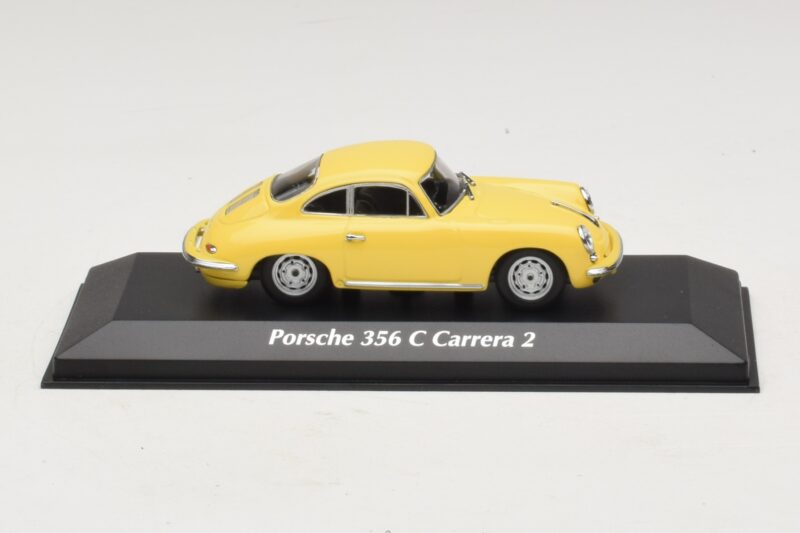
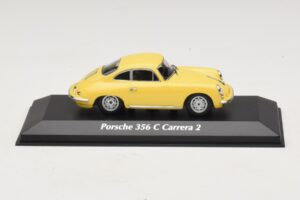
TL;DR: The Maxichamps Porsche 356C Carrera 2 1:43 is a sealed diecast replica of the 1963 coupe in Yellow. The Carrera 2 name marks the 356's two-litre four-cam engine, among the most performance-focused versions of the line. Collectors judge this model on rounded proportions, slim chrome and paint, and its accessible tier suits early Porsche shelves.
Few shapes are as unforgiving of a casting as the 356. Every surface curves, so any wobble in the roofline shows. This Maxichamps Porsche 356C Carrera 2 in Yellow, at 1:43, puts that challenge in the palm of a hand and rewards a slow, close look.
The 356's silhouette is a single rounded teardrop, with a gently sloping roof, bulged fenders and slim bumpers. A sealed one-piece body keeps those curves unbroken, which is the advantage when no panel lines interrupt them. Check the roofline for symmetry from the front and rear, then the fender curves for evenness. Yellow shows highlights brightly and makes any irregularity along the roof visible, so neat, thin chrome and printed badges should stay crisp at the edges. A model that passes this test earns its place on a shelf.
The casting has a dense, solid feel that belies its length of about nine centimeters. Metal retains its shape across years and tolerates handling better than more brittle materials. Details like the headlight surrounds and bumpers are usually printed or moulded at this tier, so inspect them under a lamp. This is not the ultra-fine finish of a hand-assembled piece, and it is priced accordingly, which keeps a multi-car 356 theme within reach. For a subject defined by its outline, the trade feels fair.
The Carrera badge on a 356 denotes the four-cam engine derived from Porsche's racing flat-four. The Carrera 2 version used a two-litre displacement, and the 356C brought disc brakes on all four wheels, an upgrade in keeping with the car's performance. It was among the most performance-focused forms of the 356, aimed at drivers who wanted race-bred power with road manners. The 1963 date places this replica at the start of the 356C era.
No engine shows on a sealed 1:43 casting, so the Carrera 2 difference lives in badging and small trim cues. Knowing what to look for turns a pretty yellow coupe into a specific variant. Buyers who care about accuracy should check the rear badge and wheel type against reference photos. It is a small exercise, and it is the reason a collector who knows the 356 line will read this model differently from a casual buyer who sees only a yellow coupe.
The 356 is the starting point for most Porsche chronologies, and the Carrera 2 variant adds an engineering story to the rounded shape. Pair it with a 550 Spyder from the same era and the two show the road and track sides of early Porsche. Handle by the base, keep the Yellow paint out of direct sun, and use a soft brush for dust. The accessible diecast tier means a small group of early Porsches is feasible even on a modest budget. Collectors who follow the marque rather than a model manufacturer will find the 356C an easy first step, and buyers placing an order get a stable, heavy little coupe for a compact cabinet.