Used

Porsche 911 997 GT3 Cup #124 Mattheus / Geoffroy / Vanbellingen / Fumal 24 Hours of Spa 2005 Minichamps 1:43
Only 2 left
Price:
33.00 €
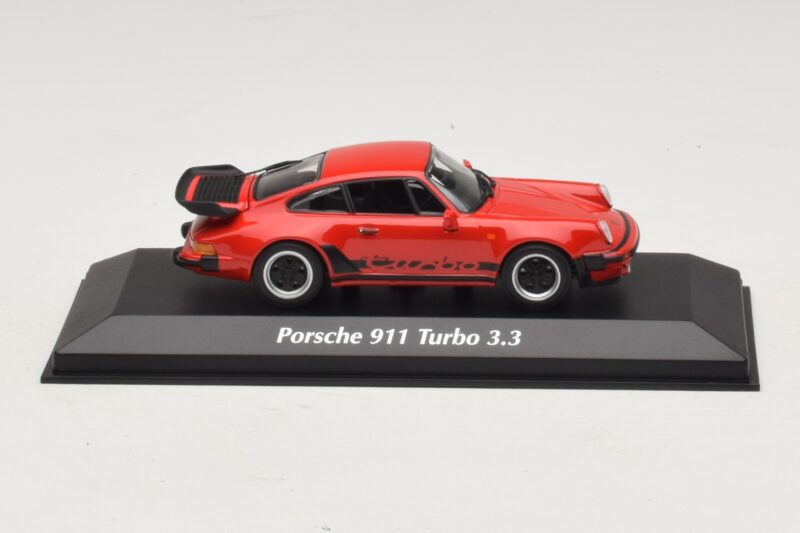
TL;DR: The Maxichamps Porsche 911 930 Turbo 3.3 Red 1:43 is a diecast replica of the 1979 turbocharged 911, cast as a sealed one-piece body. Wide rear hips and a tall tail define the silhouette, and red paint sharpens both. It is the extreme sibling to the 911 SC on a compact 1970s Porsche shelf.
Look at the tail first. Everything about the 930 Turbo 3.3 announces itself from behind: the hips flare, the rear wing rises to a wide, flat edge, and the whole car squats. Maxichamps reproduces that rear view in red diecast at 1:43, and the tail is where the casting earns or loses your trust.
Porsche introduced the 911 Turbo in 1975 with a 3.0-liter engine and enlarged it to 3.3 liters for 1978, adding an air-to-air intercooler. The intercooler needed room, so the earlier whale tail gave way to a taller, flatter rear wing, the shape on this 1979 car. That is why the tail is the visual signature, and why a buyer should look at it first. The Turbo also earned a name for demanding handling, since power arrived in a rush on a rear-engined chassis, which added to its reputation among enthusiasts. A shape this distinctive is hard to hide in miniature.
Official US sales of the Turbo ran from the mid-1970s into 1979, then paused for several years before the car returned later in the decade. That makes a 1979 car one of the last of the first American run, a detail that appeals to American buyers tracing how emissions rules shaped what dealers could offer. The Turbo's wide, low shape also stood well apart from every other 911 in a showroom, which is exactly why it remains the model many 911 shelves are built around.
The rear fender flares are the model's hardest job. They bulge outward from the doors in a smooth curve, and a good casting shows that curve as one continuous swell with the wheel sitting snugly inside. Red paint highlights the swell, so any flat spot or kink becomes visible under a lamp. Check that the front fenders keep their narrower line, since the contrast between narrow nose and wide tail gives the car its attitude. A hard metal shell holds those proportions steadily over time.
This is a sealed casting. The practical effect is that the door lines, the lid line and the tail all stay clean around the biggest curves on the car, and the finish flows across the shell as one surface. Weight is solid for the size, and the model sits low and square. The limit is clear: no interior to examine beyond what the glass shows. For a car whose appeal is its exterior shape, that is a reasonable trade, and it keeps the price in an accessible range. Beside the red SC in this series, the same paint color makes the shape difference easy to see: the Turbo looks lower and wider even though both share the same basic roofline.
A Turbo belongs at the dramatic end of a 911 row. Put it beside the SC and the difference in width and tail height is immediate, and add a 993 or a GT2 RS to follow the line through four decades. Keep the red away from sun exposure, since long-term light fades warm colors, and light the shelf from above and slightly behind to rake highlights across the flares. A cabinet door or dust cover keeps the casting clean. For hobbyists who want a compact 1970s supercar silhouette without paying for a larger scale, this red 3.3 Turbo is a straightforward piece to buy and display.