Used
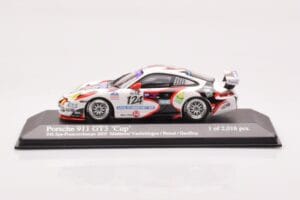
Porsche 911 997 GT3 Cup #124 Mattheus / Geoffroy / Vanbellingen / Fumal 24 Hours of Spa 2005 Minichamps 1:43
Only 2 left
Price:
33.00 €
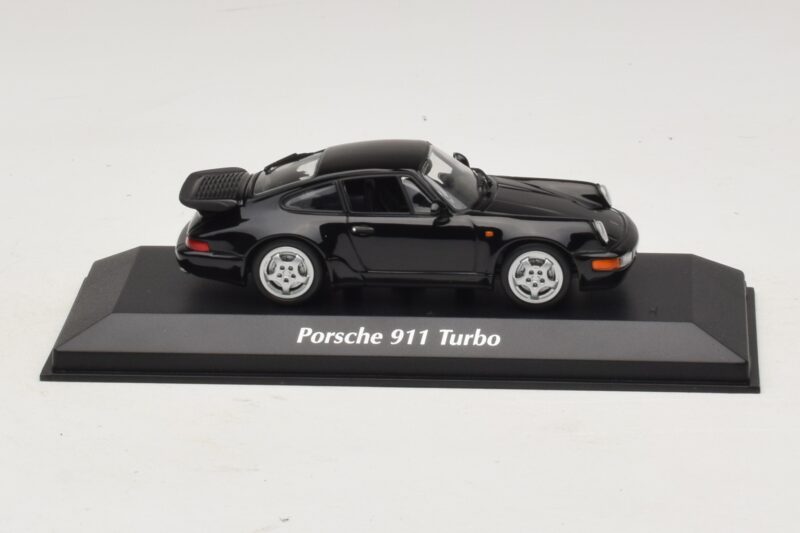
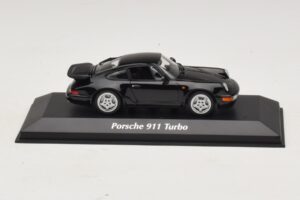
TL;DR: The Maxichamps Porsche 911 964 Turbo 1:43 in Black is a diecast replica of the 1990 turbocharged 911. A sealed one-piece body focuses attention on stance, gloss and the wide rear arches. It suits collectors tracing the Turbo from its 1970s origin to the early 1990s on a compact shelf.
Black is the hardest colour for a model to carry, and the 964 Turbo rewards the challenge. Maxichamps casts the 1990 Porsche 911 964 Turbo in Black diecast at 1:43, where gloss, shut lines and stance have nowhere to hide and the car's shoulder lines do the talking.
The body is a sealed casting with no opening panels, which is exactly why black works. Without hinge gaps to interrupt it, the surface reads as one polished form, and reflections travel unbroken from the front wings across the doors to the rear haunches. Any waviness in the casting would show as a kink in those reflections, so a clean run is a good quality sign. The zinc alloy shell gives noticeable heft for 1:43, and a hard metal base keeps the gloss stable. Check the window surrounds against the paint: crisp separation is what keeps a black car from looking like a single dark block.
The 964 looks like a 911 but is smoother in its details, with bumpers blended into the bodywork instead of standing off it. A turbo version adds broad rear arches and a large rear wing, and those two features set the silhouette. At this scale, compare wheel fill within the arches, the angle of the windscreen and the way the wing sits against the roofline. Small parts such as lamps, mirrors and badges are rendered through printing and moulded detail rather than separate pieces, a normal trade-off for a durable diecast. Look from behind first, since the Turbo's width shows best from there.
Porsche launched the 964 generation in 1989 as a heavily revised 911, with coil springs replacing the older torsion bars and ABS and power steering bringing the car into modern territory. The Turbo followed in 1990 with a 3.3-litre turbocharged flat-six, carrying the engine layout of the earlier 930 into a more refined chassis. For the first time, a Turbo 911 could be driven hard without the nervous reputation of its ancestor. That shift from raw to controllable is the story the model tells quietly through its smoother lines.
Placed beside a 930 Turbo, the 964 shows the evolution at a glance: softer bumpers, a more integrated tail and a wing that sits as part of the design instead of a bolt-on. A collector working through air-cooled Turbos will find the pairing instructive, because the changes are visible without any caption. The 1990 car marks the point where the Turbo became a daily-usable sports coupe while keeping the rear-engine character that defines the 911.
A red 964 Turbo exists in the same catalogue family, and the choice comes down to what you want from the shelf. Black emphasises surface and form, sits well among silver or grey cars, and rewards good lighting. Red adds colour contrast and brightens a mixed display. At roughly 10 cm long, either takes little room, and owning both lets you compare how paint changes the way the same body reads. Keep dust off black with a soft brush, since it shows marks sooner, and avoid direct sun. Collectors who want to buy one Turbo for a serious 1:43 Porsche line will find Black the most demanding and, in the right light, the most satisfying.